
Dry Lab Design Trends: Infrastructure for Data-Driven Science
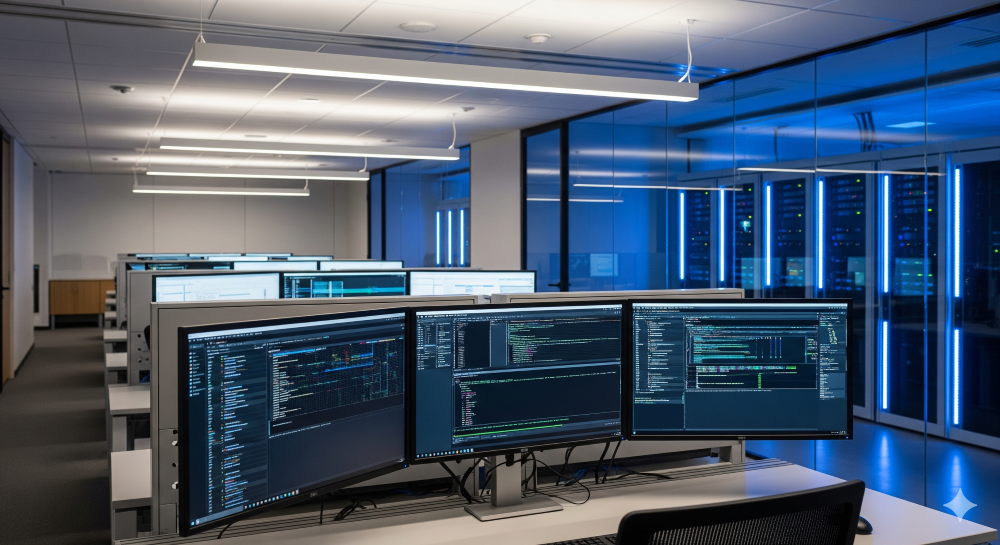
The pipette is being replaced by the GPU. Why your next lab needs more servers than sinks.
Credit: Gemini (2026)
Introduction: the rise of in-silico discovery
For the last fifty years, the image of a scientist has been a person in a white coat holding a pipette. Today, that image is rapidly changing to a data scientist sitting behind three monitors. The pharmaceutical industry is undergoing a massive paradigm shift from "wet" bench science (biological experimentation) to "dry" computational science (data modeling and AI simulation).
As Artificial Intelligence (AI) and Machine Learning (ML) take over the heavy lifting of drug discovery, the physical requirements of the research facility are evolving. For the lab architect and lab planner, this means the priority is shifting from plumbing and fume hoods to power density and data cabling. This guide explores the critical infrastructure required to support dry lab design and the unique needs of the modern bioinformatician.
The ratio flip: from 80/20 to 20/80
Historically, a standard biotech program required an 80:20 split—80 percent wet lab for experimentation and 20 percent dry office for writing reports.
Today, heavily computational startups are requesting a 50:50 split, and in some AI-driven drug discovery firms, the ratio has completely flipped to 20:80. This inversion fundamentally changes the building's cost structure. While wet labs are expensive due to plumbing and exhaust, computational research space is expensive due to electrical loads and cooling demands. Architects must design flexible floor plates that can accommodate this "ratio flip" over the life of the lease, ensuring a building doesn't become obsolete as the tenant's workflow becomes more digital.
Infrastructure: the need for power and cooling
A wet lab runs on air (ventilation); a dry lab runs on electrons. The infrastructure density required for high-performance computing (HPC) dwarfs standard office requirements, often catching developers off guard during the MEP design phase.
Power density challenges
A typical commercial office is designed for a plug load of three to five watts per square foot. A bioinformatics dry lab, however, may require 10 to 15 watts per square foot at the desk level to support multiple high-resolution monitors, local GPU processors, and personal servers. This requires larger panel boards, increased transformer capacity, and dedicated circuits to prevent tripping breakers during intense data processing sessions.
Server room cooling strategies
The heart of the dry lab is the local server room. While cloud computing is popular, as datasets grow into the petabytes, latency and egress fees often make on-premises (on-prem) storage necessary.
Hot Aisle/Cold Aisle: Efficient server room cooling requires strict airflow management to prevent mixing supply and exhaust air. Racks should be arranged so that cool supply air (65°F-70°F) enters the front of the servers (cold aisle) and hot exhaust air (95°F+) is rejected out the back (hot aisle) into a contained return plenum.
Liquid Cooling: As chip density increases, standard air cooling is reaching its thermodynamic limit. Forward-thinking designs are now including plumbing manifolds for rear-door heat exchangers or direct-to-chip liquid cooling systems in server closets. This allows for rack densities exceeding 20kW, which would otherwise be impossible to cool with air alone.
Bioinformatics lab layout: human-centric design
Designing for data scientists is different than designing for chemists. The ergonomic and environmental needs of a person staring at code for ten hours a day are specific and demanding. The environment must reduce cognitive load, not add to it.
Lighting and glare control
In a wet lab, 70 to 100 foot-candles of bright, uniform light is critical for safety and precision. In a dry lab design, that same brightness creates debilitating glare on glossy computer screens, leading to eye strain and migraines.
Indirect Lighting: Use suspended linear fixtures that bounce light off the ceiling to create a soft, shadow-free ambient glow. This raises the perceived volume of the room without creating "hot spots" on screens.
Task Lighting: Democratize the lighting control. Provide individual, dimmable task lights at each workstation so researchers can control their immediate environment—some prefer near-darkness for coding, while others need light for reviewing papers.
Blackout Shades: South and West-facing windows must have high-performance roller shades (1% openness or blackout) to prevent direct sunlight from washing out monitors during peak afternoon hours.
Acoustic separation
Wet labs are naturally noisy places, filled with the hum of fume hoods, -80°C freezers, and centrifuges (often exceeding NC-50). Computational research space requires deep focus and "library-quiet" conditions.
Zoning: Do not place the bioinformatics team directly adjacent to the break room, elevator lobby, or the noisy wet lab entry. Use buffer zones (storage, corridors) to separate them.
Finishes: Use high-NRC (Noise Reduction Coefficient) ceiling tiles (0.75+), carpeted flooring, and acoustic wall panels to dampen sound reverb. Sound masking systems (white noise) can also be effective in open-plan setups to mask distinct speech frequencies.
Data cabling: the fourth utility
In the modern lab, data connectivity is as vital as electricity or water. If the network goes down, the dry lab is effectively closed.
Cat6A vs. Fiber: Standard Cat6 Ethernet is often insufficient for moving genomic datasets that can reach terabytes in size. Dry lab design increasingly specifies Fiber-to-the-Desk (FTTD) to ensure gigabit speeds and low latency directly at the workstation.
Redundancy: Data loss is catastrophic. Dry labs require redundant operational pathways (two varied cable routes entering the building from different streets) to ensure that if a backhoe cuts one line, the science doesn't stop. This concept, borrowed from data center design, is now standard for computational bio-facilities.
Future-proofing: the flexible dry lab
Just as wet labs use movable benches to adapt to new assays, dry labs need flexibility to adapt to new team structures. The definition of a "workstation" changes every few years as hardware evolves.
Raised Floors: Consider low-profile raised access floors (4-6 inches) for dry zones. This allows power and data cabling to be re-routed instantly without trenching concrete or dropping unsightly power poles from the ceiling.
Mobile Furniture: Avoid built-in millwork desks. Use height-adjustable, mobile tables that allow teams to "swarm" and reconfigure for collaborative sprints or hackathons. Today's solo coding station might need to become a collaborative team pod next month.
Conclusion: the digital future of biology
The next blockbuster drug will likely be discovered on a screen, not in a test tube. As the life sciences industry digitizes, the physical laboratory must evolve to house the digital tools of discovery. By mastering dry lab design—prioritizing robust power density, advanced cooling strategies, and human-centric ergonomics—lab architects can build the infrastructure that accelerates the speed of innovation. The successful lab of the future is a hybrid machine, seamlessly integrating the biological reality of the wet lab with the digital potential of the dry lab.
Frequently asked questions (FAQ)
What is the difference between a dry lab and an office?
While they look similar, a dry lab requires significantly higher utility density (power and cooling) and data redundancy than a standard office. It is a technical production environment, not just an administrative space.
Can you convert a wet lab to a dry lab?
Yes, and it is often easier than the reverse. The high ceilings and robust HVAC of a wet lab are easily adapted for dry lab use. The main challenge is typically adding enough electrical capacity and data infrastructure.
Do dry labs need emergency power?
Yes. While a power outage in an office is an inconvenience, in a dry lab running a week-long simulation, it is a disaster. Critical workstations and local servers must be on the Uninterruptible Power Supply (UPS) and backup generator circuits.
