
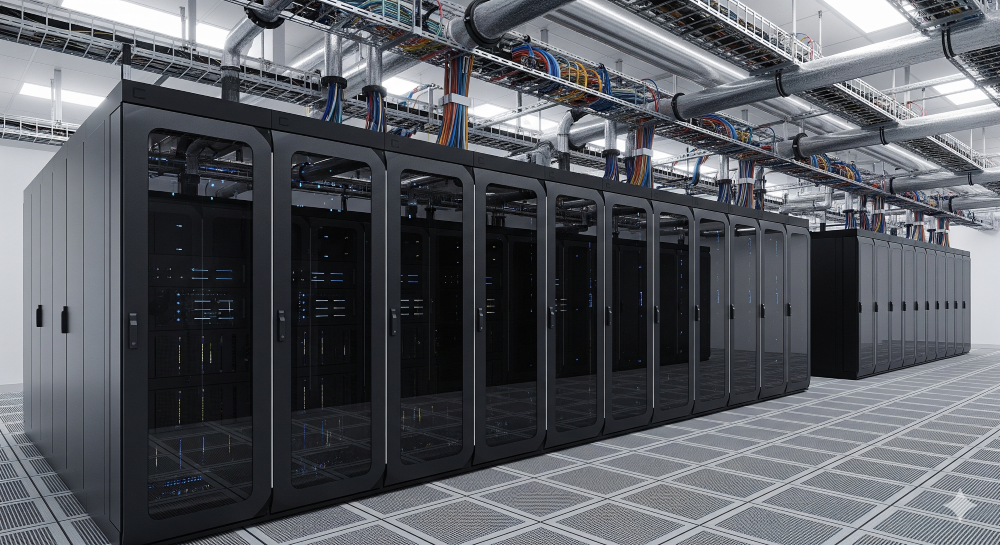
Don't let the server room melt. Calculating the massive cooling loads of AI-driven drug discovery.
Credit: Gemini (2026)
Introduction: The data gravity dilemma
As explored in our analysis of dry lab design trends, the shift toward computational science has transformed the laboratory into a data factory. Next-generation genomic sequencers and cryo-EM microscopes generate terabytes of raw data daily. While the cloud offers infinite scalability, it introduces two critical problems: latency and cost.
For the lab architect and IT director, the concept of "data gravity" dictates the design. Because transferring petabytes of data to the cloud is slow and expensive (egress fees), the processing power must physically move closer to the data source. This resurgence of on-premise computing requires a server room that functions less like a utility closet and more like a micro data center.
Sizing the footprint: power density over square footage
In traditional office design, server rooms are sized by square footage—typically allocating a specific percentage of the floor plate. In bioinformatics infrastructure, this metric is obsolete; spaces must be sized by power density.
A standard office server rack draws two to four kilowatts (kW). A rack dedicated to AI-driven drug discovery, stacked with GPU-heavy nodes (like NVIDIA H100s) for protein folding simulations, can draw upwards of 20 to 50 kW per rack.
The Implication: A room that used to hold ten racks might now only support two high-density racks before tripping the main breaker or overwhelming the cooling capacity. This phenomenon is known as "stranded capacity," where there is plenty of physical floor space left, but zero available power or cooling.
Design Action: Lab planners must calculate the "kW per rack" metric early in schematic design. This often triggers the need for dedicated transformers, upgraded UPS systems, and 480V distribution rather than standard 208V/120V panels.
Lab server cooling strategies
Removing the massive heat generated by high-density computing is the primary engineering challenge. A simple split-system AC unit on the wall is no longer sufficient for loads exceeding 5kW per rack.
Hot aisle/cold aisle containment
Efficiency begins with the server rack layout.
The Setup: Racks are arranged in rows so that the fronts face each other (cold aisle) and the backs face each other (hot aisle). In high-density labs, this often involves "In-Row" cooling units placed directly between the server racks to shorten the airflow path.
The Containment: Physical barriers (doors and roof panels) enclose one of the aisles to prevent hot exhaust air from mixing with the cool supply air. This increases cooling efficiency by up to 30 percent and allows higher fan speeds without creating hot spots. Without containment, the server room becomes a "mixing bowl" where CRAC units fight to cool air that has already been heated, wasting massive amounts of energy.
Liquid cooling: the next frontier
As chip densities increase, air is becoming an inefficient medium for heat transfer. Water conducts heat 24 times better than air. Many life science firms are adopting liquid cooling strategies to manage extreme thermal loads.
Rear-Door Heat Exchangers: Active liquid-cooled doors replace the standard perforated back door of the server rack. These doors contain a radiator coil chilled by the building's water supply, neutralizing the heat at the source before it ever enters the room.
Direct-to-Chip: Liquid coolant is piped directly to cold plates sitting on top of the processors inside the server, eliminating the need for loud server fans and drastically reducing the room's air conditioning load. This approach allows for densities exceeding 100kW per rack.
Case study: Recursion Pharmaceuticals' BioHive-2
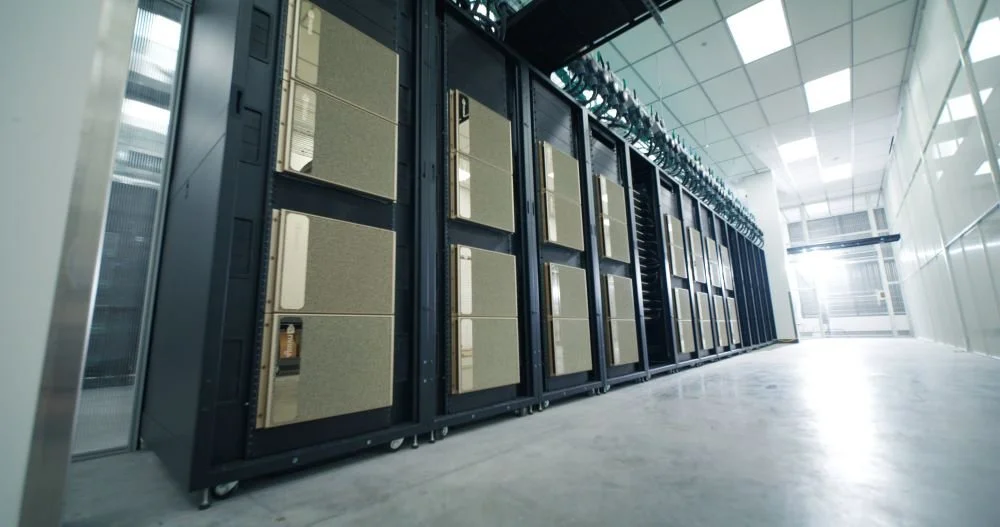
In Salt Lake City, Recursion Pharmaceuticals faced the exact data gravity dilemma described above. To map biology for drug discovery, their automated labs generate over two million cellular images per week, creating a massive proprietary dataset. Moving this volume of data to the cloud for training foundation models was inefficient due to latency and cost constraints.
The Solution: In 2024, they completed "BioHive-2," an on-premise supercomputer powered by 63 NVIDIA DGX H100 systems containing a total of 504 H100 Tensor Core GPUs.
The Infrastructure: Ranked as the fastest supercomputer wholly owned by a pharmaceutical company, BioHive-2 operates at massive power densities. It is four times faster than its predecessor, BioHive-1, requiring advanced cooling and power distribution to handle the intense thermal load of hundreds of H100 GPUs running in parallel.
The Result: By keeping this high-density compute on-premise, Recursion can train massive foundation models like Phenom-1 (a deep-learning model for cell images) significantly faster than before. This case illustrates that for AI-driven biology, the "lab server room" has evolved into a micro data center that rivals national supercomputing facilities, requiring specialized architectural and engineering attention.
The hybrid model: tiering data
The most common strategy is a hybrid approach that balances performance with cost.
On-Premise (Hot Data): Active datasets currently being sequenced or analyzed require ultra-low latency. These are kept on local, high-performance flash storage in the lab server room. This hardware is expensive and hot, requiring the robust infrastructure detailed above.
Cloud (Cold Data): Once the analysis is complete, the data is "tiered" off to the cloud for long-term storage and compliance. This "Cold Data" does not require high-speed access, allowing labs to use cheaper cloud archival tiers (like AWS Glacier) rather than buying endless racks of hard drives.
This tiered approach allows the lab architect to size the on-site server room for "peak processing" rather than infinite storage, saving valuable floor space for wet lab functions.
Conclusion: the micro data center
The server room is no longer an afterthought; it is the brain of the modern laboratory. By understanding the physics of lab server cooling and the electrical demands of high-density computing, design teams can prevent thermal shutdowns that destroy data and halt research. In the era of AI, a robust server room is just as critical to the scientific mission as the fume hoods and the pipettes. Designing these spaces requires the same level of rigorous planning, redundancy, and future-proofing applied to the rest of the critical lab environment.
Frequently asked questions (FAQ)
What is the difference between an MDF and an IDF?
The Main Distribution Frame (MDF) is the primary hub for the building's network and usually houses the servers. Intermediate Distribution Frames (IDFs) are smaller satellite closets on each floor that connect local workstations to the MDF. In labs, the MDF requires heavy cooling, while IDFs typically do not.
How heavy is a fully loaded server rack?
A standard rack filled with storage and GPU servers can weigh over 2,000 pounds. Structural engineers must verify point loads, especially if the server room is located on a raised access floor or an upper level of an existing building.
Can you use sprinklers in a server room?
Yes, but it is risky. Most high-value server rooms utilize a "pre-action" sprinkler system (which requires two triggers to release water) or a clean agent gas suppression system (like FM-200) that extinguishes fires without damaging the electronics.
