
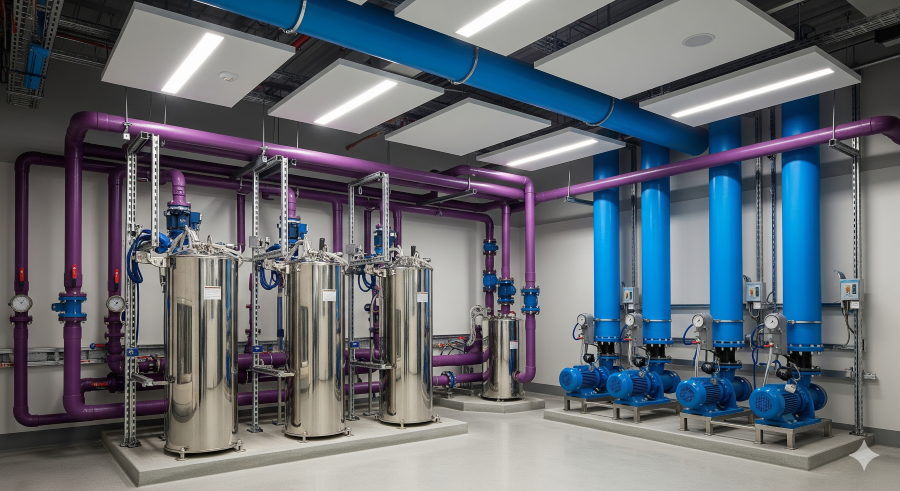
Labs drink water like they burn energy. Designing closed-loop systems to weather future droughts.
Credit: Gemini (2026)
Introduction: The thirsty laboratory
While energy efficiency often dominates the sustainability conversation, water scarcity is rapidly becoming a critical constraint for life science development. A typical laboratory consumes four to five times more water than a commercial office building, driven by high-intensity cooling loads, sterilization processes, and pure water generation. In drought-prone regions like California and Massachusetts, water districts are beginning to impose strict quotas on new industrial connections, effectively threatening a facility's "license to operate" before the foundation is even poured.
For the lab architect, the era of "single-pass" cooling is over. To ensure business continuity and regulatory compliance, modern facilities must treat water as a finite, recirculating resource rather than a cheap, disposable commodity. This article explores the engineering strategies behind lab water systems that prioritize conservation without compromising science, ensuring that the facility remains resilient even as municipal supplies tighten.
Process water cooling: closing the loop
The single largest waste of water in older laboratories is single-pass cooling. Historically, researchers would cool equipment (like electron microscopes, lasers, NMRs, or distillation columns) by running tap water through the machine and dumping it directly down the drain. A single electron microscope can waste 1,500 gallons of potable water per day using this method. Beyond the sheer volume of waste, this practice subjects sensitive equipment to the temperature fluctuations and sediment often found in municipal lines.
The solution: Closed-loop process water cooling. Instead of using domestic water, the facility utilizes a dedicated Process Chilled Water (PCW) loop. This loop circulates treated water between the equipment and a central chiller or plate-and-frame heat exchanger connected to the building's main cooling system. The water is cooled, recirculated, and never leaves the pipe.
The Impact: Converting a facility from single-pass to closed-loop cooling can reduce total building water consumption by 25 to 40 percent immediately. It also provides a stable thermal environment for instruments, improving experimental accuracy.
Sterilization water usage: taming the autoclave
Autoclaves (steam sterilizers) are essential for biological research but are notorious water hogs. Traditional units use a constant stream of cold tap water to "temper" (cool down) the hot condensate discharge before it enters the sewer system. This is required by plumbing codes, which typically prohibit discharging water hotter than 140°F (60°C) to prevent damaging PVC pipes. In many older units, this "tempering water" runs 24/7, even when the autoclave is idle.
Conservation strategies:
Water-Saving Retrofits: Installing "load-sensing" mechanical valves that only allow tempering water to flow when the autoclave is actually discharging hot condensate, rather than running continuously.
Vacuum Systems: Specifying modern autoclaves with high-efficiency vacuum pumps. Older units use water ejectors (venturi systems) to create a vacuum, consuming hundreds of gallons per cycle. Modern electric vacuum pumps use zero water for suction.
Cooling Loop Integration: Connecting the autoclave to the building's chilled water loop to handle the cooling load of the effluent. This heat exchanger approach eliminates the need for single-pass tempering water entirely, transferring the heat to the mechanical plant instead of the sewer.
Water reclamation systems
For a net-zero lab design, using potable water for non-potable tasks is inefficient. Water reclamation systems (often piped as distinct "purple pipe" networks) capture alternative sources for cooling towers and flushing fixtures, which represent the bulk of a building's non-potable demand.
Air Handler Condensate: In humid climates, large laboratory air handling units (AHUs) generate thousands of gallons of pure, distilled condensate water daily from cooling coils. Instead of piping this to the drain, it can be captured and used as relatively clean make-up water for cooling towers.
RO Reject Water: Generating pure laboratory water (Type 1 or Type 2) creates a significant waste stream called "reject water." This water is too mineral-heavy for experiments, but is perfectly clean enough for flushing toilets or cooling tower make-up.
Rainwater Harvesting: Collecting roof runoff for irrigation or toilet flushing, reducing the demand on the municipal supply.
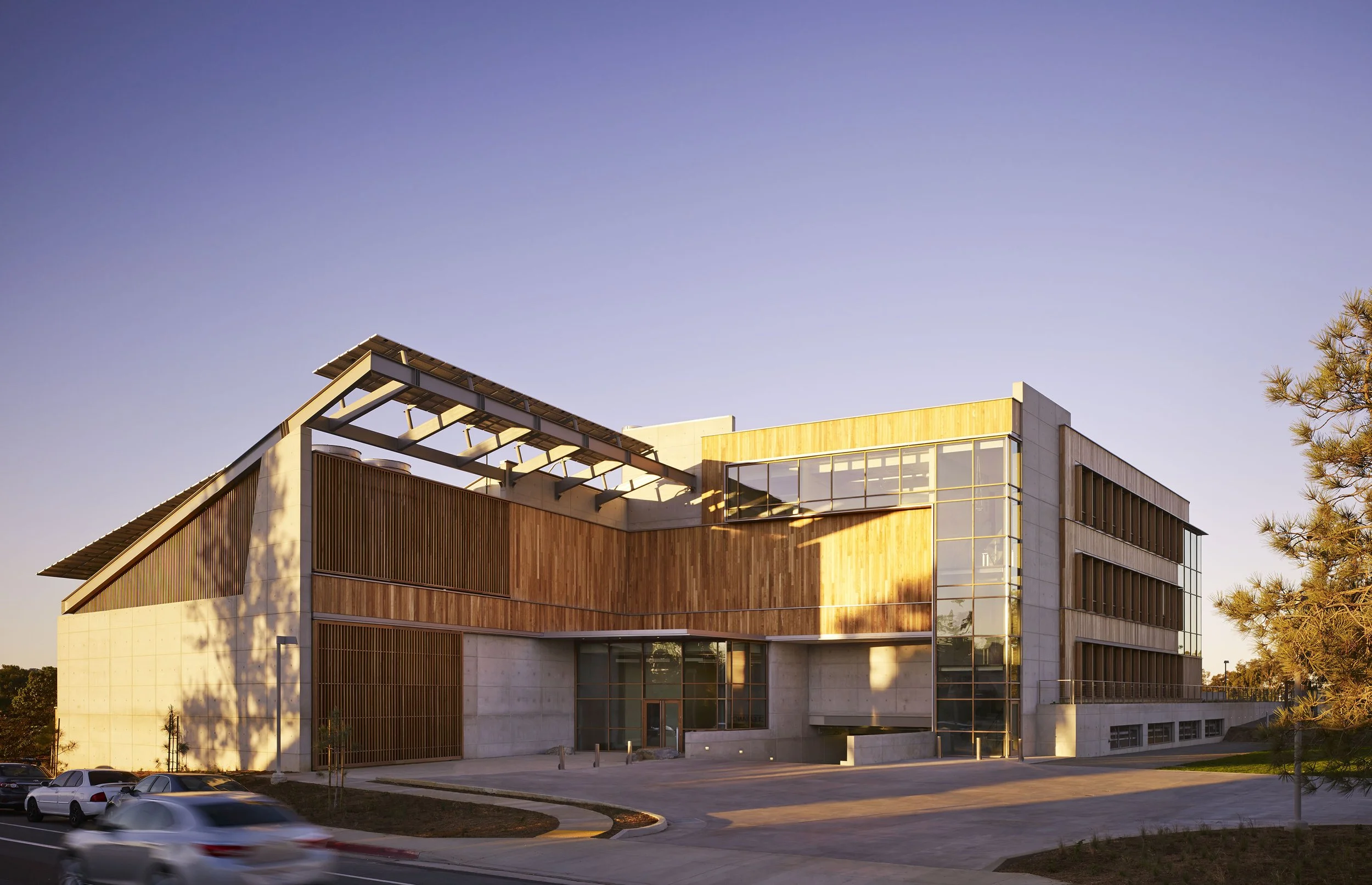
Case study: The J. Craig Venter Institute
The J. Craig Venter Institute (JCVI) in La Jolla, California, stands as the gold standard for water independence. Located in an arid desert climate, the facility was designed to operate as a "net-zero water" building.
The Strategy: The building utilizes a massive 95,000-gallon cistern to capture rainwater.
The Usage: This harvested water effectively meets the building's non-potable demands, including cooling towers and toilet flushing.
The Result: By combining aggressive low-flow fixtures with rainwater harvesting and closed-loop process cooling, JCVI reduced its potable water demand to a fraction of a comparable lab, proving that high-intensity science can thrive even in water-scarce environments.
Image Credit: J. Craig Venter Institute
Conclusion: resilience against drought
As climate change accelerates, water reliability will become as important as power reliability. A lab that shuts down because of a municipal water restriction is just as paralyzed as one without electricity. By implementing closed-loop lab water systems and aggressive reclamation strategies, lab planners are not just saving money—they are building resilience, ensuring that research can continue even when the reservoirs run low.
Frequently asked questions (FAQ)
What is the difference between process water and domestic water?
Domestic water is potable (drinkable) water connected to sinks, showers, and eye-wash stations. Process water is non-potable water used strictly for mechanical cooling and equipment; it is often treated with corrosion inhibitors and is not safe for consumption.
Can you use recycled water in lab sinks?
No. Lab sinks must use potable water for safety reasons (e.g., washing hands, rinsing eyes, cleaning glassware). Recycled water is strictly for mechanical systems (cooling towers) and sanitary systems (toilets).
How much water does an autoclave use?
A standard, old-school laboratory autoclave can consume between 400 to 900 gallons of water per day if left idling with continuous tempering flow. Water-saving kits can reduce this by over 90 percent.
