
Waste Streams in High-Throughput Screening: Architecting for Bulk Disposal
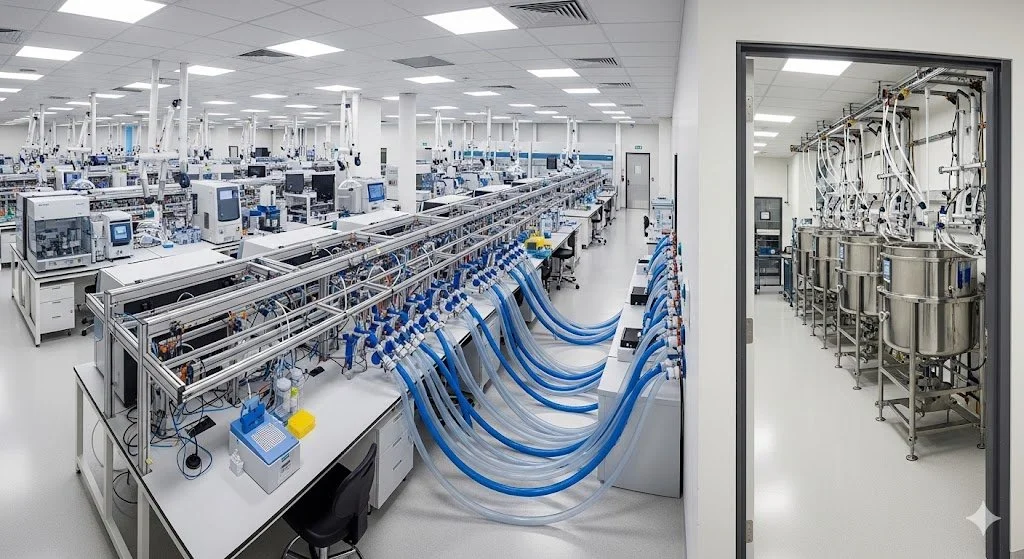
High-throughput screening generates waste at an industrial scale, necessitating built-in, automated chemical waste routing and centralized solid waste logistics. | Credit: Gemini (2026)
Your robot can pipette 1,000 plates a day. Who takes out the trash? Designing bulk waste lines is a critical, yet frequently overlooked, component of designing for automation in a modern laboratory. Automation creates waste at a pace that is magnitudes faster than human operators. While a manual bench scientist might fill a small biohazard bin and a two-liter chemical waste carboy over the course of a week, an automated high-throughput screening (HTS) deck can generate that same volume in a matter of hours.
If a facility relies on standard, human-scale waste receptacles, the robotic workflow will inevitably grind to a halt. When the onboard trash chutes fill up, the robot's sensors trigger a hard stop, requiring a technician to enter the work envelope, remove the waste, and reset the system. This constant intervention defeats the purpose of "walkaway" automation. To achieve true continuous operation, architects and facility managers must design automated waste disposal systems directly into the building's plumbing and pneumatic infrastructure.
Designing for this scale requires a transition from localized waste collection to facility-wide waste logistics. This involves engineering high-capacity chemical waste routing for caustic or hazardous liquids, integrated solid waste chutes for thousands of spent pipette tips, and sophisticated building management system (BMS) alarms to monitor centralized waste vats before they overflow.
Key Takeaways
Continuous Operation: True walkaway automation requires automated waste removal systems to prevent robots from pausing due to full localized trash bins.
Solid Waste Logistics: Facilities must design gravity chutes or pneumatic transport systems to rapidly move massive volumes of spent pipette tips and microplates away from the automation deck.
Chemical Waste Routing: Integrated vacuum lines and automated pump stations are necessary to safely transport hazardous liquid waste from robotic decks to centralized, monitored holding tanks.
Regulatory Compliance: Centralized, high-volume waste systems must adhere strictly to EPA and local fire code regulations regarding secondary containment, exhaust ventilation, and hazardous material limits.
How do you manage the sheer volume of solid waste in high-throughput screening?
The primary byproduct of automated liquid handling is a mountain of single-use plastics. An HTS deck running 24/7 can easily consume and discard tens of thousands of pipette tips, reagent troughs, and 384-well microplates in a single day. Managing this solid waste logistics challenge requires physical architectural interventions, as standard under-bench bins will overflow almost immediately.
The most effective solution is the integration of direct gravity drop chutes. By core-drilling through the laboratory workbench—and in some cases, through the structural floor slab itself—engineers can create a direct path from the robot's onboard waste slide to a massive, rolling collection bin located on a lower interstitial floor or dedicated service corridor. This removes the physical bulk from the clean laboratory environment and allows facilities staff to swap out massive collection bins without ever interrupting the robotic run.
When multi-floor gravity drops are not structurally feasible, planners often utilize localized vacuum transport systems. Similar to the pneumatic tubes used in banking, these systems actively suction spent pipette tips from the deck and transport them through overhead conduit networks to a centralized, high-capacity compactor. This automated waste removal approach keeps the primary scientific floorplate clear of debris and reduces the cross-contamination risks associated with manually transporting biohazardous trash through the lab.
What are the best practices for chemical waste routing from automated decks?
Liquid waste generated by HTS systems is typically a complex, potentially hazardous mixture of biological buffers, organic solvents, and chemical reagents. Relying on technicians to manually swap out 10-liter carboys beneath the deck is ergonomically dangerous and disrupts the automation process. Instead, modern facilities employ hard-plumbed chemical waste routing systems.
These systems utilize active vacuum aspiration to pull liquid waste from the robot's wash stations directly into a dedicated, chemically resistant piping network (often constructed of CPVC or specialized PVDF materials). This network routes the fluid away from the clean lab into a centralized waste utility room equipped with large-scale, double-walled holding tanks.
Safety and environmental control are paramount in these fluid networks. The holding tanks must be actively exhausted to the facility's dedicated hazardous exhaust system to prevent the buildup of volatile organic compound (VOC) vapors. Furthermore, the routing lines must include automated check valves and liquid level sensors tied to the BMS. If a centralized tank reaches 80% capacity, the system must automatically alert environmental health and safety (EHS) personnel while preventing the automation decks from pumping further waste into the line.
Comparing Waste Profiles: Manual vs. Automated Screening
Solid Waste Volume: Manual processing generates small, easily managed volumes of tips and plates (e.g., 1-2 bins per week). Automated screening generates industrial volumes, often requiring 50-gallon drums or direct-to-dumpster chutes daily.
Liquid Waste Collection: Manual work utilizes small, localized carboys stored under the fume hood or bench. Automated systems require continuous chemical waste routing to 100+ gallon centralized holding tanks.
Operator Intervention: Manual waste removal is a daily housekeeping task. Automated setups require facility-level logistics, utilizing pumps, sensors, and dedicated service staff to manage bulk removal without stopping the science.
Space Allocation: Manual waste bins require minimal footprint. Bulk automated waste disposal requires dedicated utility corridors, core-drilled floors, and specialized, exhausted storage rooms.
How does automated waste disposal impact hazardous materials compliance?
Transitioning from localized carboys to centralized chemical waste routing fundamentally changes a facility's regulatory risk profile. The United States Environmental Protection Agency (EPA), under the Resource Conservation and Recovery Act (RCRA), strictly regulates the accumulation of hazardous waste. When a facility consolidates waste into massive central tanks, they must rigorously manage accumulation time limits and total volume thresholds to remain compliant with their generator status.
Architecturally, this means the centralized waste holding rooms must be designed as High Hazard (H-Occupancy) spaces. This requires specialized fire suppression systems, explosion-proof electrical fixtures, and extensive secondary containment infrastructure. The floor of the waste room must be capable of acting as a containment basin, designed to hold 110% of the volume of the largest tank in the event of a catastrophic rupture.
Furthermore, mixing different waste streams from multiple robotic decks into a single bulk line can create dangerous chemical incompatibilities. Facilities must install separate, dedicated lines for organic solvents, aqueous biological waste, and highly reactive reagents to prevent exothermic reactions or toxic gas generation within the plumbing infrastructure.
Expert FAQ: Lab Waste Management
Q: Can we retrofit gravity waste chutes into an existing laboratory building?
A: It is possible, but structurally complex. Core-drilling through a floor slab requires ground-penetrating radar (GPR) to avoid severing existing post-tension cables or structural rebar. If floor penetrations are impossible, pneumatic transport tubes routed through the ceiling are the best retrofit alternative.
Q: How do we prevent chemical vapors from traveling back up the waste lines to the robot?
A: Chemical waste routing systems must feature deep P-traps and one-way check valves near the point of connection at the robotic deck. Additionally, the centralized collection tanks must be maintained under continuous negative pressure by the building's hazardous exhaust system, ensuring air is always pulled away from the laboratory.
Q: Are there automated systems to manage the empty reagent bottles?
A: While bulk liquid and tips are easily automated, empty glass or rigid plastic reagent bottles still largely require manual removal due to their size and variability. However, designing dedicated "dirty elevators" or service lifts adjacent to the automation core allows technicians to remove this bulk packaging without crossing paths with clean reagents or sterile samples.
References
National Research Council. Prudent Practices in the Laboratory: Handling and Management of Chemical Hazards. National Academies Press, 2011.
United States Environmental Protection Agency (EPA). Hazardous Waste Generator Regulations: A User-Friendly Reference Document. EPA Office of Resource Conservation and Recovery, 2022.
National Institutes of Health (NIH). Design Requirements Manual (DRM). Office of Research Facilities, 2020.
Occupational Safety and Health Administration (OSHA). Toxic and Hazardous Substances: Bloodborne Pathogens (29 CFR 1910.1030). U.S. Department of Labor.
