
Automated Sample Storage: The "Vending Machine" Wall
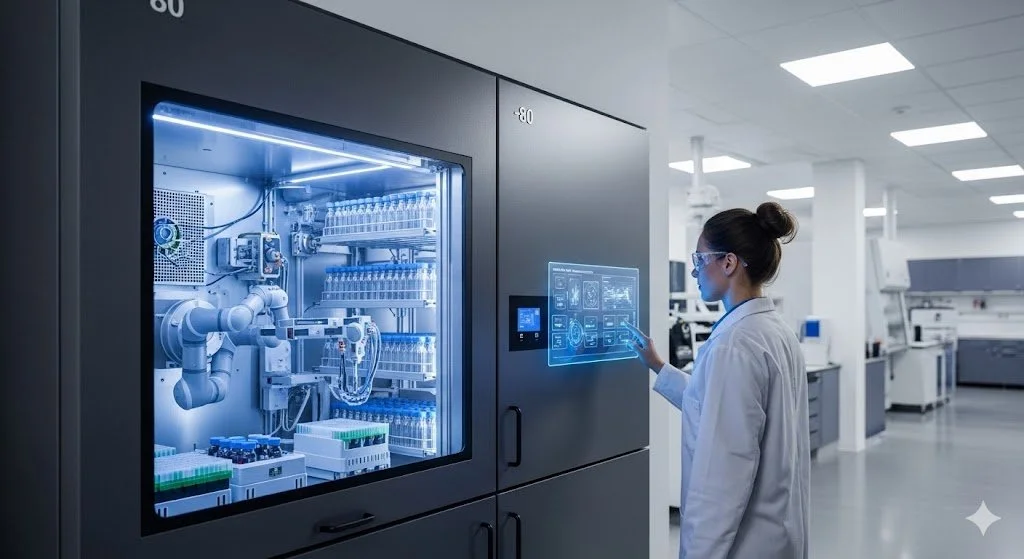
Integrating massive automated sample storage systems requires specialized architectural planning to support immense weight and manage substantial heat rejection. | Credit: Gemini (2026)
It looks like a vending machine, but weighs 5 tons. Structural considerations for automated compound stores require a drastic departure from standard laboratory architectural planning. As facilities transition to high-throughput compound management and massive biobanking operations, the traditional rows of standalone upright freezers are being replaced by colossal, fully automated storage systems.
These robotic "vending machines" for biological samples offer unparalleled inventory tracking and temperature stability, ensuring that delicate specimens are retrieved without exposing the entire inventory to ambient air. However, dropping a multi-ton, towering piece of machinery into a lab environment presents significant logistical and structural hurdles. When designing for automation, architects must prioritize these heavy-duty requirements long before the equipment arrives on site.
Integrating an automated -80 automated freezer into a floorplan goes far beyond simply finding enough square footage. Facility managers and structural engineers must meticulously evaluate the building's floor loading capacity, ensure adequate ceiling clearances for robotic gantry movements, and design robust HVAC infrastructure to reject the immense heat generated by the system's massive redundant compressors.
Key Takeaways
Floor Loading Capacity: Structural slabs must be engineered or reinforced to support live loads exceeding 250–350 pounds per square foot (psf) to safely house automated stores.
Vertical Clearances: Ceiling heights must accommodate not only the physical height of the unit but the overhead clearance required for installation, maintenance, and robotic z-axis movements.
Heat Rejection Strategies: High-density compressors require dedicated chilled water loops to manage intense thermal output efficiently without overwhelming the room's ambient HVAC.
Access and Rigging: Facility design must include clear, reinforced pathways, oversized doors, and freight elevator capacities capable of transporting massive modular components during installation.
How does an automated store impact floor loading capacity?
The most immediate structural challenge when specifying an automated sample storage system is its sheer mass. A standard laboratory floor is typically engineered to support a live load of 100 to 125 pounds per square foot (psf). A fully loaded, mid-sized automated compound store can easily exert a concentrated load of 250 to 350 psf or higher, far exceeding standard commercial building codes.
This weight comes from the dense concentration of thousands of glass or plastic vials, the heavy steel framing required for the robotic gantry, and the massive insulated panels forming the -80°C enclosure. If a facility places one of these units on an unreinforced suspended slab, the resulting deflection could not only damage the building but also knock the internal robotics out of alignment, causing catastrophic system jams.
To safely distribute this weight, structural engineers often design custom steel dunnage or load-spreading base plates that transfer the concentrated point loads across a wider area of the concrete slab or directly onto primary structural beams. In many retrofit scenarios, the only viable location for these multi-ton units is on a slab-on-grade foundation (the ground floor) to completely bypass suspended load limitations.
Why are ceiling heights critical for -80 automated freezers?
Automated stores maximize storage density by utilizing vertical space. These systems are essentially tall, insulated silos that rely on internal robotic cranes to retrieve sample racks from the highest shelves. Consequently, a unit can easily stand 10 to 14 feet tall, immediately ruling out facilities with standard 9-foot drop ceilings.
Planners must account for "clear height," which extends beyond the physical dimensions of the freezer itself. Manufacturers generally require a minimum of 24 to 36 inches of unobstructed clearance above the unit to accommodate service technicians, allow for the installation of massive refrigeration compressors, and provide space for utility tie-ins like electrical conduits and liquid nitrogen (LN2) backup lines.
If an automated storage system must be placed in a room with a restrictive ceiling height, architects may need to remove acoustic ceiling tiles and route MEP (mechanical, electrical, and plumbing) infrastructure around the footprint of the machine. In purpose-built biobanking facilities, it is common to design a double-height room or a recessed "pit" specifically to house these towering automated architectures.
How do you manage the heat rejection of compound management systems?
Maintaining an internal temperature of -80°C across a volume large enough to hold millions of samples requires immense refrigeration power. Standard upright ultra-low temperature (ULT) freezers reject their heat directly into the surrounding room, which is manageable in small numbers. However, an automated sample storage system acts like a concentrated bank of a dozen ULT freezers, generating tremendous amounts of heat.
If this heat is rejected into the ambient laboratory environment, it will rapidly overwhelm standard variable air volume (VAV) cooling systems, causing room temperatures to spike and triggering equipment failures. Therefore, most large-scale automated stores are specified with water-cooled condensers rather than air-cooled units.
Water-cooling systems tie directly into the facility's chilled water loop. This effectively decouples the thermal load from the room's air conditioning, transferring the heat outside to the building's central cooling towers. Planning for this requires plumbers and mechanical engineers to route dedicated, insulated supply and return water lines directly to the footprint of the automated store, equipped with specialized leak detection failsafes.
Comparing Storage Specs: Manual Upright Freezers vs. Automated Stores
Typical Floor Loading: A standard manual -80°C upright freezer exerts roughly 100–120 psf. A fully loaded automated storage system demands 250–350+ psf, requiring structural evaluation.
Vertical Height: Upright freezers are generally 6.5 feet tall and fit under standard ceilings. Automated stores range from 10 to 14+ feet, requiring double-height spaces or removed drop ceilings.
Heat Rejection: Manual freezers reject 2,000–3,000 BTUs/hr into ambient air. A large automated store can reject 20,000–40,000+ BTUs/hr, often necessitating dedicated chilled water loops.
Utility Footprint: Standalone units require a single 208V outlet. Automated systems require high-amperage 3-phase power, dedicated ethernet drops, compressed air lines, and chilled water connections.
Expert FAQ: Automated Sample Storage Facilities
Q: Can an automated storage system be relocated easily if the lab layout changes?
A: No. Unlike standalone freezers that are simply unplugged and rolled on casters, an automated store is a fixed, semi-permanent architectural installation. Moving one requires fully decommissioning the unit, unbolting it from the floor, meticulously realigning the robotics, and re-routing complex MEP utilities.
Q: How do we prevent ice buildup on the robotic mechanisms operating at -80°C?
A: Humidity control is critical. Automated stores are heavily insulated and feature specialized airlock picking modules that use a flow of dry air or nitrogen gas to prevent ambient, moisture-laden air from entering the primary cold zone during sample retrieval, preventing frost on the robotics.
Q: What happens to the automated store during a prolonged power outage?
A: Facilities must equip these systems with dual-redundancy. The unit's compressors and robotic controllers must be wired to the building's emergency generator backup. Additionally, automated stores feature liquid nitrogen (LN2) or liquid carbon dioxide (LCO2) backup injection systems that can maintain internal temperatures for days even if all mechanical cooling fails.
References & Further Reading
Structural Engineering Institute (SEI). Minimum Design Loads and Associated Criteria for Buildings and Other Structures (ASCE/SEI 7-22). American Society of Civil Engineers, 2022.
National Institutes of Health (NIH). Design Requirements Manual (DRM). Office of Research Facilities, 2020.
American Society of Heating, Refrigerating and Air-Conditioning Engineers (ASHRAE). Laboratory Design Guide: Planning and Operation of Laboratory HVAC Systems, 2nd ed., ASHRAE, 2015.
International Society for Biological and Environmental Repositories (ISBER). Best Practices: Recommendations for Repositories. 4th ed., ISBER, 2018.
