USGS Fisheries Research Station Prepares for Move to Upgraded Facility
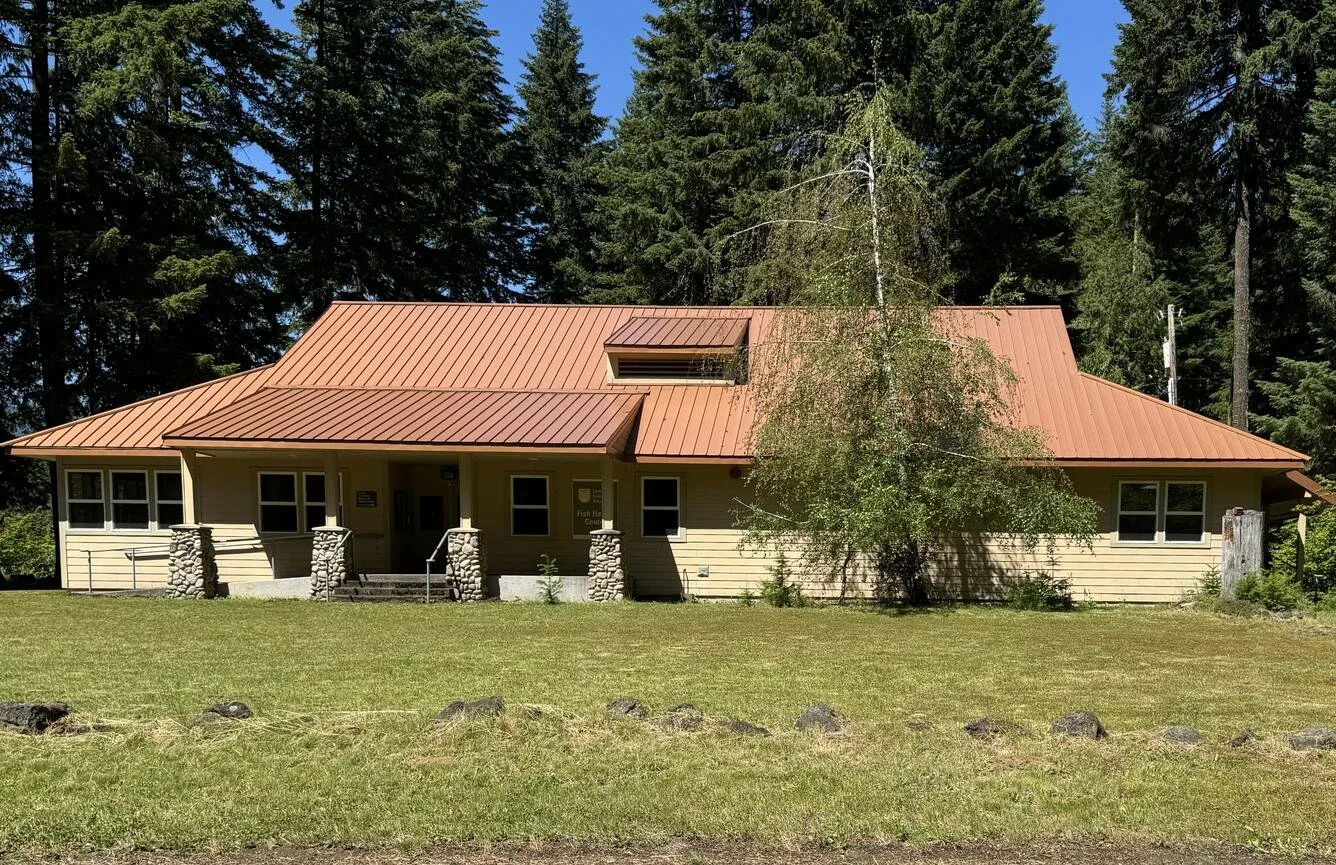
The USGS Western Fisheries Research Center is renovating a facility in Willard, WA, to serve as the new home of its Columbia River Research Laboratory. Image: Nandita Kohli
The US Geological Survey’s Western Fisheries Research Center is preparing to relocate its Columbia River Research Laboratory to a renovated facility in Willard, WA, marking a significant upgrade for a research program with deep roots in Pacific Northwest fisheries science.
Located approximately two miles north of the laboratory’s current home in Cook, WA, the new facility was previously occupied by the US Fish and Wildlife Service’s Lower Columbia Fish Health Center. The US Fish and Wildlife Service provided the facility, while the US Forest Service, which owns the property, facilitated the transfer of lease rights to USGS.
Renovations are underway to adapt the building for the Western Fisheries Research Center’s laboratory, office, and field research needs. The center hopes to complete the move before the start of the new year, in the latest chapter in the evolution of a research organization that dates to the late 1930s.
The center was originally part of the US Fish and Wildlife Service and focused largely on fish health issues associated with salmon hatcheries. Those hatcheries were developed in part to mitigate the impacts of major dams that blocked historic salmon migration routes. Originally based only in Seattle, the Western Fisheries Research Center has since expanded to five locations, while its scientific scope has grown to include aquatic species behavior and ecology.
The Columbia River station is one of those locations and supports fisheries and aquatic resource research throughout the Columbia River Basin.
Planning around science and field operations
Because much of the Columbia River station’s research takes place outside the laboratory, the project team has been able to develop a transition plan that allows scientific work to continue while the new building is renovated.
“The Columbia River station’s research primarily takes place in the field. Therefore, during the renovation and relocation, staff are working from home to complete office work,” says Michael Schmidt, center director of the USGS Western Fisheries Research Center. “We have also received help from US Fish and Wildlife Service who is providing space at their Willard National Fish Hatchery to rear fish required for certain activities, and we continue to have access to our existing gear storage and prep areas while the new site is renovated.”
That combination of remote office work, continued access to the existing facility, and support from a partner agency has helped minimize disruptions during the transition.
Planning for the new space has centered on understanding how staff use laboratory areas as well as the storage and preparation spaces required to support field research.
“Our science and facilities staff work closely to plan based on our laboratory, field equipment storage and preparation, and office needs,” Schmidt says. “This information is provided to our contractor leading the renovation.”
A designated member of the science staff serves as the primary point person for laboratory planning, coordinating with other researchers to consolidate their needs and communicate them to facilities staff and contractors. A biosafety contractor is also reviewing the laboratory plans and providing recommendations.
The approach creates a clear channel between the researchers who will use the facility and the professionals responsible for designing and renovating it.
From preliminary design to renovation
USGS architects developed preliminary designs for the facility in 2024. Those plans were then provided to the design-build contractors responsible for completing the formal design and carrying out the renovation.
Doyon is serving as the primary contractor for the project, while UNICOR is handling furniture. Local contractors are also participating, primarily as subcontractors.
Compared with larger or more technically complex laboratory projects, Schmidt described the renovation as relatively straightforward. The facility primarily consists of office space with a small laboratory, and its work with aquatic species does not introduce some of the disease transmission concerns that can affect laboratories working with humans, birds, or mammals.
Federal and private sector laboratories also follow many of the same design and safety guidelines, Schmidt notes, reducing significant differences in the fundamental planning requirements.
The biggest project obstacle may instead be the schedule—and the weather.
“Biggest challenge will be getting most of the work done before this winter,” Schmidt says. “The building is at a higher elevation and access can be constrained by snowfall, especially for larger trucks.”
Completing major renovation and delivery activities before conditions limit site access is therefore a key priority for the project team.
A significant upgrade for the research program
The relocation will provide Columbia River station staff with a newer working environment and updated equipment—a substantial improvement over the existing facility.
“This is a much newer building which will have all new office space and new laboratory equipment,” Schmidt says. “This is a significant change from the existing, much older facility.”
The move also reflects a broader history of facility transitions across the Western Fisheries Research Center. A new main laboratory was constructed at the center’s primary Seattle location in the early 1990s, around the time the organization transitioned from the U.S. Fish and Wildlife Service to the National Biological Survey and later to USGS. More recently, the center’s station in Klamath Falls, OR, relocated from leased space to a nearby Bureau of Reclamation facility.
In the Columbia River Gorge, the Willard project demonstrates how an existing federal facility can be adapted to support a new research program while leveraging partnerships and maintaining scientific continuity during construction.
Once renovations are complete, the upgraded laboratory, office, and field support spaces are expected to strengthen the Western Fisheries Research Center’s ability to conduct fisheries and aquatic resource research throughout the Columbia River Basin.
For a research organization that has continued to expand its scientific mission since the 1930s, the move provides a newer facility designed around the Columbia River station’s current operational needs, as well as a long-term home for its work in the region.