Structural and Operational Lessons from the USF Marine Lab Fire
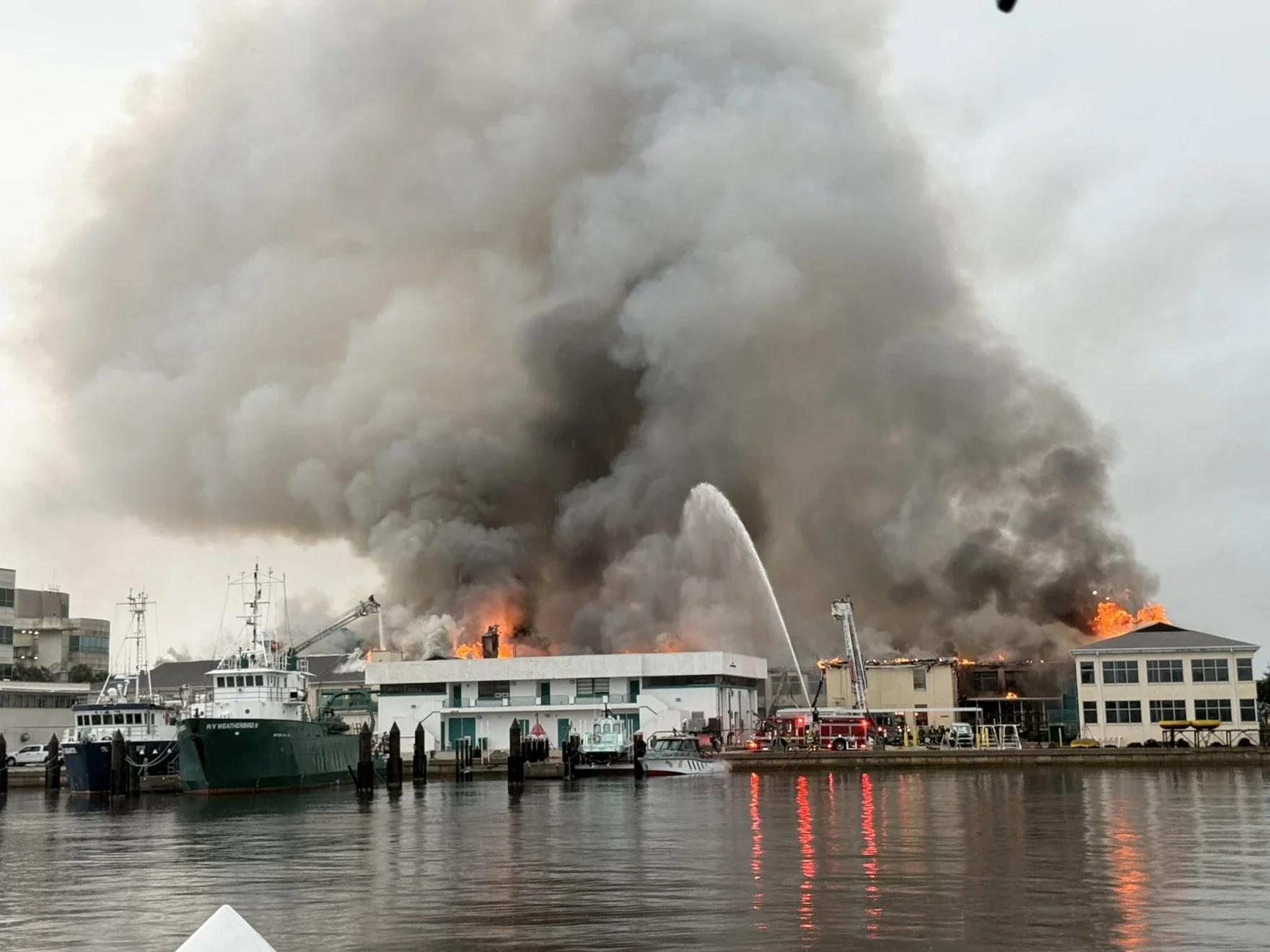
Flames rise from the Marine Science Laboratory during a two-alarm fire at the University of South Florida St. Petersburg campus on Saturday, May 2, 2026. Image: Angela Lawton/Courtesy/WUSF
Editor’s Note: Laboratory disaster recovery highlights the critical vulnerability of specialized academic infrastructure to sudden environmental disruptions. The recent lightning-induced fire at the University of South Florida’s Marine Science Laboratory underscores the necessity of robust facility contingency planning, redundant data systems, and adaptive spatial strategies. For laboratory planners and facility managers, this incident serves as a stark reminder that resilience must be engineered into both physical infrastructure and long-term capital allocation strategies.
The catastrophic roof fire that crippled the University of South Florida (USF) Marine Science Laboratory on May 2 has transitioned from an emergency response operation into a complex, multi-year facility recovery challenge. The blaze, which drew more than 200 firefighters from 11 agencies to the St. Petersburg campus, halted critical regional research initiatives spanning sea-level rise modeling to hurricane intensification tracking.
While academic leadership remains focused on maintaining continuity for 150 displaced students and faculty, facility managers and lab planners are facing the arduous task of assessing systemic smoke and water damage, managing complex insurance claims, and planning the building's uncertain structural future.
The anatomy of vulnerability: smoke, water, and delayed infrastructure failure
While the structural inferno was largely contained to the building's aging wooden roof structure—a component that had likely not undergone comprehensive renovation since the 1970s—the true facility loss extends far beyond the charred roofline. Driven into lower floors by millions of gallons of firefighting water, dense smoke and moisture permeated highly sensitive analytical spaces.
Initial recovery efforts spearheaded by Tom Frazer, dean of the College of Marine Science, successfully extracted critical assets including autonomous underwater gliders, carbon-testing mangrove specimens, and irreplaceable Antarctic core samples. However, facility engineers are now encountering a secondary wave of equipment degradation. Although localized network servers and high-value computational assets functioned long enough to facilitate emergency data duplication, subsequent corrosion from airborne particulates and humidity has begun triggering delayed hardware failures.
This delayed lifecycle decline represents a critical consideration for lab operations managers handling post-disaster remediation. Standard instrumentation, such as mass spectrometers recently procured to re-establish baseline water contaminant testing, requires highly controlled ambient environments. Deploying sensitive electronics into temporary, non-optimized environments—such as the lobby of the adjacent Knight Oceanographic Research Center where many operations have been consolidated—elevates the risk of ambient contamination and premature component failure.
Re-engineering custom research environments
The logistical reality of rebuilding academic research space is compounded by the presence of highly bespoke, non-commodity infrastructure. For lab planners, the loss of specialized, custom-fabricated apparatuses presents a significantly steeper hurdle than replacing off-the-shelf casework or standard fume hoods.
At USF, this bottleneck is exemplified by the destruction of a proprietary, handblown glass carbon-dating apparatus colloquially known as the “dirt burner” within the geological oceanography suite. Because the system was custom-fabricated to precise experimental specifications, its re-commissioning requires sourcing specialized artisan glassblowers, executing rigorous vacuum-testing protocols, and recalibrating baseline environmental controls—a timeline estimated to consume at least a full calendar year before external researchers or graduate students can safely utilize the space.
Furthermore, the facility's localized cold-storage infrastructure remains under intense scrutiny. While structural freezers containing decades of biological fish specimens captured from Tampa Bay remained operational or structurally intact enough to preserve samples during extraction, the long-term viability of these specimens cannot be verified until full analytical capabilities are restored.
Capital allocation and insurance complications
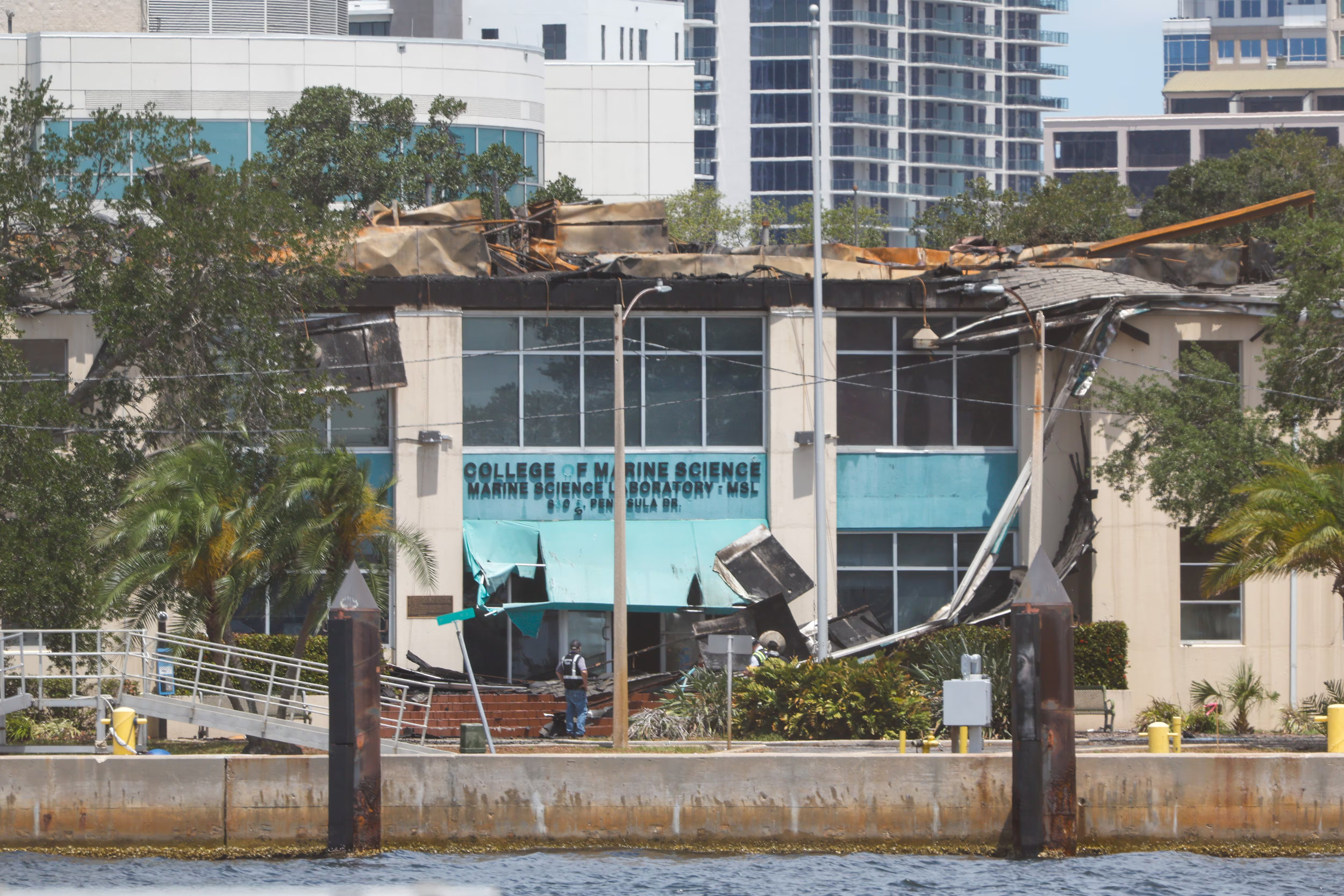
Damage to the USF Marine Science Lab after the building fire on May 2. Image: Jefferee Woo|Tampa Bay Times
Prior to the incident, the Florida State Legislature had approved $10 million in capital funding intended for comprehensive hurricane hardening and roof replacement projects at the Marine Science Laboratory. The intervening disaster has shifted the conversations from proactive facility modernization to reactive capital restructuring.
University leadership is currently locked in an extensive asset evaluation period with insurance adjusters to establish the exact baseline valuation of the structural and programmatic losses. State representatives, including Senator Nick DiCeglie (R-St. Petersburg), have indicated that supplementary state allocations cannot be codified or approved during legislative budget sessions until the final scope of insurance coverage is completely reconciled.
For institutional planners, this intermediate limbo emphasizes the value of flexible, modular benching and adaptive swing spaces. The ability of the USF College of Marine Science to maintain its active marine monitoring buoys in the Gulf of Mexico just one week after the fire was largely attributable to the decentralized infrastructure of its neighboring Ocean Circulation Lab.
What this means for your next lab project
Building true structural and programmatic resilience into a laboratory ecosystem requires anticipating catastrophic utility and envelope failures before they occur. When designing or renovating academic and research facilities, planners should consider several critical takeaways from the USF incident:
Implement zoned material protection: Ensure that historical, high-value, or irreplaceable sample collections are housed within structural containment zones equipped with independent fire suppression, advanced particulate filtration, and secondary water-diversion paths.
Establish rapid swing-space protocols: Design adjacent facilities with standardized, flexible utility connections (plug-and-play gas, data, and power lines) to allow displaced research teams to quickly integrate salvaged instrumentation into temporary spaces without requiring extensive MEP overhauls.
Account for corrosive deposition in contingency budgets: Recognize that electronic and analytical infrastructure exposed to smoke or high humidity may pass initial inspections but suffer accelerated galvanic corrosion over the subsequent 60 to 90 days. Insurance and recovery documentation must reflect these extended lifecycle risks.
As USF navigates its multi-year path toward structural restoration, the incident will continue to serve as a benchmark case study for disaster recovery, proving that the ultimate resilience of a science community relies entirely on the adaptable design of the physical infrastructure supporting it.
References
University of South Florida College of Marine Science. (2024). Emergency Facility Management and Research Continuity Report.
National Science Foundation. (2023). Decarbonization and Asset Realignment Plan for Polar Research Vessels.