
Power & Data Density for Liquid Handlers: Architecting for High-Throughput Utilities
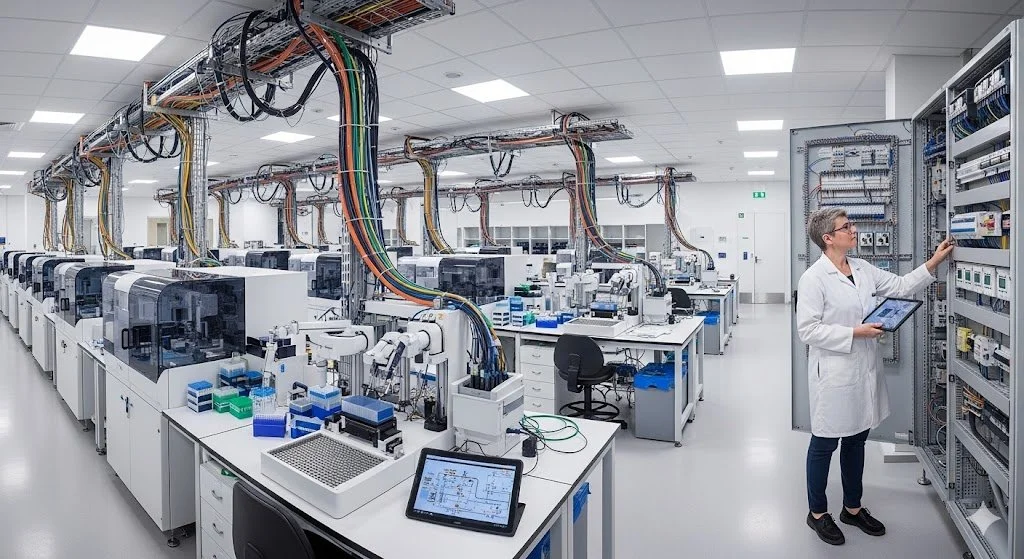
High-throughput automated laboratories demand specialized overhead utility infrastructure to support the intense electrical and data loads of modern liquid handling robots. | Credit: Gemini (2026)
One liquid handler is fine. Ten of them will melt your circuit breaker. Planning for high-density automation is a critical, yet frequently underestimated, phase in laboratory design. As life science facilities transition from manual benchwork to highly automated pipelines, the physical footprint of the equipment often distracts from the invisible, compounding strain placed on the building's electrical and network grids. Ultimately, designing for automation requires a fundamental shift from focusing on bench space to prioritizing these critical hidden utilities.
High-throughput automated decks, such as those manufactured by Hamilton, Tecan, and Beckman Coulter, are essentially industrial robots operating in a cleanroom environment. They integrate multiple motorized axes, onboard thermal cyclers, peltier coolers, and high-vacuum pumps. When a facility attempts to deploy a fleet of these systems without a comprehensive utility assessment, they risk frequent power trips, data bottlenecks, and catastrophic loss of high-value reagents during automated runs.
To successfully scale automated liquid handling utilities, laboratory managers and electrical engineers must collaborate to design robust, redundant infrastructures. This involves meticulous electrical load planning, the strategic deployment of UPS backup power systems, and the installation of dedicated, high-bandwidth Ethernet drops.
Key Takeaways
Dynamic Load Profiling: Assess peak power consumption during simultaneous component activation (e.g., thermal cycling and vacuum pumps), not just the resting draw.
Centralized vs. Distributed UPS: Implement dual-conversion uninterruptible power supplies (UPS) to condition power and bridge the critical gap between grid failure and generator start.
Dedicated Data Infrastructure: Isolate automation data traffic on dedicated VLANs with hardwired CAT6a or CAT7 ethernet drops to prevent network latency from interrupting run protocols.
Overhead Utility Distribution: Utilize overhead busways and drop-cords to maintain layout flexibility and keep power/data cables away from potential floor-level liquid spills.
Why is electrical load planning critical for automated liquid handlers?
Automated liquid handlers are not standard lab appliances; they are complex electro-mechanical assemblies with highly variable power demands. A standard 120V, 20A circuit may easily support a centrifuge or a vortexer, but a fully loaded robotic deck can draw between 1,200 to over 3,000 watts depending on its onboard accessories. When integrating on-deck incubators, heavy-duty robotic arms, and HEPA filtration enclosures, the power requirements escalate exponentially.
The danger lies in simultaneous peak loads. During a complex protocol, a liquid handler might simultaneously engage its wash station pumps, begin ramping up a 96-well thermal block, and activate its primary gantry motors. If multiple machines on a shared circuit reach this peak state simultaneously, the breaker will inevitably trip. Electrical load planning must account for these synchronized operational peaks rather than relying on the average stated power consumption.
To mitigate this, engineers must provision dedicated, heavy-duty circuits for each primary automated deck. In dense environments, this often means upgrading the facility's main electrical panel and pulling specialized 208V/240V, 30A lines directly to the automation core. This proactive scaling ensures that as the lab throughput grows, the electrical grid remains resilient and stable under maximum load.
Comparing Utility Profiles: Traditional vs. Automated Workstations
Typical Power Draw: Traditional manual workstations require roughly 200–500 watts for basic pipettes, shakers, and laptops. Automated liquid handling decks demand 1,500–3,000+ watts due to multi-axis motors and integrated thermal modules.
Circuit Requirements: Traditional setups function reliably on shared 120V/20A wall receptacles. High-density automation requires dedicated, unshared 120V/20A or even 208V/30A circuits per machine.
Data Connectivity: Manual stations operate on standard Wi-Fi or simple CAT5e drops. Automated decks require hardwired, dedicated CAT6a/CAT7 ethernet drops communicating via static IP addresses.
Backup Power Strategy: Standard benches rarely require UPS backup unless utilizing small, sensitive instruments. Automated fleets demand inline, dual-conversion UPS systems sized for 120% of the calculated peak load to secure long-running, high-value assays.
How does UPS backup power protect high-throughput workflows?
A momentary power flicker that dims the lights is a minor annoyance to a human researcher; to an automated liquid handler running a 14-hour next-generation sequencing (NGS) prep, it is a catastrophic event. Voltage sags or micro-outages can force the robotic controller to reboot, aborting the run, wasting thousands of dollars in proprietary reagents, and destroying irreplaceable patient samples.
Implementing a robust uninterruptible power supply (UPS) infrastructure is non-negotiable for high-density automation. Dual-conversion UPS units are highly recommended because they continuously process incoming AC power into DC and back to AC, delivering a perfectly clean, zero-transfer-time sine wave to the equipment.<sup>3</sup> This "power conditioning" protects sensitive internal microprocessors from grid noise and voltage spikes.
When planning UPS backup power, facilities must choose between localized (point-of-use) units for each deck or a massive centralized UPS room. While localized units are cheaper to deploy initially, they consume valuable floor space and generate localized heat. Centralized UPS systems, paired with automatic transfer switches (ATS) tied to the building's diesel generators, offer superior long-term resilience and simplify maintenance protocols.
Why are dedicated Ethernet drops essential for automation grids?
The physical movement of liquids is only half the function of a modern liquid handler; the other half is continuous data processing. These machines exchange massive volumes of telemetry, log files, and LIMS (Laboratory Information Management System) data in real-time. Relying on facility-wide Wi-Fi or daisy-chained network switches introduces unacceptable latency and packet loss into this critical communication loop.
If the primary control PC loses communication with the robotic deck for even a fraction of a second, the software will often trigger an emergency abort to prevent hardware collisions or sample cross-contamination. Therefore, hardwired, dedicated Ethernet drops must be pulled directly from the main MDF (Main Distribution Frame) or isolated IDF (Intermediate Distribution Frame) to the automation zone.
Network architects must physically and logically segment automation data. Installing CAT6a or CAT7 shielded cabling prevents electromagnetic interference (EMI) generated by the liquid handlers' own motors from corrupting the network signal. Furthermore, placing these Ethernet drops on isolated VLANs (Virtual Local Area Networks) ensures that routine facility traffic—like employee video calls or large file downloads—does not steal bandwidth from critical robotic protocols.<sup>4</sup>
Expert FAQ: Automated Liquid Handling Utilities
Q: Should we run power and data from the floor or the ceiling?
A: Overhead distribution is highly preferred. Running electrical conduits and Ethernet drops down from overhead busways keeps cables away from potential liquid spills on the floor. It also allows for much greater modularity; if a deck needs to be moved or upgraded, overhead drops can be relocated far easier than core-drilling new floor boxes.
Q: How do we calculate the true peak load of a liquid handler before purchasing?
A: Do not rely solely on the generic specification sheet, which often lists an "average" operating wattage. Request a "Site Preparation Guide" from the manufacturer (e.g., Tecan or Hamilton) and ask the field application scientist for the specific power draw of the exact configuration you are purchasing, especially if you are adding third-party integrations like ODTCs (On-Deck Thermal Cyclers).
Q: Can multiple liquid handlers share a single large UPS?
A: Yes, a centralized UPS is an excellent strategy. However, the system must be meticulously sized. Calculate the aggregate peak load of all connected decks, add a 20-30% safety margin for future expansion, and ensure the facility's emergency generators can spool up and take the load before the UPS battery runtime depletes (typically within 5 to 10 minutes).
References & Further Reading
Lin, J. & Patel, R. "Electrical Infrastructure Planning for High-Throughput Laboratory Automation." Journal of Laboratory Automation, vol. 28, no. 4, 2024, pp. 312-320.
American Society of Heating, Refrigerating and Air-Conditioning Engineers (ASHRAE). Laboratory Design Guide: Planning and Operation of Laboratory HVAC Systems, 2nd ed., ASHRAE, 2015.
Carter, S. "Mitigating Risk in Automated Workflows: The Role of Dual-Conversion UPS." Lab Manager Magazine, Oct. 2025.
Society for Laboratory Automation and Screening (SLAS). Guidelines for Facility Preparedness and Automation Integration, SLAS Technical Documentation, 2025.
