
Pilot Plant Design: Bridging the Gap Between R&D and Manufacturing
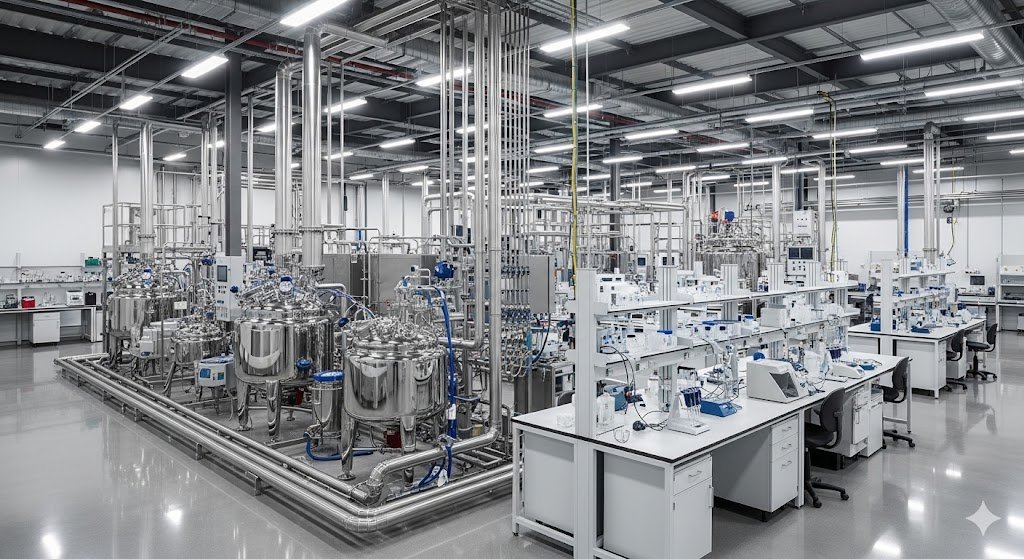
A modern scale-up facility acts as a structural bridge, blending the analytical precision of a clinical laboratory with the heavy utility demands of an industrial manufacturing floor. | Credit: Gemini (2026)
Navigating the Awkward Middle Phase of Scale-Up
It's too big for a flask, too small for a factory. The unique design challenges of the Pilot Plant stem from its inherently transitional nature. When a biopharmaceutical or chemical product successfully graduates from the research and development (R&D) bench, it is rarely ready for immediate commercial manufacturing. The physical behavior, thermal dynamics, and mixing kinetics of a 500-milliliter flask do not linearly translate to the multi-thousand-liter bioreactors used in full commercial production. To safely bridge this gap, organizations must build an intermediate testing ground: the scale-up facility.
Designing this "middle phase" architecture requires planners to balance opposing forces. The space must be robust enough to handle heavy industrial utilities, high-voltage power, and massive liquid volumes, yet clean and precise enough to support delicate analytical equipment. By applying adaptable floorplate strategies to this hybrid environment, architects can eliminate physical bottlenecks during the technology transfer process.
Successful pilot plant design creates a versatile sandbox for process engineers. It allows them to experiment with mid-sized, 50-liter to 500-liter mobile skids, test new plumbing configurations, and troubleshoot automated control systems before committing hundreds of millions of dollars to a permanent, hard-piped commercial manufacturing facility.
Key Takeaways
Architectural Hybridity: Balancing the structural and utility requirements of heavy industrial processing equipment with the environmental control and cleanliness of an analytical laboratory.
Process Development Lab Integration: Co-locating bench-scale analytical testing immediately adjacent to the mid-scale processing floor to accelerate real-time quality control (QC) feedback loops.
Utility Modularity: Designing overhead utility matrices and quick-disconnect panels to support the rapid reconfiguration of mobile processing skids without requiring MEP renovations.
GMP Pilot Plant Compliance: Establishing cleanroom classifications, unidirectional personnel flows, and strict airlock protocols necessary to produce clinical-grade materials under Good Manufacturing Practices.
How a Process Development Lab Differs from Standard R&D
While traditional R&D laboratories focus on the discovery of a molecule or compound, a process development lab focuses entirely on the manufacturability of that product. Architecturally, this shift dictates a significantly different physical environment. While an R&D lab might prioritize extensive linear casework and standard chemical fume hoods, a process development space must prioritize vertical clearance, heavy utility distribution, and floor-level logistics.
Process development equipment—such as mid-scale centrifuges, tangential flow filtration (TFF) systems, and 200-liter single-use bioreactors—cannot sit on a standard 36-inch-high bench. Therefore, the architecture relies heavily on open floor space. Planners must engineer the concrete slab to support dynamic, vibratory loads and include strategically sloped floors leading to trench drains capable of handling massive, sudden liquid discharges during equipment wash-down cycles.
Furthermore, the vertical spatial requirements change drastically. A standard 9-foot drop ceiling is a fatal constraint in pilot plant design. Process engineers require 14 to 20 feet of clear height to accommodate tall mixing tanks, overhead hoists for lifting heavy raw materials, and complex vertical ductwork required to manage the intense thermal loads generated by processing skids.
Why Flexibility Is the Core of Pilot Plant Design
The only constant in a scale-up facility is change. Because the primary goal of the facility is to optimize and troubleshoot unproven manufacturing processes, the equipment layout will shift constantly. If architects design a pilot plant with fixed "monuments"—hard-plumbed, bolted-down tanks surrounded by rigid partition walls—the facility will become instantly obsolete the moment the production parameters change.
True architectural flexibility requires "plug-and-play" utility infrastructure. Rather than routing chilled water, compressed air, and three-phase power through fixed walls, modern pilot plants deploy overhead service matrices. Dropping utility panels from a reinforced ceiling grid allows technicians to roll mobile processing skids into position, connect them via sanitary quick-disconnect hoses, run a batch, and then roll the equipment back into storage when the process is complete.
This modularity must also extend to the facility's exhaust and ventilation systems. Installing flexible "elephant trunk" exhaust snorkels allows operators to capture localized heat or chemical vapors directly at the source of the mobile equipment, rather than over-engineering the general room exhaust to handle worst-case scenarios across the entire floorplate.
Preparing the Architecture for a GMP Pilot Plant
Not all pilot plants simply test processes; many are tasked with producing the actual materials used in Phase 1 and Phase 2 human clinical trials. When a facility transitions to this role, it becomes a GMP pilot plant, and the architectural burden increases exponentially to satisfy strict regulatory requirements from agencies like the FDA or EMA.
A GMP pilot plant must adhere to rigorous cleanroom standards. For most non-aseptic clinical manufacturing operations, this typically means ISO Class 7 or ISO Class 8 environments—equivalent to EU GMP Grade C or Grade D, respectively. This requires stripping away the exposed, industrial aesthetic. The overhead utility matrices must be sealed behind walkable, interstitial ceiling planks. Walls must be constructed of seamless, chemically resistant materials (such as modular cleanroom panels) with coved corners that eliminate 90-degree angles where dust and bio-burden can accumulate.
Moreover, the facility floor plan must physically enforce contamination control through unidirectional routing. Architects must design strict personnel airlocks (gowning and de-gowning rooms), separate material pass-throughs, and dedicated dirty-to-clean flow paths that physically prevent cross-contamination between different clinical batches or raw materials.
Comparing Facility Types: R&D Lab vs. Pilot Plant vs. Full Manufacturing
Primary Objective: R&D focuses on discovery and optimization at the micro-scale. The pilot plant focuses on manufacturability and clinical batch production at the mid-scale. Full manufacturing focuses on maximum throughput and continuous efficiency at the macro-scale.
Spatial Layout: R&D relies on fixed benches and fume hoods. The pilot plant relies on open floors, high ceilings, and mobile skids. Full manufacturing relies on fixed, hard-plumbed, multi-story structural equipment installations.
Utility Distribution: R&D utilizes standard wall-mounted or bench-mounted utilities. The pilot plant requires flexible, overhead quick-disconnect utility panels. Full manufacturing requires massive, permanent, hard-piped stainless steel infrastructure.
Regulatory Stringency: R&D operates under general lab safety (GLP) standards. A GMP pilot plant must adhere to strict clinical cleanroom and documentation standards. Full commercial manufacturing operates under the most rigid, unyielding cGMP protocols.
Expert FAQ: Pilot Plant Design
Q: What is the ideal ceiling height for a pilot plant?
A: While standard laboratories operate with 9 to 10 feet of clearance, a functional scale-up facility should target a minimum clear height of 15 to 20 feet. This accommodates vertical bioreactors, gravity-fed processing steps, overhead utility distribution, and the necessary lifting hoists for handling heavy raw material drums.
Q: How do we handle wastewater generated by a scale-up facility?
A: Due to the high volume of liquids, pilot plants cannot rely on standard laboratory sinks. The floorplate must incorporate heavy-duty stainless steel trench drains. More importantly, this effluent must be routed to a centralized, automated pH-neutralization system before it is legally allowed to be discharged into the municipal sewer system.
Q: Does a pilot plant require a dedicated loading dock?
A: Yes. A standard laboratory loading dock is insufficient. A scale-up facility receives pallets of raw materials and ships out 200-liter drums of clinical product. The design must include an industrial-grade receiving bay integrated directly with a quarantine/release warehouse, preventing raw industrial pallets from entering the clean processing zones.
References
International Society for Pharmaceutical Engineering (ISPE). Baseline Guide Vol. 2: Oral Solid Dosage Forms. 3rd ed., ISPE, 2016.
National Institutes of Health (NIH). Design Requirements Manual (DRM). Office of Research Facilities, 2020.
World Health Organization (WHO). WHO Good Manufacturing Practices for Pharmaceutical Products: Main Principles. WHO Technical Report Series No. 986, Annex 2, 2014.
