
Bioreactor Facility Design: Ceiling Heights and Utility Needs
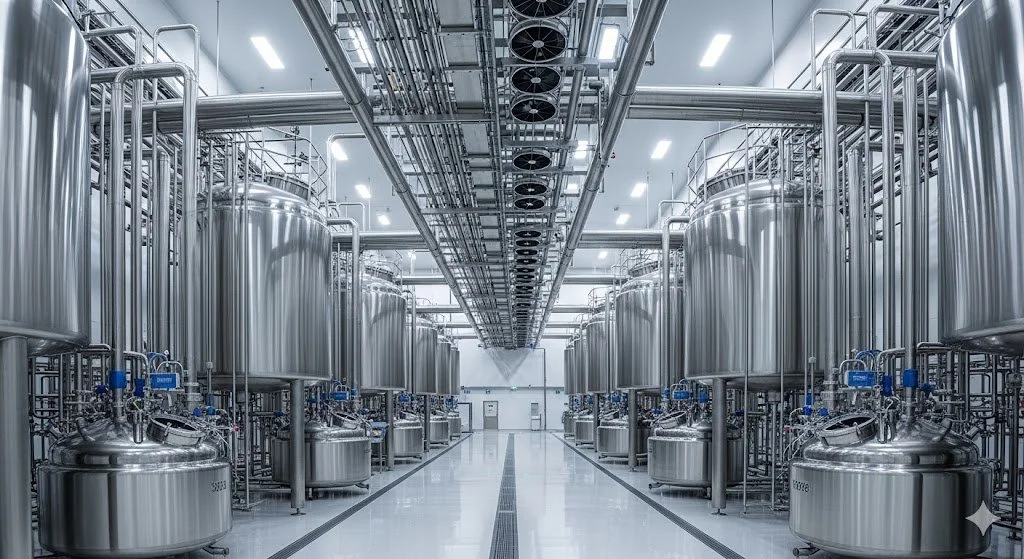
High bay lab design is essential for accommodating the towering vertical clearance and intense overhead utility demands of 500L+ stainless steel bioreactors. | Credit: Gemini (2026)
When the Beaker Becomes a Tank
Designing high-bay spaces for pilot-scale fermentation completely rewrites the rules of laboratory architecture. In traditional bench-scale research, biological processes occur in small, easily manipulated vessels. However, transitioning a successful monoclonal antibody or cellular therapy into production requires scaling up those same processes into towering 500-liter or 2,000-liter stainless steel vessels.
This leap in scale exposes the severe limitations of standard commercial real estate. Dropping a massive, multistory tank into a conventional room is structurally impossible. To solve this, architects must integrate specialized high bay lab design into their blueprints, ensuring enough vertical clearance not only for the tanks themselves, but for the complex network of bioreactor utilities required to keep them operational. As detailed in our guide on pilot plant design: bridging the gap between R&D and manufacturing, this awkward middle phase of development demands an architecture that marries industrial load capacities with clinical precision.
The success of a fermentation suite relies entirely on the heavy infrastructure hidden in the ceiling above. By utilizing flexible utility drops to power skid-mounted equipment, facility managers can create highly adaptable, cavernous spaces that are perfectly equipped to handle the extreme thermal, physical, and pneumatic demands of continuous large-scale bioprocessing.
Key Takeaways
High Bay Lab Design: Eliminating standard drop ceilings in favor of 18- to 24-foot clear heights to accommodate tall bioreactor vessels, overhead hoists, and complex HVAC ducting.
Bioreactor Utilities: Supplying massive volumes of process chilled water, clean steam, compressed air, and specialty gases directly to the point of use to maintain precise biological environments.
Skid-Mounted Equipment: Utilizing mobile, pre-piped stainless steel processing units that can be rapidly reconfigured or swapped out as manufacturing demands shift.
Utility Drops: Deploying reinforced ceiling service panels equipped with heavy-duty quick-disconnects to provide flexible, top-down power and fluids to the processing floor.
Why High Bay Lab Design Is Mandatory for Pilot-Scale Fermentation
A 500-liter bioreactor is not just a wide tank; it is a towering vertical cylinder designed to optimize the hydrostatic pressure and gas transfer rates necessary for cell culture growth. When you add the agitation motors mounted on top of the vessel, the structure easily breaches standard ceiling limits. A high bay lab design is an absolute necessity to physically house this equipment.
However, the clearance requirement extends far beyond the top of the motor. Facility planners must engineer significant headspace above the tallest equipment to allow for maintenance access. Technicians frequently need to use overhead gantry cranes or specialized hoists to lift heavy agitator shafts, remove heavy steel lids, or load large bags of dry media powder into the top ports of the tank.
If a facility attempts to squeeze a pilot-scale fermentation suite into a space with 10-foot ceilings, the operation becomes instantly paralyzed. Routine maintenance tasks become impossible, and the room rapidly overheats due to the lack of convective volume. A minimum clear height of 18 to 24 feet is the standard architectural baseline for these specialized scale-up environments.
Mastering Bioreactor Utilities and Thermal Management
The metabolism of a 500L+ cell culture generates a substantial amount of exothermic heat. If left unchecked, temperatures can quickly exceed lethal thresholds for the cell culture — typically above approximately 40°C — causing irreversible damage to the biological process. Consequently, bioreactor utilities are defined by extreme thermal management requirements. Standard ambient air conditioning is entirely insufficient for this scale; the heat must be actively pulled out of the vessel using heavy-duty liquid cooling.
Architects and mechanical engineers must design robust process chilled water (PCW) loops that circulate directly through the specialized cooling jackets wrapped around the stainless steel tanks. This requires pulling massive, insulated piping from central facility chillers down into the high-bay space. For broader guidance on how these biological lab design considerations shape mechanical infrastructure decisions, the principles of airflow, containment, and thermal management apply across all scales.
Conversely, before a fermentation run begins, the entire empty tank and all associated piping must be absolutely sterile. This is accomplished through Sterilize-in-Place (SIP) — a process distinct from Clean-in-Place (CIP), which uses detergent solutions and hot water rinses to remove product residues. SIP specifically injects clean steam (steam generated from highly purified RO/DI water in 316L stainless steel generators, free of boiler chemicals) at temperatures of 121°C or higher directly into the system. The sudden thermal expansion of the steel during this process requires structural supports and piping anchors designed to flex and absorb mechanical stress without fracturing.
The Flexibility of Skid-Mounted Equipment and Overhead Utility Drops
In the fast-paced world of biomanufacturing, process requirements change rapidly. Hard-plumbing a bioreactor directly into the floor and walls creates a rigid "monument" that cannot be easily adapted for a new product line. To combat this, modern facility design relies heavily on skid-mounted equipment. This need for adaptability is especially acute in cell and gene therapy facilities, where processes evolve rapidly and the ability to reconfigure production suites quickly is a competitive advantage.
A "skid" is a self-contained processing unit — including the tank, pumps, sensors, and local control panels — all mounted onto a single, movable stainless steel frame. To maximize the utility of these mobile skids, architects design the facility with overhead utility drops. Instead of routing pipes through the walls, heavy-duty service matrices are suspended from the high-bay ceiling.
These utility drops feature sanitary quick-disconnect fittings for chilled water, clean steam, compressed oxygen, and three-phase electrical power. When a process engineer needs to reconfigure the room, they simply disconnect the umbilical hoses, roll the skid to a new location, and plug it back into a different overhead drop. This top-down infrastructure keeps the floor entirely clear of tripping hazards and enables rapid facility changeovers without requiring destructive demolition.
Comparing Scale-Up Stages: Benchtop Bioreactors vs. 500L+ Tanks
Spatial Requirements: Benchtop models fit under standard cabinets on 36-inch-high tables. 500L+ tanks require high bay lab design with 18- to 24-foot clear ceilings and reinforced concrete slabs.
Utility Delivery: Small-scale systems plug into standard 120V wall outlets and use small compressed gas cylinders. Large-scale tanks rely on complex overhead utility drops for high-voltage three-phase power and hard-piped facility gases.
Thermal Management: Benchtop models use localized Peltier coolers or small heated blankets. Industrial tanks require massive, building-level clean steam generators and process chilled water loops.
Sterilization Logistics: Small glass vessels are detached and carried to a central autoclave. Massive steel tanks are permanently fixed and require automated, in-line Sterilize-in-Place (SIP) utility configurations.
Expert FAQ: Bioreactor Facility Design
Q: Does a high-bay bioreactor facility need a specialized floor?
A: Absolutely. A fully loaded 500-liter tank can weigh thousands of pounds. The concrete slab must be heavily reinforced to accommodate the dynamic and static loads of large-scale processing equipment. Furthermore, the floor must be coated with a highly chemical-resistant, seamless finish and sloped toward high-capacity stainless steel trench drains to handle the massive liquid volume of daily wash-down cycles. For guidance on finish selection in controlled environments, see our overview of selecting appropriate flooring based on lab usage and scope. A structural engineer should assess actual live and dynamic load requirements on a per-project basis.
Q: How do we handle the exhaust from a massive bioreactor?
A: Fermentation processes release significant volumes of off-gas, primarily carbon dioxide and potentially hazardous volatile organics or bio-aerosols. The facility's HVAC system must include dedicated, hard-ducted exhaust lines that connect directly to the bioreactor's vent filters, pulling the off-gas through secondary HEPA filtration or thermal oxidizers before safely discharging it to the building exterior.
Q: Why use clean steam instead of regular plant steam for sterilization?
A: Regular "plant steam" is generated in boilers that use anti-scaling chemicals and corrosion inhibitors. If this steam contacts the inside of a bioreactor, those chemicals will contaminate the tank and destroy the biological cell culture. "Clean steam" is generated using 316L stainless steel generators and highly purified RO/DI water, ensuring nothing but pure H₂O contacts the sterile product-contact surfaces.
Q: When does a fermentation facility need to meet cGMP standards?
A: Once a facility transitions from process development to producing materials for human clinical trials, it must operate under cGMP. This triggers a cascade of architectural requirements — from cleanroom classifications and unidirectional personnel flow to rigorous documentation and environmental monitoring. For a detailed look at how those compliance demands shape facility layout and construction, see our article on overcoming the obstacles to locating a cGMP facility.
References
International Society for Pharmaceutical Engineering (ISPE). Baseline Guide Vol. 6: Biopharmaceutical Manufacturing Facilities. 3rd ed., ISPE, 2023.
National Institutes of Health (NIH). Design Requirements Manual (DRM). Office of Research Facilities, 2020.
American Society of Heating, Refrigerating and Air-Conditioning Engineers (ASHRAE). Laboratory Design Guide: Planning and Operation of Laboratory HVAC Systems. 2nd ed., ASHRAE, 2015.
Odum, J.N. Sterile Product Facility Design and Project Management. 2nd ed., CRC Press, 2004.
