
Embodied Carbon in Lab Builds: Concrete, Steel & Mass Timber
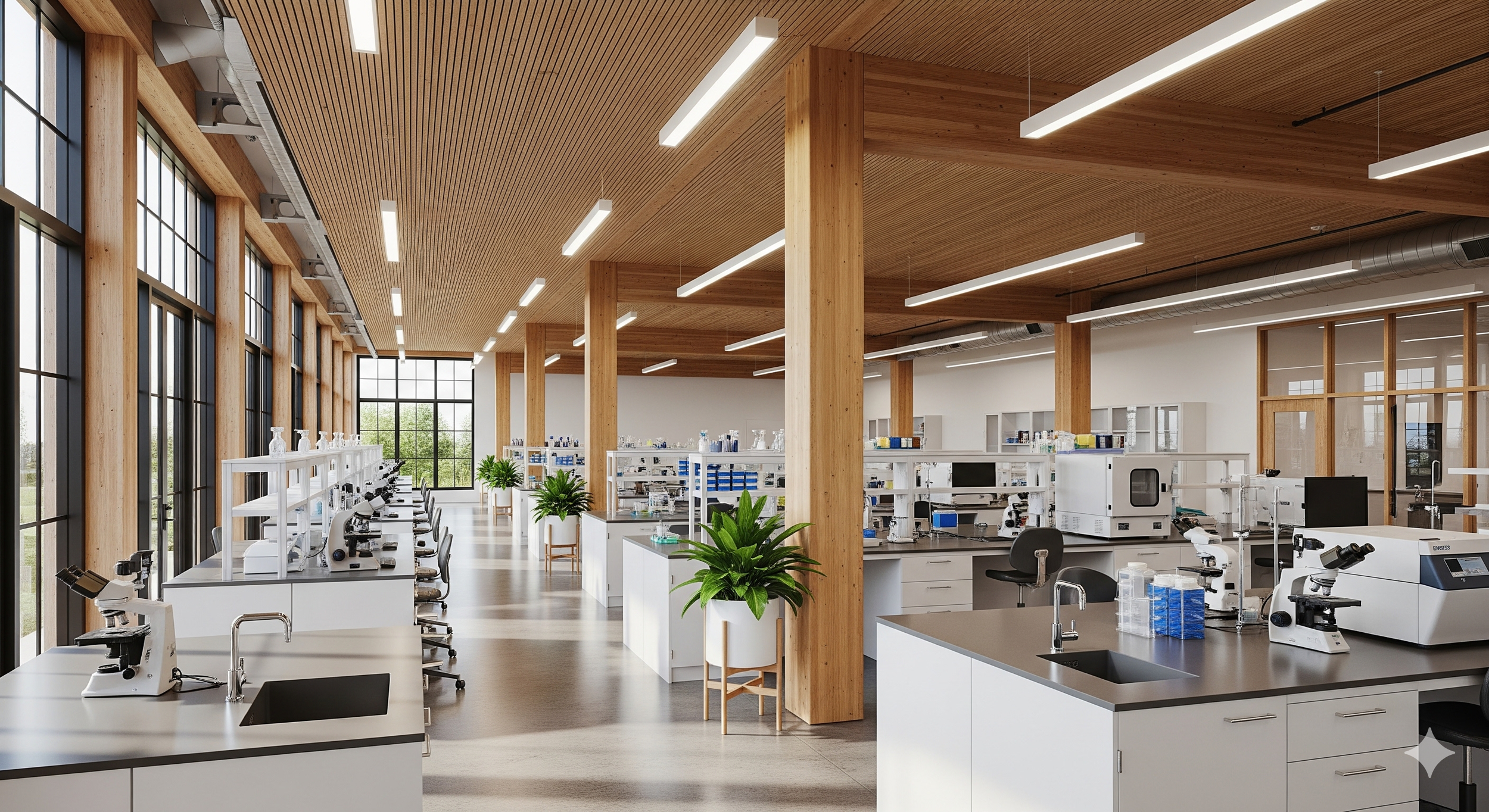
The structure is 50% of your carbon. Why Mass Timber is becoming the structural material of choice for biotech.
Credit: Gemini (2026)
Introduction: The concrete reality
For decades, the sustainability conversation in the life sciences focused almost exclusively on operational carbon—the energy required to run the lights, fans, and freezers. While achieving net-zero lab design remains critical, as grids green and HVAC systems become more efficient, the spotlight is shifting to the building itself.
Embodied carbon materials—the greenhouse gases emitted during the extraction, manufacturing, and transportation of building materials—account for roughly 11 percent of global carbon emissions. In a heavy, vibration-sensitive laboratory building, the structure alone can represent over 50 percent of the facility's total carbon footprint before the doors even open. For the lab architect and structural engineer, reducing this footprint requires a radical rethink of the traditional concrete-and-steel default.
The mass timber revolution
The most significant shift in sustainable lab construction is the rise of mass timber lab design. Cross-Laminated Timber (CLT) and Glulam beams offer a structural alternative that sequesters carbon rather than emitting it.
Vibration Control: Historically, timber was considered too "bouncy" for sensitive microscopy. However, modern mass timber systems, often paired with a thin concrete topping slab, can achieve the stringent vibration criteria (VC-A or VC-B) required for most research applications.
Aesthetics as an Asset: In the competitive biotech market, the warm, exposed wood aesthetic of a mass timber building is a powerful recruitment tool, distinguishing a facility from the sterile, clinical look of traditional labs.
Speed: Timber components are prefabricated off-site, allowing for rapid assembly that can shave weeks off the construction schedule.
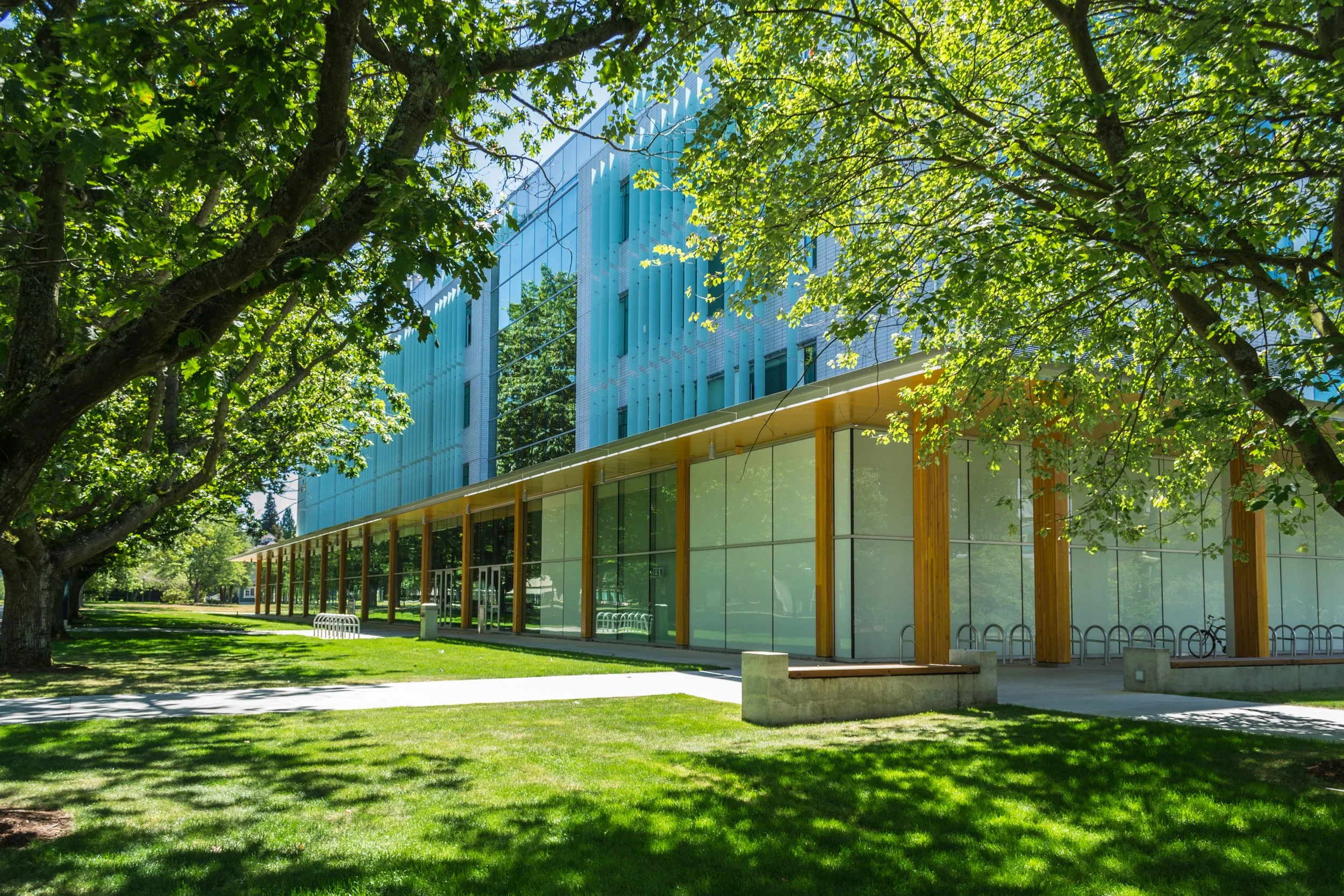
Real-world snapshot: UBC Earth Sciences Building
A pioneering example of this shift is the University of British Columbia (UBC) Earth Sciences Building. This five-story facility utilizes a hybrid system of Cross-Laminated Timber (CLT) floor plates and glulam columns. By choosing timber over concrete for the heavy structure, the project sequestered over 1,000 tonnes of CO2—equivalent to taking 400 cars off the road for a year. The facility successfully houses complex research labs, proving that wood structures can meet the rigorous fire, vibration, and acoustic standards of modern science.
Credit: Wikimedia Commons
Low-carbon concrete: changing the mix
Concrete is the backbone of lab construction, providing the stiffness and fire resistance required for high-hazard occupancies. It is also one of the most carbon-intensive materials on earth due to the production of Portland cement.
Engineers are now specifying low-carbon concrete mixes to mitigate this impact without sacrificing performance.
SCMs (Supplementary Cementitious Materials): Replacing 30 to 50 percent of cement with industrial byproducts like fly ash (from coal plants) or slag (from steel manufacturing).
Carbon Injection: Technologies that inject CO2 into the wet concrete mix, where it mineralizes and becomes permanently trapped, simultaneously strengthening the concrete.
Steel: the recycled backbone
Where steel is unavoidable—such as in long-span framing or vibration-critical zones—sourcing matters.
Electric Arc Furnace (EAF): Steel produced in EAF mills using renewable electricity and high recycled content has a significantly lower carbon intensity than steel from traditional coal-fired blast furnaces.
Optimization: Structural engineers are using generative design software to "right-size" beams, shaving tons of steel tonnage out of the design by placing material only where it is structurally necessary.
The role of life cycle assessment (LCA)
To make informed decisions, design teams are utilizing Life Cycle Assessment (LCA) tools early in the schematic design phase. These models allow the lab planner to compare the carbon impact of a steel bay versus a timber bay in real-time.
By quantifying the Global Warming Potential (GWP) of different structural systems, teams can make data-driven decisions that balance cost, constructability, and carbon.
Conclusion: building for the century
A laboratory built today will likely stand for fifty years or more. If it is built with high-carbon concrete and virgin steel, that carbon debt is locked in forever. By embracing mass timber lab design and low-carbon alternatives, architects can deliver facilities that support the future of science while respecting the future of the climate.
Frequently asked questions (FAQ)
Is mass timber fire safe for labs?
Yes. Mass timber chars rather than melts. Large timber members maintain their structural integrity during a fire longer than unprotected steel. When combined with sprinkler systems, they meet strict fire codes for laboratory occupancies.
Does low-carbon concrete cure slower?
High-volume fly ash mixes can have slower early-strength gain, which might affect the construction schedule (e.g., when forms can be stripped). However, with additives and careful scheduling, this can be managed effectively by the contractor.
Can you use mass timber for wet labs?
Absolutely. The timber structure is typically kept separate from the wet bench environment. The floor slab (often a concrete topping on timber) is sealed with epoxy or high-performance sheet vinyl to create a chemical-resistant, waterproof barrier, protecting the wood structure below.
