Florida’s Semiconductor Growth Accelerates with NeoCity’s Multi-Use Lab
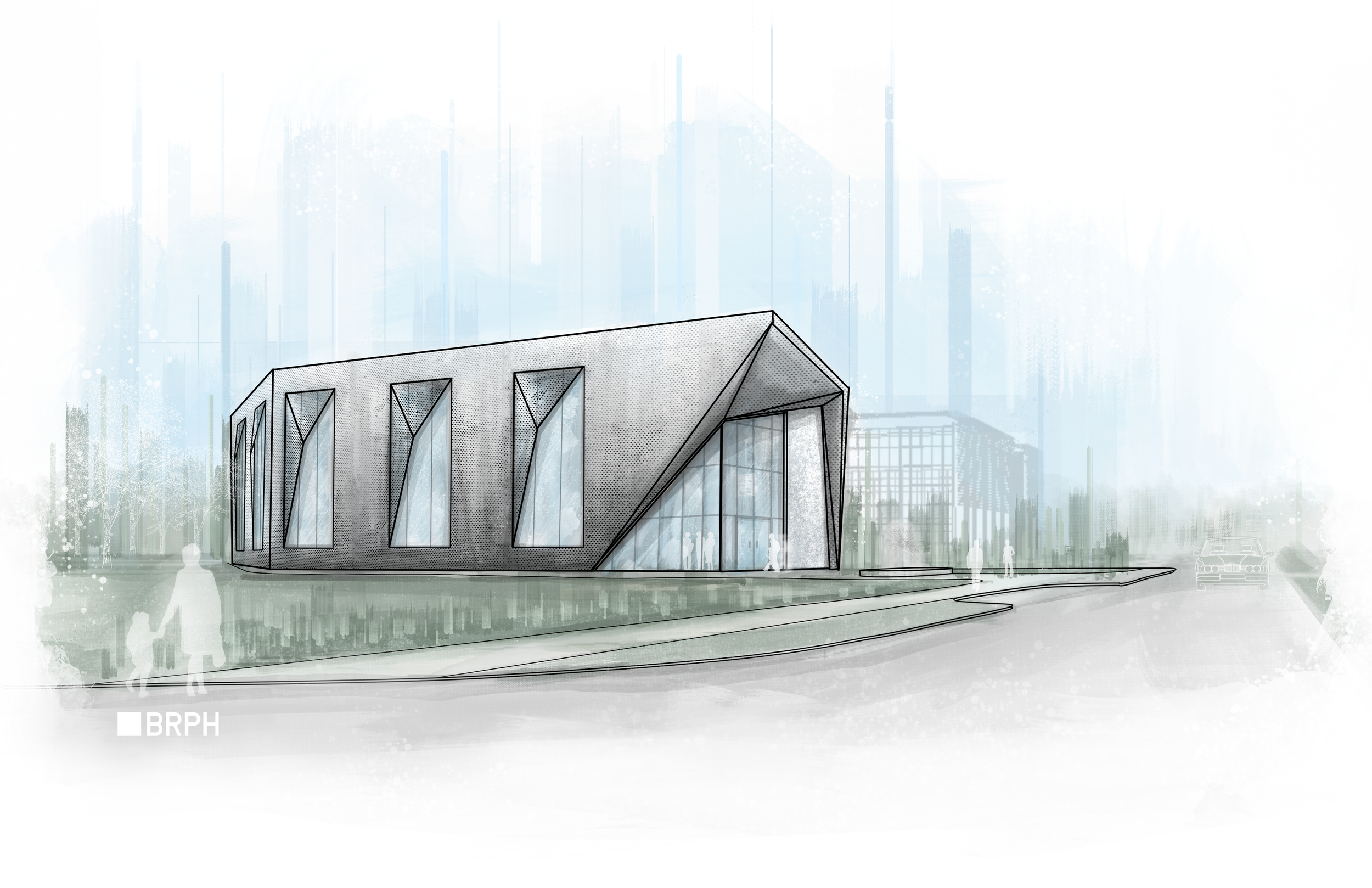
A rendering of the 30,000-sf Multi-Use Lab Building at NeoCity in Kissimmee, FL—funded by a $17.5M state grant and designed to attract research and manufacturing partners while supporting Florida’s growing semiconductor sector. Image: Courtesy of BRPH
When Osceola County in Florida began planning its next major project at NeoCity—a 500-acre master-planned technology district in Kissimmee—it set out to create something that would serve both the region’s semiconductor ambitions and its long-term economic goals. The result is the upcoming Multi-Use Lab Building, a 30,000-sf facility designed to attract research and manufacturing partners while remaining adaptable to future tenants whose names and needs are still unknown.
Funded primarily through a $17.5 million Florida Job Growth Grant, the project marks the state’s largest single award through that program and underscores Florida’s expanding role in semiconductor innovation. Construction is expected to begin in mid-2026 and finish by the end of 2027.
Designing for unknown users
Unlike many laboratory projects built for a single company or institution, this facility was conceived as a multi-tenant space. That presented an immediate challenge: how do you design a lab for users who haven’t been identified yet?
“We started with really sort of a blank slate,” says Conrad Ballance, facilities management director for Osceola County. “We collected a lot of information about what this lab should be—it should be scalable, flexible. It should have a lot of capability that basically could facilitate any number of functions that potential tenants could want.”
Flexibility became the foundation of the design. Matthew Flores, AIA, chief design and creative leader at BRPH, explains that his team approached the project with “adaptability and flexibility as our number one design driver,” supported by other lenses such as sustainability, operational efficiency, and safety. “This project is a little bit unique in that we didn’t have an end user,” Flores notes. “As we’ve gone on, we’ve interviewed people from the county and also some potential users of the space to help inform the design.”
That early collaboration among the design team, county officials, and potential tenants has defined the project’s framework. Assistant county manager Amanda Clavijo, who oversees NeoCity’s development strategy, is part of the team that applied for the grant and collaborates with the rest of the project team to fulfill the vision of developing a multi-tenant lab on the NeoCity site.
The county began marketing the lab before construction to help shape its direction. “We’ve been marketing the lab to attract tenants early on to help inform the design,” Clavijo says. “We do a lot of outreach, a lot of talks, a lot of one-on-one meetings with potential interested parties.”
Clavijo notes that the county has already secured initial tenants but remains open to attracting additional collaborators. “Your early partners and site partners will definitely get the opportunity to be part of how the site grows,” she says, adding that those who lease space in the facility will help shape not only the Multi-Use Lab Building itself, but future developments across the NeoCity campus.
Infrastructure built for change
Designing for unknown users meant the building needed to accommodate a wide range of potential research activities—particularly those specific to semiconductor R&D. To achieve that, BRPH and the county developed an infrastructure strategy that anticipates needs before tenants arrive.
Flores describes the concept as a “plug-and-play” lab, with modular bays and standardized utilities that allow users to easily adapt their space. “Our approach really starts with modularity and understanding the standardized lab bay and then creating labs that can flex—they can grow or contract as needed,” he says. Demountable wall systems, 20-foot floor-to-floor heights, and modular connection points for power, gases, and ventilation will enable fast customization.
Ballance emphasizes that infrastructure decisions made during construction will pay off later. “The whole idea is put the ventilation in now during construction, and if a tenant needs it, we can leverage that capability,” he says. “It’s about putting the infrastructure in that would enable the tenants to much more easily, and probably at a lower cost, tailor their space to whatever their needs are.”
Semiconductor labs bring unique physical challenges. The team planned for cryogenic equipment, compressed gases, and vibration-sensitive tools, all of which require special treatment. “We’re going to have cryogenics in the individual labs—for example, cryostats require compressed helium, which generates a lot of noise and vibration,” Ballance says. “We have to design features into the building that would accommodate those types of activities that you wouldn’t necessarily find in a normal chemistry lab.”
Flores adds that acoustic and environmental controls were integrated early. “When we were looking specifically at the cryo lab and storage for that, we’re going to position that in a place where the noise would be less intrusive,” he says. The design includes thicker sound-rated walls and rooftop screening for vent stacks and mechanical systems.
A magnet for innovation
The Multi-Use Lab Building will be NeoCity’s fifth structure and a central piece in the district’s strategy to become a hub for high-tech collaboration. “NeoCity is a master-planned district,” Clavijo says. “We have design guidelines all to ensure that we honor the vision of the site—to be high-tech, to be modern, to be attractive to the industry.”
The county established a design review board, made up of staff and external design professionals, to uphold that vision and ensure projects move efficiently through review and permitting. The Multi-Use Building is designed not only to draw additional interest to the site but also to spark a desire for tenants to remain long-term.
“We are very protective of the vision,” Clavijo says. “Since we’re still early on in the development of the district, it is a big investment for us.”
Flores noted that NeoCity’s blank-slate condition offers both opportunity and responsibility. “When you do have such a blank slate to work with, it’s almost daunting,” he says. The design review board, he notes, is helpful to ensure “that we’re making the right choices every step of the way.”
Beyond the technical aspects, BRPH is focused on placemaking. “As much as this is about technology and advancement and growth, it’s also a project that’s very much about place-making and understanding how people are going to experience the space,” Flores says. “Innovation and technology doesn’t mean that we forego the human experience.”
The result will be a facility that balances high-tech capability with visual appeal. The design draws inspiration from the materiality of the microchip wafer, featuring a dynamic double-skin façade of perforated metal that “filters light into the space during the day and glows as a beacon of technology and innovation” at night, according to Flores.
Navigating the public-sector partnership
Because the project is almost entirely state-funded, coordination with the Florida Department of Commerce adds an additional layer of requirements—but also strong support. “The State is a great partner and super easy for us to work with, but it does add just a little bit of steps in our reporting requirements,” Clavijo says. “As long as you’re mindful that it is predominantly a grant-funded project, and honor those requirements through the process, we’re able to really navigate through that pretty well.”
To streamline oversight, Clavijo and Ballance meet weekly to align grant and construction milestones so that nothing is missed or miscommunicated. “We intentionally collaborate across departments,” she says. “We’ve got this cross-functional team that, in real time, is supporting the project. I think that has helped us be smooth in the way that we coordinate and work together.”
Ballance agrees: “Within the project team, our process is to comply with the terms of the grant. So for us, it’s pretty seamless.” His team, Ballance notes, is tasked with preparing and submitting reports so the grant agency can monitor our progress.”
That communication extends beyond the county and BRPH. The team brought Austin Commercial onboard as construction partner early in design. “They’ve been on every meeting, every step of the way, providing cost feedback and making sure we’re staying in line with our goals,” Flores says.
Ballance adds, “That was extraordinarily important—to bring them on when the design started. They provide cost feedback on everything from building construction to site circulation and stormwater, and we determine what fits within the budget.”
Anchoring Florida’s semiconductor growth
NeoCity’s Multi-Use Lab Building is not just another research facility—it’s part of a larger statewide strategy to strengthen domestic chip production and advanced packaging. “NeoCity is specifically focused on advanced packaging in the semiconductor space,” Clavijo says. The county’s partners include SkyWater Technology, which operates the Center for Neovation fabrication facility, as well as iMEC, the Florida Semiconductor Institute, and the Florida Semiconductor Engine, a National Science Foundation–funded consortium headquartered at NeoCity.
“This lab is a piece of the puzzle of onshoring advanced packaging and building that semiconductor ecosystem for the state of Florida,” Clavijo says. “It’s a key piece because it will help smaller businesses, startups, or universities that want to be part of the ecosystem.”
Ballance points out that the project fills a market gap: “This is a resource that is not really readily available in the marketplace, in terms of this type of square footage,” he says. “Typically, you’d have to build all of the infrastructure yourself. Here, we can provide a small lab for a small company or several thousand square feet for a larger one. That flexibility is an attraction.”
Flores adds that the building’s central location within NeoCity makes it “a hub of innovation… with the buildings as the spokes.” He notes that Central Florida’s legacy in aerospace and technology “makes all the sense in the world to be developed, and the fact that they have the space to do it and to do it the right way really sets them up for success.”
Lessons learned so far
The project team acknowledges that designing without precedent brought valuable lessons. “We didn’t have a recipe for this,” Ballance says. “We spent a lot of time talking to a lot of people,” he says. “Almost anybody in the business that walked through the door, we asked questions about what they might want to see in the lab.” That outreach helped ensure the building would remain relevant for decades. “We wanted to be guarded against building a building that would be obsolete in 10 or 15 years,” he says.
Clavijo offers another takeaway: “We started off too small. We had anticipated a 10,000-square-foot lab, and the more we talked about it, the more we realized we should see how we can expand upon it.” With support from BRPH and the county commission, the design grew into a two-story, 30,000-square-foot structure—initially building out only the first floor but preparing the second for future use.
Flores summarizes the team’s shared goal: to create a facility that both inspires and performs. “We want people to come in to work and feel proud of where they’re coming,” he says. “It’s a dynamic facility that glows as a beacon of technology and innovation.”