
Webinar Preview: How to Build a Cleanroom
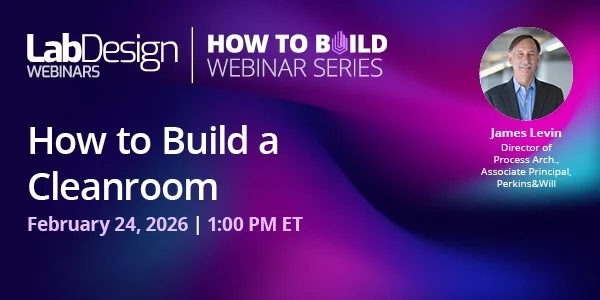
Tune in on February 24 at 1:00 pm ET, or anytime afterward via on demand viewing.
As cleanrooms become more integral to advanced manufacturing, biotechnology, and high-precision research, the expectations placed on these controlled environments continue to grow. Today’s facilities must do more than meet strict contamination standards—they must also remain flexible enough to support evolving processes, new technologies, and shifting regulatory requirements.
On Tuesday, February 24, 2026, at 1:00 pm ET, Lab Design will host a free webinar, How to Build a Cleanroom, offering a comprehensive look at what it takes to design, construct, and optimize a cleanroom for long-term performance. The webinar will be available on demand afterward for viewing at any time.
Led by Jim Levin, director of process architecture and associate principal at Perkins&Will, this session will walk attendees through the full lifecycle of a cleanroom facility—from early planning conversations to post-occupancy evaluation.
For lab planners, architects, engineers, facilities managers, and end users, the webinar will provide practical guidance on how to future-proof cleanroom investments. As automation, modular workstations, and advanced monitoring systems become more common, infrastructure demands are increasing. Airflow and filtration systems must be carefully engineered to maintain environmental control. Electrical and mechanical capacities must accommodate expanding equipment loads. Equipment placement and data integration strategies must be thoughtfully coordinated to support both performance and compliance.
This session will begin at the earliest project stages, outlining the critical questions to ask during kickoff meetings and feasibility discussions. Attendees will learn how to define process requirements, establish cleanliness classifications, and anticipate future expansion or reconfiguration needs. The webinar will also explore how to align stakeholders—from lab users and facilities teams to external consultants and vendors—to ensure that operational goals, safety standards, and budget realities are fully integrated into the project strategy.
Register now to watch live on February 24, or to watch on demand anytime afterward.
Beyond initial design, the discussion will cover construction sequencing, commissioning best practices, and the importance of validating performance before occupancy. Cleanrooms are highly sensitive environments where even small oversights can compromise safety or productivity. Understanding when and how to engage vendors, test systems, and document compliance can significantly reduce risk and avoid costly rework.
Importantly, the webinar will not stop at project completion. Post-occupancy evaluation and ongoing optimization are essential to maintaining long-term value. Participants will gain insight into monitoring strategies that track airflow performance, environmental conditions, and ergonomic considerations. The session will highlight how continuous evaluation supports occupant health, safety, and welfare while enabling facilities to adapt as processes evolve.
By attending this webinar, participants will:
Understand key design strategies for adaptable cleanrooms that support evolving processes while maintaining compliance with health, safety, and welfare standards.
Identify infrastructure considerations—including airflow, filtration, electrical, and mechanical systems—that enable safe, controlled environments amid changing technologies and workflows.
Learn best practices for aligning stakeholders and vendors to promote operational efficiency and long-term performance.
Explore post-occupancy evaluation techniques that enhance safety, ergonomics, and ongoing optimization.
This course is approved by AIA CES for 1 LU/HSW credit, reinforcing its focus on safety, compliance, and the well-being of occupants.
For organizations planning a new cleanroom, renovating an existing space, or seeking to make their facilities more adaptable, this webinar offers actionable strategies to help ensure that today’s investment remains resilient for tomorrow’s demands. Register now!