
Digital Twin Integration: Visualizing Operations in Real-Time
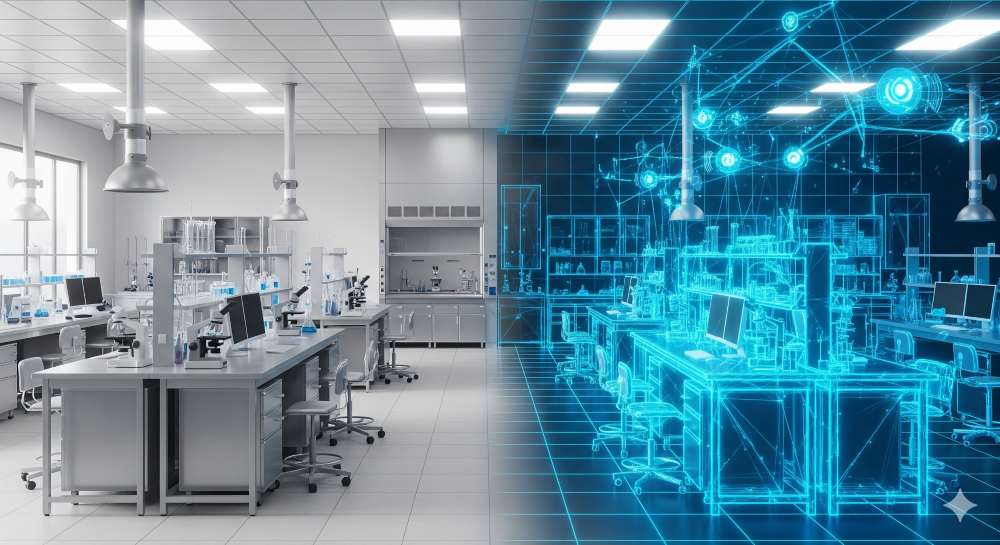
You can't optimize what you can't see. Why the most important asset in your new lab is its digital replica.
Credit: Gemini (2026)
Introduction: The data-driven facility
Modern laboratories are the most complex commercial buildings on the planet. They are living machines composed of intricate ventilation networks, specialized piped gases, and highly sensitive environmental controls. Yet, despite this complexity, many facility managers still rely on static 2D floor plans and reactive maintenance logs to keep the science running.
Just as researchers have shifted from physical experimentation to computational modeling—a transition we detailed in our analysis of dry lab design trends—facility operators are now undergoing their own digital revolution. The vehicle for this transformation is the lab digital twin: a dynamic, real-time virtual replica of the physical laboratory. By linking the building's mechanical sensors directly to a 3D model, operators gain unprecedented visibility into the health, efficiency, and utilization of the facility.
Beyond construction: BIM facilities management
During the design and construction phase, lab architects use Building Information Modeling (BIM) to coordinate pipes, ducts, and structure in 3D, preventing physical clashes before concrete is poured. However, historically, once the building was handed over to the owner, this incredibly data-rich BIM model was archived and forgotten.
The foundation of a lab digital twin is reclaiming this data for operations. This practice, known as BIM facilities management (or 7D BIM), involves handing over an "as-built" model linked directly to the Computerized Maintenance Management System (CMMS).
The Benefit: When a fume hood exhausts an error code, the facility manager doesn't just receive a text alert; they open the digital twin to see the exact 3D location of the hood, the specific VAV box controlling it in the ceiling plenum, and the digital maintenance manual—all before ever stepping foot in the lab or donning PPE.
Asset tracking and space utilization
A life science facility is in a constant state of flux. Equipment is shared, moved, and sometimes hoarded. In a traditional facility, locating a shared piece of mobile equipment—like a specialized centrifuge or a mass spectrometer—requires walking the halls.
By integrating Real-Time Location Systems (RTLS) via RFID or Bluetooth tags into the digital twin, operators enable seamless asset tracking.
Operational Efficiency: Researchers can query the digital twin to instantly locate shared equipment on the floor plan, eliminating wasted time.
Space Optimization: The twin can track utilization rates. If the data shows a specific tissue culture suite is only occupied 15 percent of the week, lab planners can reallocate that high-value real estate rather than unnecessarily expanding the building.
Predictive maintenance: saving the science
In a laboratory, equipment failure is not just an inconvenience; it can destroy years of research. A catastrophic failure of a -80°C ultra-low temperature (ULT) freezer or an unexpected shutdown of an exhaust fan can ruin irreplaceable biological samples.
The highest ROI of a lab digital twin is realized through predictive maintenance. By layering Internet of Things (IoT) sensors over the physical equipment and feeding that telemetry into the digital model, AI algorithms can identify anomalies before a breakdown occurs.
Reactive vs. Predictive: Instead of waiting for a freezer's temperature alarm to trigger (reactive), the digital twin monitors the freezer's compressor vibration and power draw. If it detects the compressor working 10 percent harder than its historical baseline, it flags the unit in the 3D model and automatically generates a work order for a technician to inspect the coil (predictive).
The Result: Maintenance is scheduled during planned downtime, preventing catastrophic losses and ensuring continuous scientific operations.
Conclusion: the living model
The physical laboratory is only half of the modern infrastructure equation. To maximize energy efficiency, protect high-value science, and optimize expensive square footage, building owners must invest in the digital envelope as heavily as the physical one. By adopting lab digital twin technology, facilities shift from a reactive posture to a proactive strategy. It transforms the building from a static container into a dynamic, intelligent partner in the scientific process.
Frequently asked questions (FAQ)
What is the difference between a BMS and a Digital Twin?
A Building Management System (BMS) controls and monitors the building's mechanical systems, typically outputting data in spreadsheets or 2D dashboards. A Digital Twin consumes the BMS data and contextualizes it within a 3D spatial model of the facility, often adding predictive analytics and asset tracking layers that a BMS cannot support.
Is it too late to create a digital twin for an older, existing lab?
No. While it is easiest to transition a construction BIM model into a twin, older facilities can be retrofitted. This is done by 3D-laser scanning the existing space to create a "point cloud" geometry, which is then converted into a functional 3D model and linked to newly installed IoT sensors.
How does a digital twin improve safety?
In an emergency, such as a chemical spill or fire, first responders and facility managers can use the digital twin to instantly visualize the location of hazardous materials, identify the status of ventilation zones, and map the safest evacuation routes in real-time.
