
Editor’s Note: Early-stage decision-making in life science facility design heavily dictates a building's long-term environmental footprint and operational expenditure. This analysis of Genesis AEC's proprietary modeling tool underscores a growing industry shift toward predictive engineering, allowing facility managers and planners to simulate utility demands and carbon emissions before breaking ground.

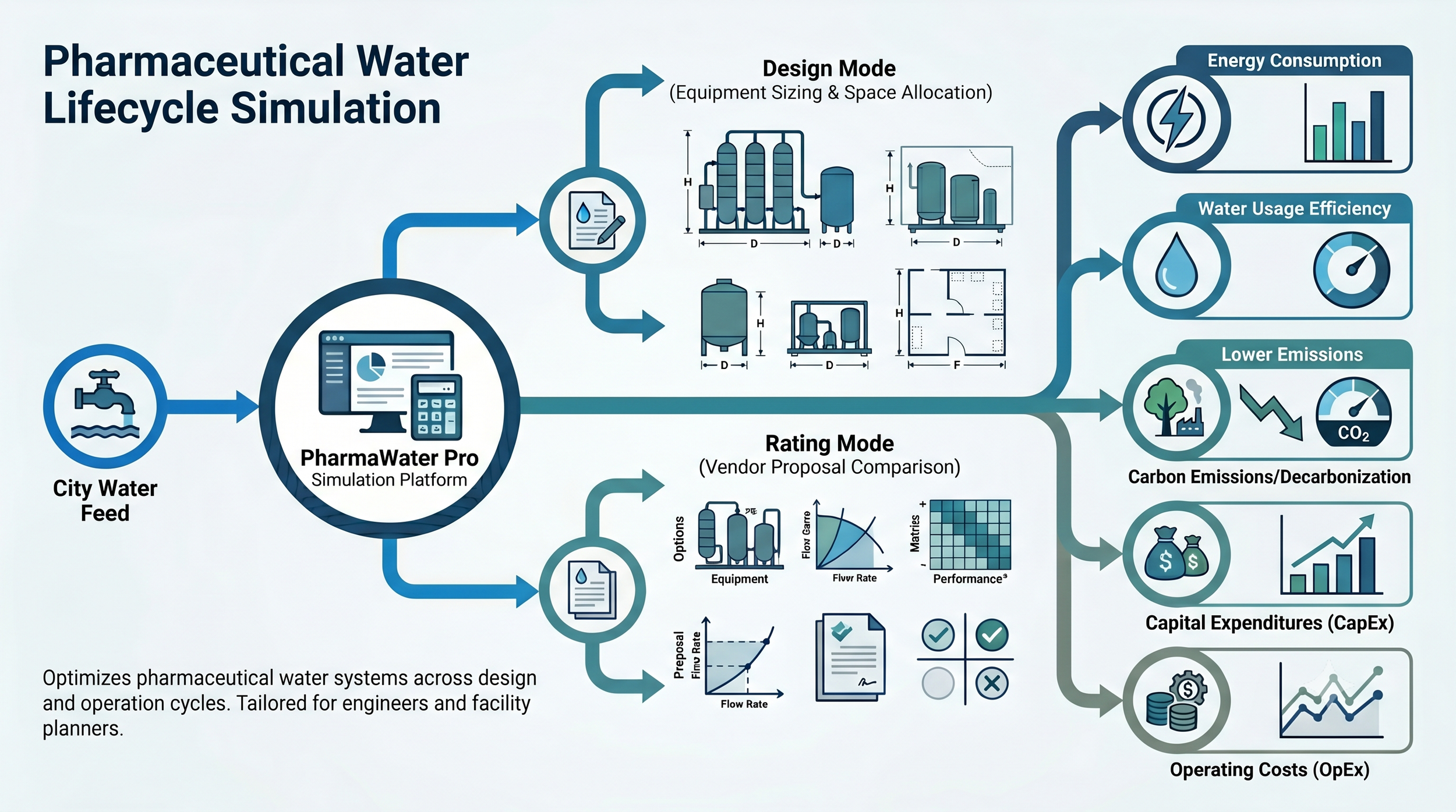
Genesis AEC’s PharmaWater Pro platform models pharmaceutical water systems from city water feed through purification, storage, and distribution, helping teams evaluate lifecycle performance before capital investments are made. Image: Courtesy of Genesis AEC
As life science organizations accelerate their corporate sustainability initiatives, early-stage engineering decisions are coming under intense scrutiny. Pharmaceutical and biotechnology production facilities rely on highly engineered, energy-intensive utilities to produce purified water (PW), water for injection (WFI), and pure steam. To optimize these high-stakes capital investments before infrastructure layout begins, consulting engineering firm Genesis AEC is highlighting its proprietary PharmaWater Pro modeling capability to simulate and evaluate lifecycle variables during conceptual design.
Balancing sustainability and high-purity compliance
High-purity water systems represent one of the most resource-intensive utilities within a life science facility, consuming significant volumes of incoming municipal water and demanding continuous energy for heating, cooling, and circulation. Choosing between competing purification technologies—such as multi-effect distillation stills, vapor compression systems, or membrane-based processes like reverse osmosis—fundamentally alters a facility’s long-term environmental and financial baseline. Each methodology carries distinct operational profiles regarding electrical consumption, steam demand, wastewater rejection rates, and preventative maintenance schedules.
Compounding this complexity is the systemic interdependence of fluid purification components. Altering a single technological variable near the point of generation triggers cascading performance shifts across the entire downstream distribution network.
“You can't just compare three technologies, because they sit in the middle of string of other unit operations that range from water softeners all the way to storage and distribution of the product water, and which technology you pick influences those other unit operations,” says Stephen Hall, PE, chief process engineer at Genesis AEC. “The platform incorporates all of the operations.”
By establishing these technology baselines during master planning, architecture and engineering teams can align system architectures with corporate decarbonization goals. These metrics are increasingly critical as organizations map facilities to international standards like ISO 14001 environmental management protocols and green building certifications.
Predictive modeling in the conceptual phase
The engineering platform addresses a chronic vulnerability in the capital project lifecycle: the necessity of locking in critical utility selections when macro-level project data is scarce. PharmaWater Pro evaluates the complete fluid infrastructure end-to-end, tracing the loop from the initial city water feed through purification, storage volume management, and distribution to final points of use. This comprehensive scope prevents engineers from analyzing individual mechanical components in isolation, which can cause undersized utilities or unexpected operational bottlenecks.
The software operates via two distinct deployment methodologies depending on the project's maturity:
Design Mode: Engineers generate conceptual configurations for greenfield facility projects, establishing preliminary equipment footprints, capacity thresholds, and utility requirements to inform early architectural space programming.
Rating Mode: The platform analyzes existing infrastructure or vendor proposals by modeling real-world equipment specifications, empowering project teams to compare operational performance data across competing suppliers.
Integrating predictive modeling early in the design phase directly supports LEED rating systems developed by the US Green Building Council, particularly regarding water efficiency credits and optimized energy performance. For facility managers looking to transition away from traditional fossil-fuel-driven steam generation, these early-stage thermodynamic simulations provide the quantitative justification required to pursue comprehensive facility electrification.
What this means for your next lab project
For facility managers, EHS directors, and project engineers, the integration of predictive utility modeling mitigates the operational risks associated with scaling up production or executing complex adaptive reuse renovations. Relying on downstream empirical adjustments during the testing and commissioning phase is inherently costly; discovering capacity shortfalls or energy inefficiencies after mechanical installation leads to expensive change orders and delayed validation timelines. Utilizing algorithmic modeling prior to procurement helps ensure that the central utility plant is scaled precisely to demand.
Furthermore, these predictive insights streamline the commissioning, qualification, and validation (CQV) workflows required by regulatory bodies. Generating precise conceptual data regarding fluid velocities, thermal maintenance zones, and sanitization cycles allows validation teams to draft accurate risk assessments long before physical equipment arrives on the manufacturing floor. As life science architecture continuously moves toward flexible, modular facility designs, utilizing data-driven modeling platforms ensures that core utility infrastructure can support evolving research and manufacturing portfolios for decades to come.
References
ISO 14001:2015 Environmental management systems—Requirements with guidance for use. International Organization for Standardization.
US Green Building Council. LEED v4.1 for Building Design and Construction.