
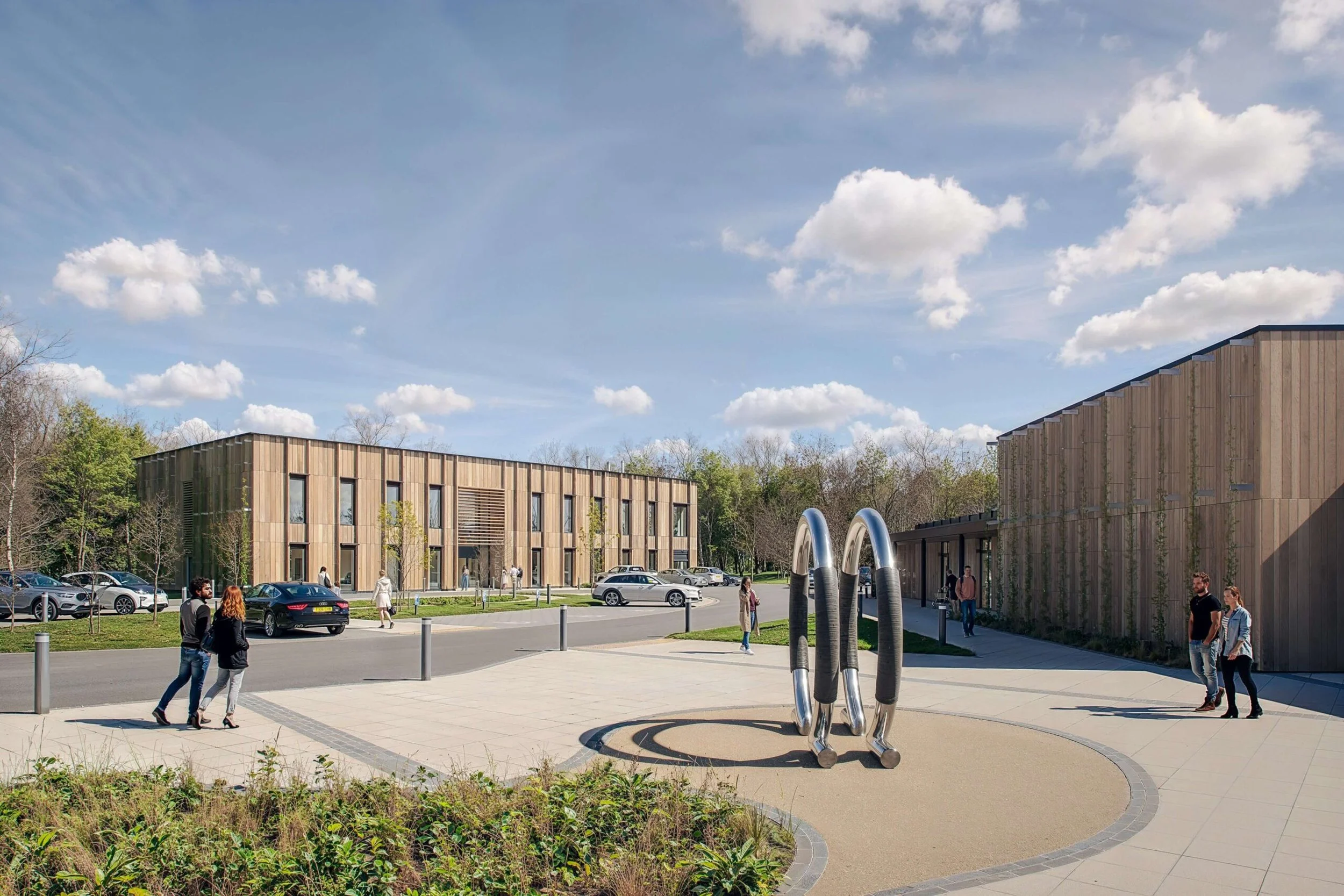
Computer generated image (CGI) of the soon-to-be-built Aspen building at the Wood Centre for Innovation. Image: Courtesy of The Oxford Trust
The Oxford Trust has officially broken ground on its newest addition to the Wood Centre for Innovation in Headington—the Aspen Building, a £7 million (about $9.2 million USD) expansion that will provide much-needed laboratory and office space for Oxford’s thriving life sciences and technology community.
Developed in partnership with Beard Construction, the 17,000-sf (1,600-sm) facility is designed to serve early-stage and grow-on companies seeking high-quality Containment Level 2 (CL2) laboratory space. The project represents a major step forward for the Trust in its 40th anniversary year, reinforcing its mission to “encourage the pursuit of science” while continuing to nurture Oxford’s innovation ecosystem.
“The Aspen Building adds much-needed grow-on CL2 capacity within the Headington Science Cluster, enabling start-ups to remain on site as they scale,” says Nicki Campling, director of innovation and operations at The Oxford Trust. “Flexible labs, upgraded services, and the STEM resources room deepen The Oxford Trust’s mission and the link between innovation and science education.”
Designed with stakeholder insight
As part of the early design process, the Trust and project architect ADP combined market engagement with community consultation to ensure the Aspen Building reflects the real-world needs of its end users.
“We combined market engagement with consultation,” says Campling. “The architects on the project, ADP, and the owners of the site, The Oxford Trust, ran public consultations during the planning process. Tenants in our current Linden Building at the Wood Centre for Innovation were invited to share feedback on design, layout and services based on their experience. That dialogue—plus advice from our project team, ADP, CPW, Gleeds, Glanville, BSG Ecology, Sylva Trees and Landshape—helped shape the brief toward flexible CL2 labs, modern offices, and a low-impact building.”
This collaborative approach has ensured that the Aspen Building is not just a physical expansion but an evolution of the Trust’s successful Linden Building, home to pioneering companies such as Bioarchitech, DJS Antibodies, and Lumai.
Flexibility for future science
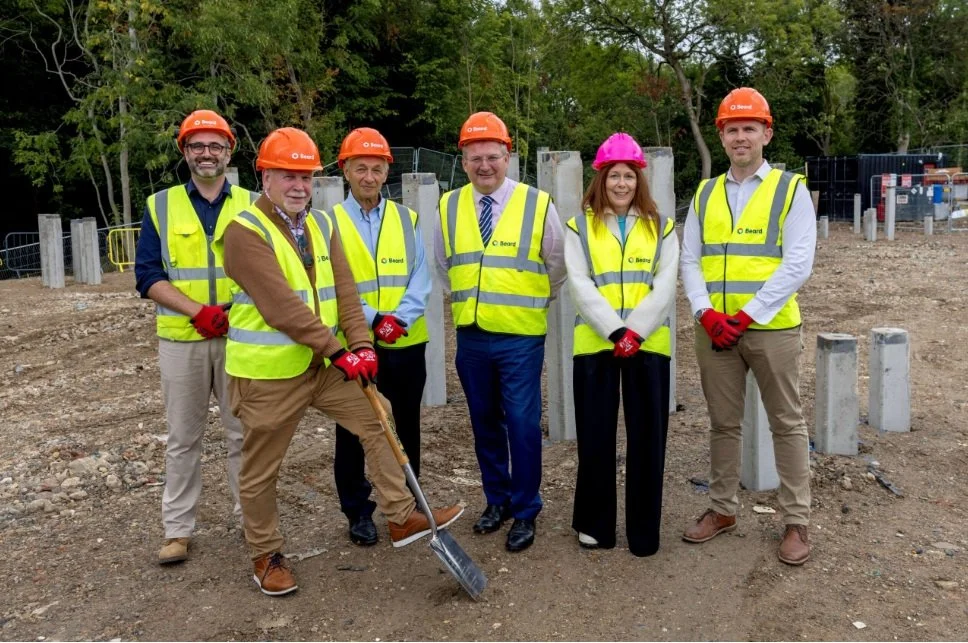
The Oxford Trust breaks ground on the £7 million Aspen Building, a 17,000-sf expansion providing flexible CL2 labs and office space to support Oxford’s growing life sciences and technology community. Image: Courtesy of The Oxford Trust
Designing lab space for yet-unknown tenants presents unique challenges, especially in fast-moving scientific fields. To address this, the project team prioritized adaptability and future-proofing at every level.
“Drawing on our experience of developing laboratory space in the Linden Building at the Wood Centre for Innovation, the team has engineered a Cat A+ lab environment designed for maximum flexibility—ensuring future tenants can easily tailor spaces to their needs,” says Campling. “The building’s core infrastructure includes UPS (uninterrupted power supply) and ducting. Our project team have a wealth of experience in delivering innovation centres across Oxfordshire and beyond.”
The Aspen Building’s two floors of mixed-use CL2 laboratories and office space have been designed to accommodate a range of disciplines, from biotechnology and chemistry to advanced materials and deeptech. Lab spaces will feature robust flooring and ceilings, fully enabled operational infrastructure, and provision for specialist services such as gases and purified water.
Sustainability at its core
Set within 15 acres of woodland, the Aspen Building has been conceived with both environmental responsibility and user wellbeing in mind. The project is targeting BREEAM Excellent and integrates a suite of sustainable features that reduce operational energy and enhance biodiversity.
“The Aspen Building targets BREEAM Excellent,” Campling tells Lab Design News. “Measures installed will include rooftop photovoltaics, air source heat pump, a living green wall, and rainwater harvesting for WC greywater. Active travel facilities—cycle parking, showers and lockers—are also included. The project delivers a minimum of 10 percent Biodiversity Net Gain, tied to our 15-acre woodland, ponds and grassland. Collected rainwater will also top up on-site ponds to reduce sewer discharge.”
In keeping with its ecological setting, the Aspen Building is strategically positioned on an existing car park to minimize disruption. “The Aspen Building is carefully positioned on an existing car park to limit ecological impact,” Campling says. “Its landscape design complements the 15-acre woodland with green infrastructure—including a green wall and BNG planting—and rainwater systems are tied to the on-site ponds and habitat to enhance environmental performance and support biodiversity.”
Collaborative delivery
Experience from the earlier Linden Building and the Science Oxford Centre directly informed the Aspen Building’s design approach. “Retrofitting the Linden Building with lab spaces provided valuable lessons in flexibility and future-proofing,” Campling explains. “These insights have informed Aspen Building’s design, ensuring it can accommodate a wide range of R&D tenants. We also enlisted feedback from our existing community of start-up companies and a working group to understand key operational factors and spatial needs, ensuring the new facility is both functional and adaptable.”
The project team includes ADP Architects, Carter Jonas, BSG Ecology, Landshape, Glanville, Gleeds, Sylva Trees, and CPW—each contributing to the building’s environmental and technical rigor.
According to Campling, ongoing communication among project partners has been critical to aligning technical requirements with design intent. “Regular meetings between the Trust, ADP, CPW (services), Gleeds (cost/programme) and Beard (build) aligned ideal requirements with technical feasibility and cost,” she says.
After a competitive tender process, Beard Construction was selected as the construction partner—chosen for both its local experience and shared values. “Beard was appointed following a competitive tender process that weighed laboratory experience, programme and cost certainty, quality, and proven performance on our original build of the Wood Centre for Innovation and the Science Oxford Centre in 2018-2019,” says Campling. “The company’s familiarity with the site and support for the charity’s mission stood out.”
Beard’s involvement continues the partnership established during the original campus build, ensuring continuity in construction quality and project ethos.
Navigating challenges to develop a future-ready innovation hub
Like many construction projects in recent years, the Aspen Building has faced economic headwinds and market uncertainty. Campling acknowledges that rising material costs have presented real obstacles, but careful planning has kept the project on track.
“One of the biggest challenges has been balancing the economic market conditions with our project budget,” she says. “Global economics have impacted the supply and cost of materials in particular which has been difficult in securing works packages. The design process was relatively smooth with the only real challenge in value engineering to ensure budget fit, whilst not compromising on the quality of building we will deliver. We have been methodical and patient in our approach, which has helped to arrive at a successful contract fulfilling the brief and budget.”
When complete in summer 2026, the Aspen Building will accommodate an estimated 80 new jobs and expand the Wood Centre for Innovation’s role as a nexus for scientific growth in Oxford. Beyond providing essential infrastructure, it will embody the Trust’s dual mission of advancing research and inspiring the next generation through STEM engagement.
With construction now underway, the project signals not just a new building on campus, but a renewed investment in the region’s innovation future. As Campling says, the Aspen Building will “establish the Wood Centre for Innovation as a central hub for life science and deep tech start-ups in the city of Oxford.”