
Walk-In Fume Hood Design: Distillation & Scale-Up Safety
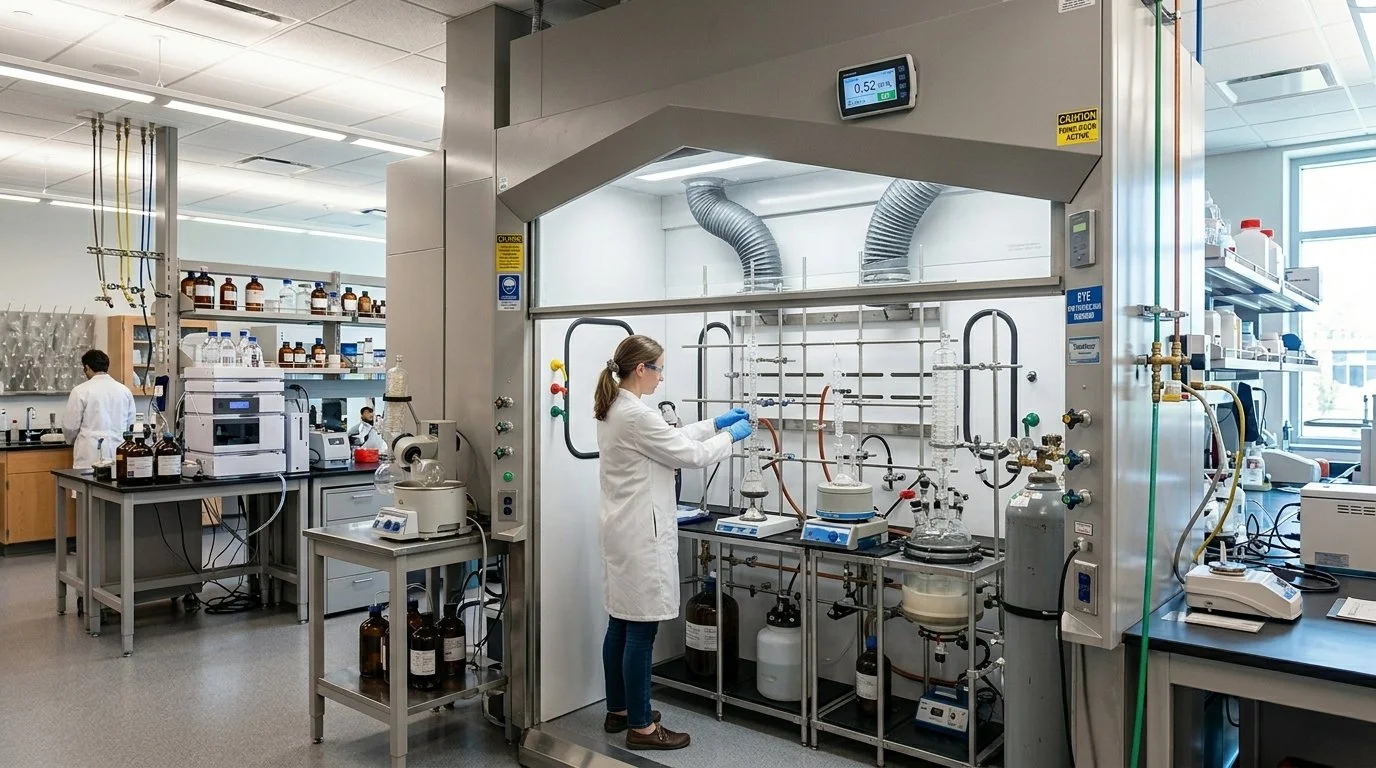
Floor-mounted hoods provide the immense vertical clearance required to safely enclose and ventilate towering distillation columns and pilot-scale reactors. | Credit: Flow (2026)
For When the Experiment Is Taller Than the Scientist
Best practices for walk-in hood design must account for the physical realities of chemical scale-up. When a synthetic route graduates from a 500-milliliter round-bottom flask to a 50-liter jacketed reactor or a multi-stage distillation column, standard laboratory infrastructure instantly becomes obsolete. A traditional benchtop fume hood simply cannot accommodate the vertical height, the complex plumbing, or the sheer mass of this transitional equipment.
To bridge this critical gap in pilot plant design, facility engineers rely on the walk-in fume hood — more accurately described in architectural specifications as a floor-mounted hood. This specialized enclosure extends directly from the laboratory floor to the ceiling, providing the massive volumetric capacity required for large apparatus containment. By eliminating the physical bench slab, technicians can roll heavy drums of solvents, mobile processing skids, and towering chromatography columns directly into the ventilated workspace.
However, scaling up the physical dimensions of the hood exponentially complicates the fluid dynamics of the facility's exhaust system. Providing safe, reliable pilot-scale ventilation requires massive volumetric airflows, sophisticated sash management, and carefully engineered internal baffles to ensure that heavier-than-air chemical vapors are captured and exhausted before they can spill out onto the active laboratory floor.
Key Takeaways
Large Apparatus Containment: Eliminating the standard benchtop to provide floor-to-ceiling clearance for towering distillation setups and mid-scale chemical reactors.
Floor-Mounted Hood Logistics: Designing flush floor sills and reinforced concrete pads that allow technicians to roll heavy processing skids and 55-gallon solvent drums directly into the enclosure.
Pilot-Scale Ventilation: Engineering massive variable air volume (VAV) exhaust systems capable of maintaining safe face velocities across exceptionally large architectural openings.
Sash Management: Utilizing horizontal sliding sashes instead of vertical guillotines to physically restrict the maximum open face area, thereby preventing catastrophic HVAC strain.
Designing for Large Apparatus Containment
The primary architectural driver for specifying a walk-in fume hood is vertical clearance. Standard benchtop hoods typically offer 48 inches of internal working height. In contrast, a floor-mounted hood provides 80 to 96 inches of internal vertical space — an absolute necessity for chemical engineering scale-up, where a single distillation column or a gravity-fed filtration setup can easily exceed six feet in height.
To support these towering structures, the interior walls of a floor-mounted hood must be structurally reinforced. Planners typically specify heavy-duty stainless steel unistrut grids mounted directly to the back and side baffles, allowing researchers to safely clamp heavy, fragile glass reactors and complex condenser networks directly to the architecture of the hood and preventing catastrophic tipping or vibration damage.
Furthermore, the floor beneath the hood requires specialized engineering. Because heavy equipment will be rolled in and out, the architectural floor must be flush with the surrounding lab — any lip or sill creates a tipping hazard for a 500-pound drum of solvent. The flooring material itself must be highly chemically resistant, typically a seamless poured epoxy or a welded stainless steel pan equipped with a localized secondary containment berm to capture bulk spills. For broader guidance on floor finish selection in technically demanding environments, see our overview of selecting appropriate flooring based on lab usage and scope.
Engineering Airflow for Pilot-Scale Ventilation
Scaling up a fume hood creates a massive aerodynamic challenge. The safety of any fume hood is fundamentally determined by its ability to capture, contain, dilute, and exhaust hazardous vapors — a four-part function that becomes exponentially harder to achieve at walk-in scale. While face velocity is a commonly cited metric, it is important to note that multiple organizations specify a range rather than a single target: OSHA's guidance cites a typical range of 60–110 fpm, while ANSI/AIHA Z9.5 specifies 80–120 fpm as acceptable, with 100 fpm being the most widely adopted industry target. Critically, face velocity alone is not a sufficient safety guarantee — containment testing per ANSI/ASHRAE 110-2016 provides a far more rigorous performance standard.
Because a walk-in fume hood has an exceptionally large opening (often spanning floor-to-ceiling), maintaining a safe face velocity requires pulling a substantial volume of air out of the building. However, the actual CFM demand of a floor-mounted hood is highly dependent on the operating sash position. With sashes fully open, the exhaust volume can overwhelm a facility's make-up air handling units and destroy the laboratory's negative pressure cascade — but with disciplined horizontal sash management, the effective open face area can be dramatically reduced. A typical large walk-in hood in normal operation may exhaust 2,500–4,000+ CFM, though this figure is sash-position-dependent and must be calculated precisely by the mechanical engineer of record for each specific installation.
To solve the sash management challenge, walk-in fume hoods are almost exclusively designed with horizontal sliding sashes rather than vertical guillotine sashes. This physically limits the user to opening only one or two narrow vertical panels at a time, drastically reducing the open face area and restricting total CFM exhausted. For a deeper dive on how VAV systems and auto-sash technology can further optimize exhaust volumes at the pilot scale, see our guide to fume hood energy reduction.
Additionally, pilot-scale ventilation must account for vapor density. Many industrial solvents (such as dichloromethane or hexane) produce vapors that are significantly heavier than ambient air. In a towering walk-in hood, these heavy vapors sink rapidly to the floor. Therefore, the internal aerodynamic baffles must be meticulously calibrated, pulling the majority of exhaust volume from lower rear slots located just inches above the floorplate, preventing heavy fumes from rolling out under the operator's feet.
Comparing Containment: Standard Benchtop vs. Walk-In Fume Hoods
Vertical Capacity: Standard benchtops provide roughly 4 feet of internal vertical clearance. Walk-in hoods provide 7 to 8+ feet of clearance for towering apparatus.
Equipment Loading: Standard benchtops require manual lifting or small hoists to place equipment on a 36-inch-high slab. Floor-mounted hoods allow massive equipment to be rolled directly in on heavy-duty casters or pallet jacks.
Sash Configuration: Standard hoods utilize vertical sliding guillotine sashes for full-width access. Walk-in hoods rely on horizontal sliding glass panels to severely restrict the open face area and manage total exhaust volume.
Exhaust Volume (CFM): A standard 6-foot benchtop hood at 100 fpm with a typical sash opening might exhaust 800–1,200 CFM. A large walk-in hood can exhaust 2,500–4,000+ CFM at normal operating sash positions, requiring dedicated, high-capacity make-up air systems to prevent room depressurization.
Expert FAQ: Walk-In Fume Hood Design
Q: Do technicians actually walk inside the "walk-in" fume hood while working?
A: No. The term "walk-in" is an architectural description that causes significant safety confusion. A technician should never physically enter the hood while an active experiment or hazardous chemical is present, as placing their head inside the enclosure breaks the protective air curtain and exposes them to concentrated toxic vapors. The hood is designed for equipment to be walked in during setup — not for a scientist to occupy during operation. For a fuller discussion of safe operational protocols, see our fume hood safety series on accident prevention.
Q: How do you supply utilities to a floor-mounted hood without a benchtop?
A: Because there is no traditional bench casework to house plumbing and electrical lines, utilities (water, vacuum, nitrogen, 120V/208V power) must be surface-mounted on the exterior side posts of the hood. Planners must also specify remote-control valves located outside the hood, ensuring the operator can shut off a runaway reaction without reaching their arms into a hazardous vapor zone.
Q: What are the fire suppression requirements for large apparatus containment?
A: Given the massive volumes of flammable solvents used in pilot-scale reactions, standard building sprinklers are often insufficient. Walk-in fume hoods frequently require localized, dedicated fire suppression systems, such as clean agent systems, hard-piped directly into the ceiling of the hood enclosure to extinguish a flash fire at the source. It is important to note that FM-200 (HFC-227ea), a historically common clean agent choice, is currently subject to a regulatory phasedown under the U.S. AIM Act, which began in 2022. Facilities specifying new systems today should consult a fire protection specialist about current low-global-warming-potential alternatives such as Novec 1230 or inert gas systems, all governed by NFPA 2001. For guidance on fire risks specific to fume hood operations, see our fume hood safety series on what causes fume hood fires.
Q: How does walk-in hood design fit into the broader pilot plant infrastructure?
A: The walk-in fume hood is just one specialized element within a much larger architectural challenge. Understanding how it integrates with the structural, utility, and regulatory demands of the full scale-up environment is essential. For a comprehensive overview, see our guide to pilot plant design: bridging the gap between R&D and manufacturing.
References
National Fire Protection Association (NFPA). NFPA 45: Standard on Fire Protection for Laboratories Using Chemicals. NFPA, 2024.
American Society of Heating, Refrigerating and Air-Conditioning Engineers (ASHRAE). ANSI/ASHRAE Standard 110-2016 (R2025): Methods of Testing Performance of Laboratory Fume Hoods. ASHRAE, 2016.
National Institutes of Health (NIH). Design Requirements Manual (DRM). Office of Research Facilities, 2020.
Occupational Safety and Health Administration (OSHA). Occupational Exposure to Hazardous Chemicals in Laboratories (29 CFR 1910.1450). U.S. Department of Labor.
