
Understanding Key Cost Drivers for Lab Construction Projects in 2026 and Beyond
Whether it’s new construction, renovation, or adaptive reuse, lab construction projects are notoriously complex. Managing the costs involved with designing and building these spaces presents unique challenges. In addition to each project’s individual nuances and specifications, developers, architects and other stakeholders need to be aware of key cost drivers, local market trends and other factors that affect the financial picture.
Lab construction costs currently range from $600 to $1,400 per sf
The cost profile for any lab construction project depends on the type of lab, and the structure itself may only account for 15% to 20% of the total cost. Current average cost for lab fit-outs (construction only, excluding equipment, design team fees, technology and security equipment) in the U.S. is as follows:
| Lab type | Cost per sf (USD) |
|---|---|
| Biosafety level 1 and 2 | $700 to $800 |
| Chemistry | $800 |
| Biosafety level 3 | $1,000 to $1,300 |
| Vivarium | $1,000 to $1,300 |
| Gene/cell therapy | $1,100 to $1,400 |
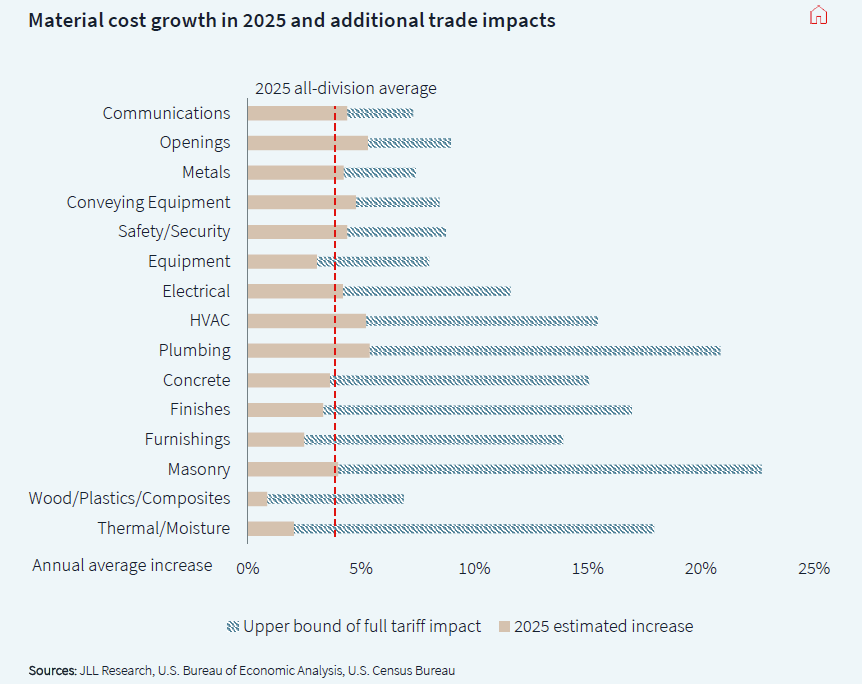
Across the construction industry, material prices for 2025 increased an average of 4.2 percent over 2024. At the same time, future increases attributable to tariffs enacted by the current US administration may range from 5 percent to 25 percent depending on the material, with an aggregate increase of around 8 percent estimated based on current policy levels.
Key cost drivers include design, MEP, finishes, and regulatory requirements
The need for precise controls, sophisticated equipment and robust safety infrastructure makes lab construction projects far more complex than other kinds of real estate. As a result, there are more layers of costs involved, and capital needs can vary widely depending on the type and scope of the project.
Design: Moreso than offices or other types of commercial real estate, lab configurations are constantly evolving in response to scientific and technological innovation. As a result, lab spaces need to be designed for flexibility and be able to accommodate new equipment such as AI-powered robotics. Lab design also needs to reflect the current and future function of the space: will it be used for the same purpose over the next five to 10 years, or will it need to pivot according to shifting priorities?
MEP: Mechanical, engineering, and plumbing (MEP) systems, which are especially complex in lab environments, typically account for roughly 50 percent of lab construction costs. This includes HVAC and air handling systems, ventilation that supports necessary air change rates, temperature, humidity control, and more. Redundant systems, energy, and recovery systems and controls also add to the complexity of costs.
Equipment: Exhaust hoods, safety cabinets, emergency ventilation or treatment systems, and other specialized equipment also make up a significant portion of lab construction costs based on the type of lab and the work being performed. For example, labs that involve working with combustible gasses need structures that can contain those gasses in the event of an emergency.
Finishes: Finishes are a key driver of construction costs and can make up 10 percent of total project costs. Even if some standardized design elements are available, specialized casework and millwork suited to the specific lab environment can contribute another 10 percent to 15 percent of total costs.
Regulatory requirements: Estimating the percentage of costs attributable to regulatory requirements is difficult and varies depending on the type of lab and the focus of the work. But it can be a significant amount, especially when a project involves overlapping regulatory frameworks.
Sustainability: Lab construction projects are often designed to meet LEED standards, with many prioritizing Gold or Platinum certification. Additionally, local sustainability regulations like California’s Title 24 and New York City’s Local Law 97 establish energy efficiency requirements, which can increase introduce higher costs to a construction project.
Local talent pools, regulations and incentives affect project costs
A project’s location plays a large role in determining construction costs. According to JLL’s 2025 Life Sciences Real Estate Perspective and Cluster Analysis, Boston is still the top overall real estate market for life sciences, followed by the San Francisco Bay Area and San Diego—all of which are high-cost locations. Life sciences firms must also take into consideration the available talent pool when choosing where to establish new lab facilities, and despite the high cost of living, California remains an attractive destination to prospective employees.
At the same time, some companies are seeking greater cost efficiency by building outside of established clusters, particularly in places with attractive incentives. Activity is on the rise in the Midwest, particularly Michigan, Indiana, and Ohio. Markets in the Mid-Atlantic region, Atlanta, and Texas are also seeing growth.
Lab construction costs will continue on upward trajectory
Looking ahead, lab construction costs are likely to increase at a steady rate. On the materials side, US trade policy will be a key factor in the timing and degree of cost increases across the construction industry. If tariffs remain in place and demand for construction rises, more costs will have to pass through. In response to these conditions, developers involved in lab construction projects are diversifying their supply chains, adding new suppliers from both within and outside the US.
Lab managers, planners, and other decisionmakers will also be keeping a close eye on the future of funding for the life sciences sector. Whether and how NIH grants and other federal sources of funding will be dispersed or altered in the coming years remains uncertain. Changing local incentives could have an impact on lab construction projects as well.
Given the complexity of these projects and the number of variables that impact cost profiles, it’s imperative to engage with knowledgeable experts who have experience in the specific type of project being planned as well as the geographic market where the project is located. A professional or team who knows the market can provide invaluable support in achieving cost efficiencies over the course of the project.