
The Making of New Jersey’s First Veterinary School
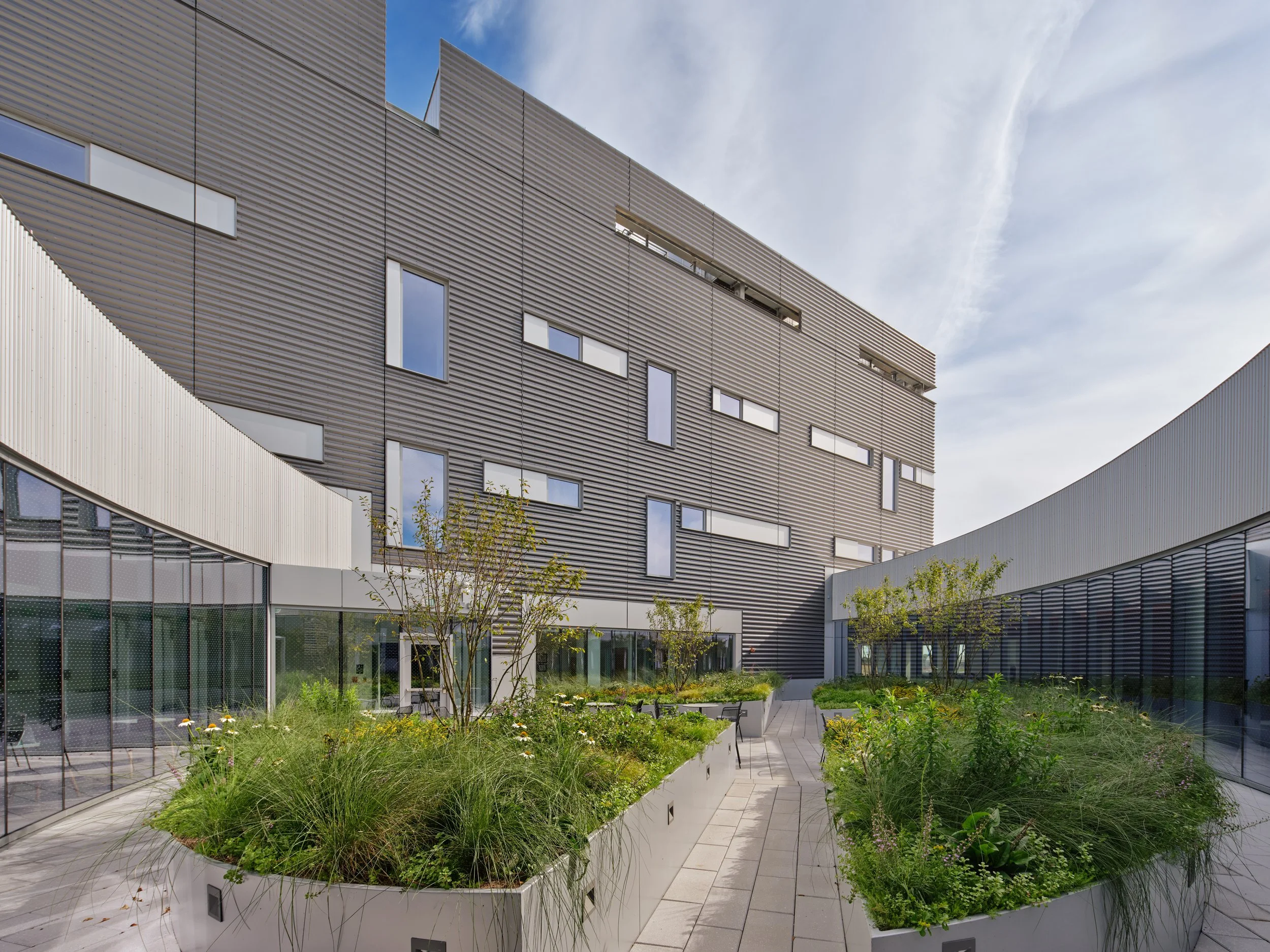
Rowan University’s Shreiber School of Veterinary Medicine opened in October 2025 as New Jersey’s first veterinary school, combining teaching, clinical care, and research in a state-of-the-art facility backed by $105 million in public and philanthropic investment. Image: Erdy McHenry Architecture
When Rowan University cut the ribbon on the Shreiber School of Veterinary Medicine in October 2025, the moment represented far more than the debut of New Jersey’s first and only veterinary school. It marked the realization of a highly coordinated academic, clinical, and research endeavor, designed to serve students, faculty, patients, and the broader South Jersey community for decades to come.
Backed by a $75 million state investment and a $30 million philanthropic commitment from Gerald and Melanie Shreiber, the new facility on Rowan’s West Campus in Harrison Township was conceived as a hybrid environment: a veterinary teaching hospital, an academic school, and a translational biomedical research center.
The project team included Erdy McHenry Architecture (architect), David Mason + Associates (structural engineering services), LF Driscoll (construction manager at risk), Pennoni (civil engineer), and The Gloucester County Improvement Authority (project developer).
Planning with purpose and partnership
A consistent theme in the school’s development was sustained, structured engagement with faculty and industry advisors.
“We put together an advisory committee that met regularly over many months as we developed our plans,” says Matthew Edson, DVM, founding dean of the Shreiber School of Veterinary Medicine. “This group included our faculty and members from our advisory council, including industry experts.”
That early engagement translated into tangible design decisions. “There was constant back-and-forth collaboration as we worked out the building’s layout and design,” Edson explains. “At the architect’s suggestion, for example, we opted to use smart glass for the viewing windows into the surgical suites. This allows us to switch instantly back and forth between transparent and opaque glass, which we think will be a nice feature for instruction.”
Other layout choices were similarly driven by workflow considerations. “As another example, the teaching hospital’s pharmacy is intentionally positioned so the public can pick up medications from both the specialty and primary sides of our clinic,” Edson notes.
Takeaway: Create a formal advisory structure that includes faculty clinicians, researchers, facilities staff, and external experts. Document workflow scenarios (clinical, academic, and public-facing) and test them iteratively. Small decisions, such as pharmacy placement or glazing technology, can have outsized impacts on efficiency and user satisfaction.
Designed for light, openness, and community
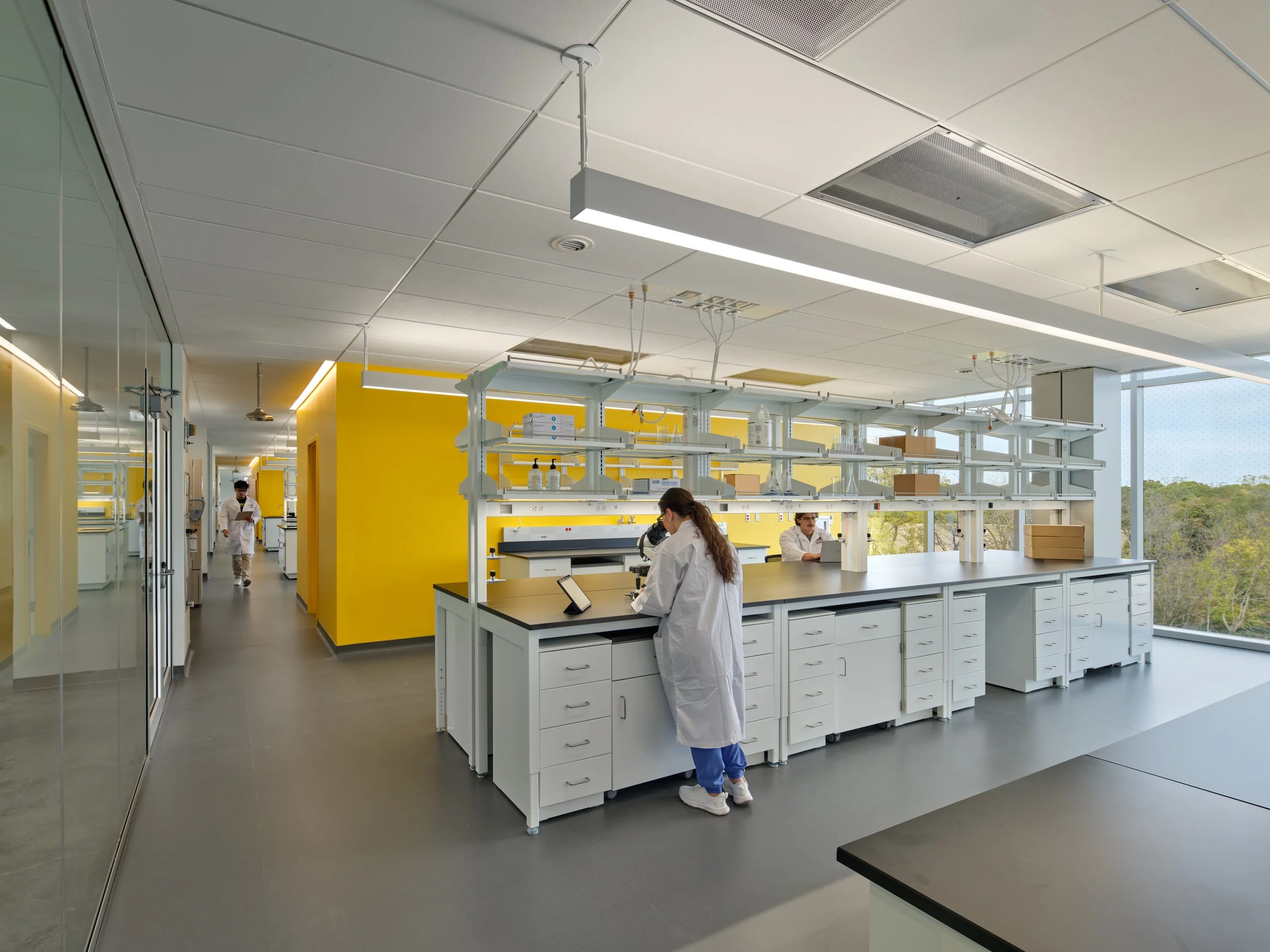
Rowan’s lab and clinical spaces balance high-performance infrastructure with daylight-filled, flexible communal areas that promote collaboration, well-being, and talent recruitment. Image: Erdy McHenry Architecture
While much of lab design centers on technical infrastructure, Rowan’s team also prioritized environmental quality and culture.
“We also wanted to create a building with a lot of natural light to create a healthy environment for our patients, students, faculty and visitors,” Edson says. “We have a beautifully landscaped courtyard on the second floor with lots of big windows overlooking our grand staircase. The space brings so much sunlight into the interior of our building and immediately draws attention from anyone who enters the building.”
That commitment to openness extended to workplace strategy. “That design concept of openness and light led us to create large, open work spaces,” Edson says. “We wanted to invite more in-person conversation, collaboration and better communication. At the same time, we have a variety of spaces, such as a break room with a small kitchen and pantry, that give students and staff options for places to relax, eat, study, or chat.”
For institutions seeking to recruit top-tier faculty and students, especially in competitive or first-in-state programs, these elements are not luxuries. They are strategic assets.
Takeaway: Balance high-performance lab and clinical zones with daylight-filled communal spaces. Provide varied work settings such open collaboration areas, quiet study zones, and informal social spaces to support both productivity and well-being. These features directly affect recruitment and retention.
Teaching, clinical care, and research under one roof
The Shreiber School was designed around a clear philosophical framework: One Health. That integration is reflected in the building’s programmatic structure.
“The building is designed to handle three complex functions,” Edson says. “It serves as a veterinary hospital, an academic school, and translational research space. Bringing these programs together within one structure supports collaboration, shared resources and interdisciplinary dialogue.”
Flexibility was built into teaching and research spaces from the outset. “Our classrooms are built with movable partitions that will enable us to adapt spaces for different student populations and teaching strategies,” Edson notes. “Rowan also invested in advanced digital tools, such as AI-enabled smart devices for video conferencing and communication. The research labs are also adaptable and include open collaborative areas with enclosed support spaces.”
Omar Tliba, DVM, MSc, PhD, associate dean for research and graduate studies, emphasizes operational efficiency in research infrastructure. “Veterinary research labs are really no different from biomedical or human health labs. They all use the same techniques and equipment,” he says. “To improve efficiency and save costs, our building shares the same site as Rowan’s new Virtual Health College Research Center, which will eventually occupy the building’s third and fourth floors. We use the same HVAC and air filtration systems. Our researchers will be able to work together under one roof to advance medicine for both people and animals.”
Takeaway: When combining academic, clinical, and research programs, design for shared infrastructure and adaptable spaces. Use movable partitions, modular lab planning grids, and flexible MEP systems. Co-locating programs with shared HVAC and filtration systems can reduce capital and operating costs while fostering interdisciplinary collaboration.
Planning for phased occupancy, growth, and technology
Large academic-clinical facilities rarely come online all at once. Rowan’s team structured the building to support phased activation.
“The building has opened in phases, with the school opening first,” says Phil Barnes, director of public relations and communications. “Shortly thereafter, the Veterinary Teaching Hospital opened its Primary Care service followed by specialty services. As that continues to expand, researchers are moving into their spaces in the research tower.”
This sequencing minimized disruption while allowing revenue-generating clinical services and research programs to ramp up methodically.
Even highly traditional disciplines can benefit from advanced technology when space supports it.
Farrier and assistant professor Patrick Reilly is conducting grant-funded research using artificial intelligence and computer imaging to analyze equine gait and hoof pressures. “The basic process of shoeing a horse hasn’t changed much,” Reilly says. “All of a sudden, in the last 20 years, we have all this technology available to us to give us new insights and show us how to get better at it.”
Designing facilities that can accommodate imaging systems, data collection equipment, and digital collaboration tools ensures that programs can evolve alongside emerging technologies.
Takeaway: Plan for phased occupancy and build flexible infrastructure so programs can launch smoothly, grow over time, and adopt emerging technologies without disruption.
Embedded sustainability and environmental stewardship
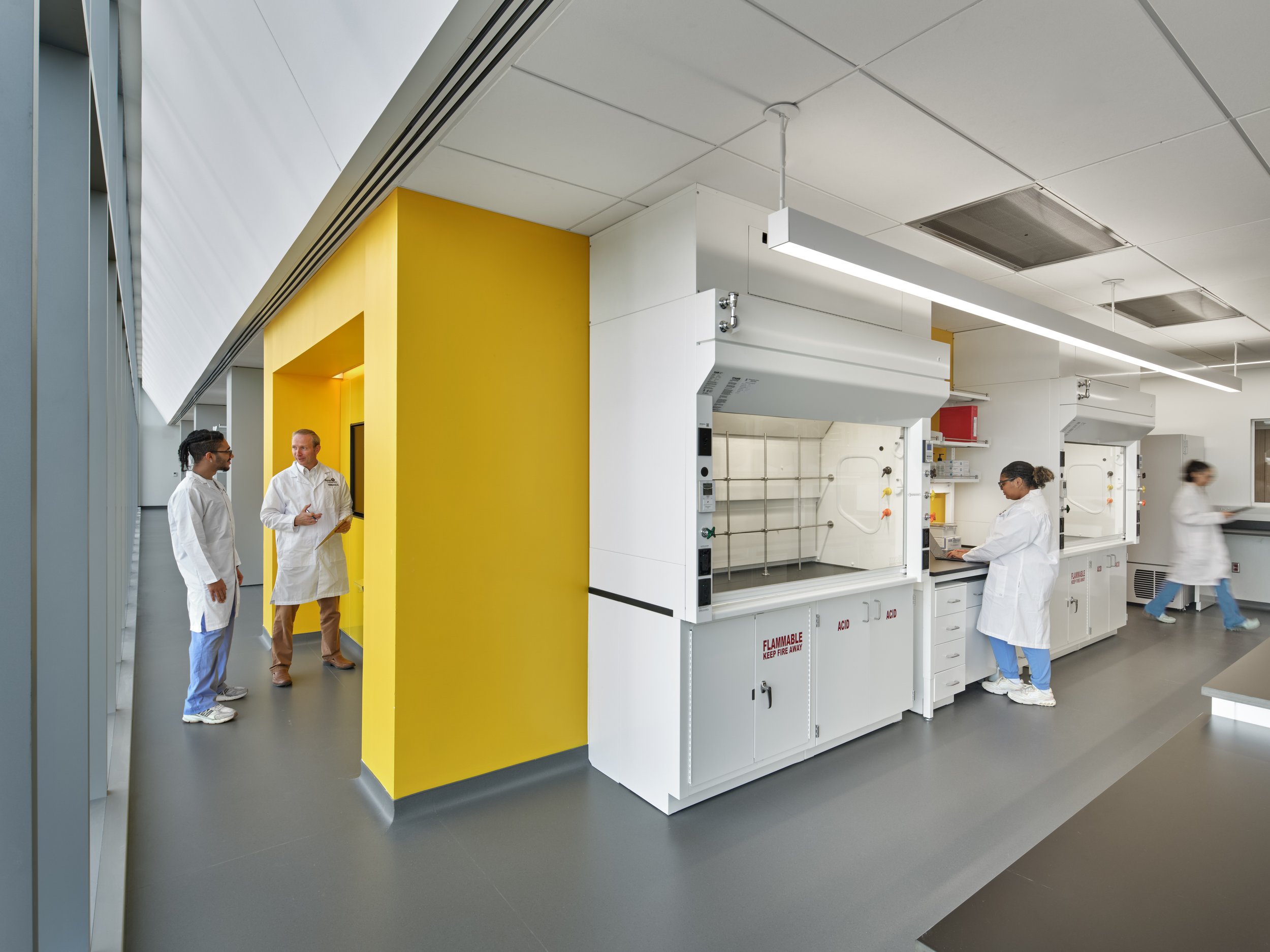
Rowan’s Shreiber School of Veterinary Medicine combines landmark architecture, flexible design, and community-centered planning to create a “vet school of the future” that supports well-being, collaboration, and long-term growth. Image: Erdy McHenry Architecture
As a major public investment in South Jersey, the Shreiber School incorporates sustainability measures that extend beyond code compliance.
“We want to promote health for all and that extends to our surroundings, which include nearby wetlands,” says Mark Miller, senior associate at Edry McHenry Architecture. “The project includes drought-resistant native plantings, bird-safe glass, and swales to filter runoff from the parking lot. The interior courtyard is irrigated with collected rainwater to help conserve water.”
The building also features “efficient LED lighting, glycol heat recovery in the lab and surgery air handling units, and a modular heat recovery chiller for simultaneous heating and cooling,” Miller notes. “Airside economizers also reduce the energy needed to cool the building.”
Water conservation was another focus, he says: “Reducing water usage was another concern, so we chose EPA WaterSense fixtures throughout the building.”
Notably, the project was designed as “an airtight, exhaust-only facility with stringent air quality standards,” Miller said, adding that energy and air quality data can be tracked and used for educational purposes.
Interior materials were selected with sustainability in mind, including locally sourced decorative glass and Cradle to Cradle–certified flooring products.
Takeaway: Align sustainability goals with programmatic mission. For health-focused institutions, water conservation, heat recovery, high-performance air systems, and data transparency can serve both operational and educational purposes. Engage landscape design as an extension of environmental stewardship.
A landmark that signals long-term commitment
As New Jersey’s first veterinary school, the building carries both practical and symbolic weight.
“The building’s vertical organization—with the research tower rising to capture expansive views—serves as a visual landmark, embodying the university's forward-looking ambition,” Miller says. “The design balances aesthetics and function by engaging the surrounding landscape, creating inviting spaces that promote well-being. Nature is thoughtfully woven into the architecture, offering moments of respite for students and faculty, which enhances mental health and fosters a deeper connection to the environment.”
The Shreiber School of Veterinary Medicine shows that complex lab and clinical facilities can be collaborative, flexible, and community-centered from day one. Through sustained stakeholder engagement, adaptable planning, shared infrastructure, phased implementation, and embedded sustainability, Rowan has created what Edson describes as a rare opportunity: “Since this is a brand-new building, we had a huge opportunity to build the ‘vet school of the future.’”
For institutions launching first-of-their-kind facilities, architecture can reinforce both identity and mission. Designing around program goals, user input, and flexible infrastructure turns a new facility into a platform for long-term growth and innovation.