
LLNL’s New Digital Backbone Positions National Security Lab for the AI Era
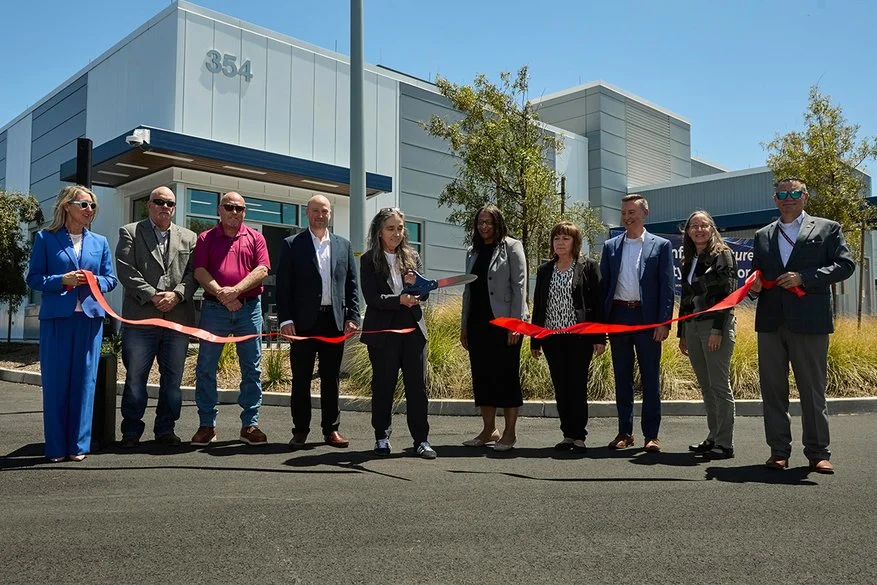
Officials with the National Nuclear Security Administration (NNSA), Lawrence Livermore National Laboratory, the NNSA Livermore Field Office and project management teams cut the ribbon marking the completion of the Digital Infrastructure Capability Expansion facility on June 9. The event celebrated a major milestone in a decade-long effort to modernize one of the Lab’s most critical infrastructure systems. Image: Glenn Silva/LLNL
For decades, laboratory infrastructure has been defined by physical assets: research buildings, utilities, mechanical systems, and specialized laboratories. Increasingly, however, a laboratory’s ability to advance science depends just as heavily on its digital infrastructure. Lawrence Livermore National Laboratory’s (LLNL) newly completed Digital Infrastructure Capability Expansion (DICE) facility reflects that shift, providing the resilient communications backbone needed to support exascale computing, artificial intelligence, secure communications, and data-intensive science for decades to come.
Officials from the National Nuclear Security Administration (NNSA), LLNL, and the NNSA Livermore Field Office celebrated completion of the project in June, marking the culmination of more than a decade of planning, design, and construction. The 13,000-sf facility replaces a telecommunications building constructed in 1985, long before cloud computing, AI, and modern high-performance computing transformed scientific research. It now serves as the laboratory’s primary gateway for networking and communications.
While DICE may resemble a data center on the surface, project leaders emphasize that the facility was engineered to meet requirements far beyond those of a conventional enterprise IT building. Supporting one of the nation’s premier national security laboratories demanded a fundamentally different design approach centered on resiliency, scalability, security, and long-term adaptability.
Designing for mission-critical science
According to LLNL principal deputy chief information officer Mark Pettit, the project’s primary objective was ensuring uninterrupted operation of mission-critical systems while anticipating technology needs that may not yet exist.
“The driving factors behind DICE’s design were rooted in the necessity to support mission-critical systems with exceptional reliability, scalability, and security,” Pettit says. “Unlike conventional laboratory buildings or typical data centers, DICE was conceived to meet the demands of rapidly advancing computational workloads, large data volume, and secure communications infrastructure spanning hundreds of buildings.”
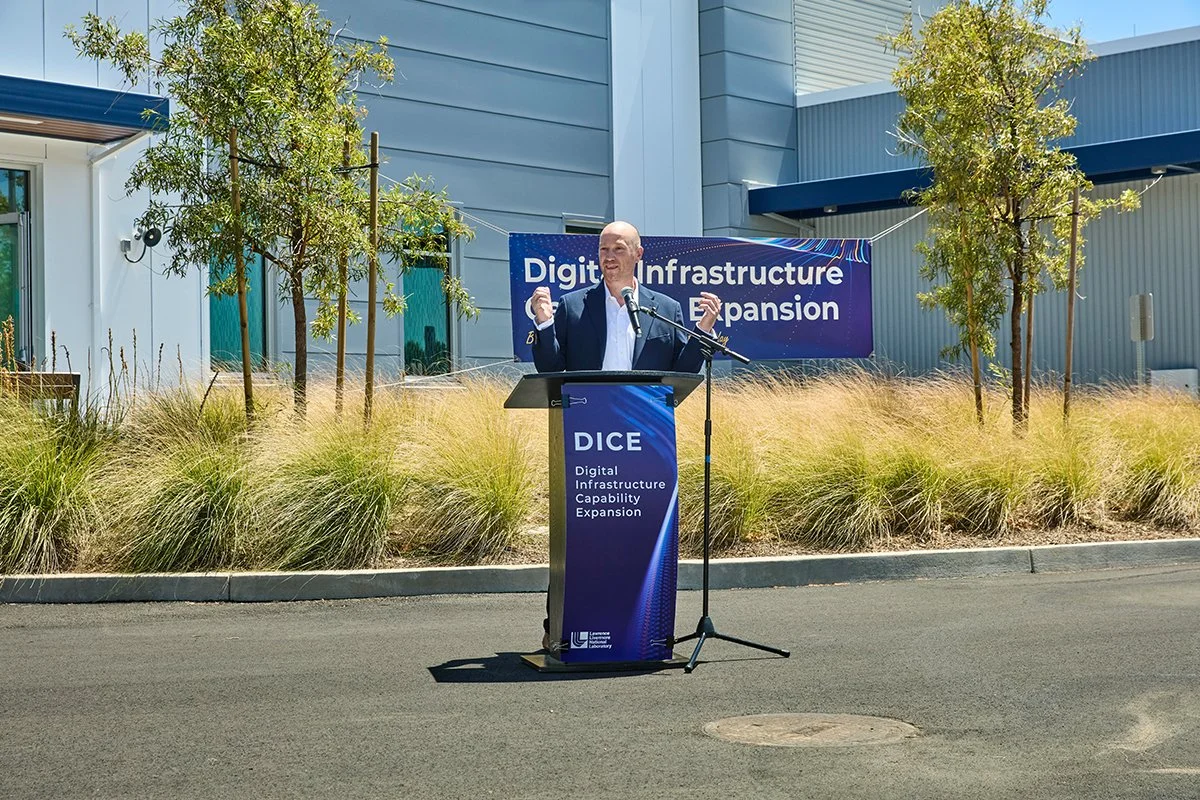
National Nuclear Security Administration Associate Administrator for Information Management and Chief Information Officer James Wolff described DICE as part of a broader push by NNSA to modernize physical and digital infrastructure across the nuclear security enterprise. Image: Glenn Silva/LLNL
Those requirements led designers to prioritize flexible equipment layouts, future-ready infrastructure, and extensive redundancy throughout the facility.
The need for modernization became increasingly urgent as LLNL expanded its capabilities in high-performance computing, artificial intelligence, and data-intensive science. As digital demands continued to grow, the laboratory’s aging communications infrastructure became increasingly difficult to scale, highlighting the need for a more resilient and future-ready facility.
Replacing an aging communications hub
The original communications facility had faithfully served LLNL for nearly four decades, but its physical limitations increasingly constrained the laboratory’s ability to grow.
“The legacy facility was hampered by limited scalability, outdated cabling, and hardware that could no longer support the laboratory’s expanding needs,” Pettit says. “Its insufficient redundancy exposed significant risks to operational continuity, especially as digital demands increased.”
Those shortcomings directly informed the design of DICE. The new facility is approximately three times larger than its predecessor and includes significantly expanded fiber infrastructure, overhead cable distribution, modern communications vaults, and ample capacity for future expansion.
Perhaps more importantly for laboratory operations, the building incorporates redundancy throughout its critical infrastructure. Utility-level electrical redundancy, smart uninterruptible power systems, redundant cooling systems, and multiple network pathways enable maintenance and upgrades without interrupting service—an increasingly important capability for research organizations that depend on continuous access to computational resources.
The facility will ultimately support communications and networking across more than 600 buildings located on LLNL’s main campus and Site 300.
Infrastructure built for AI and exascale computing
As laboratory computing continues evolving, facility infrastructure must keep pace with rapidly increasing demands for bandwidth, power, and cooling. Pettit notes that the explosive growth of AI, high-performance computing, and data-intensive science significantly influenced every aspect of the building’s engineering.
“Rapid growth in high-performance computing, artificial intelligence, secure communications and data-intensive science directly influenced the facility’s design,” he says. “DICE incorporates expanded fiber infrastructure, modern communications spaces, flexible equipment layouts and additional capacity to accommodate future technologies.”
That flexibility is particularly important given the pace of technological change. Rather than designing solely around today’s equipment, the project team focused on creating infrastructure capable of accommodating future computational technologies while remaining adaptable as mission requirements evolve. The facility is expected to provide the digital foundation needed to support LLNL’s continued expansion of AI capabilities, exascale computing, and increasingly data-intensive scientific research.
Balancing resiliency and sustainability
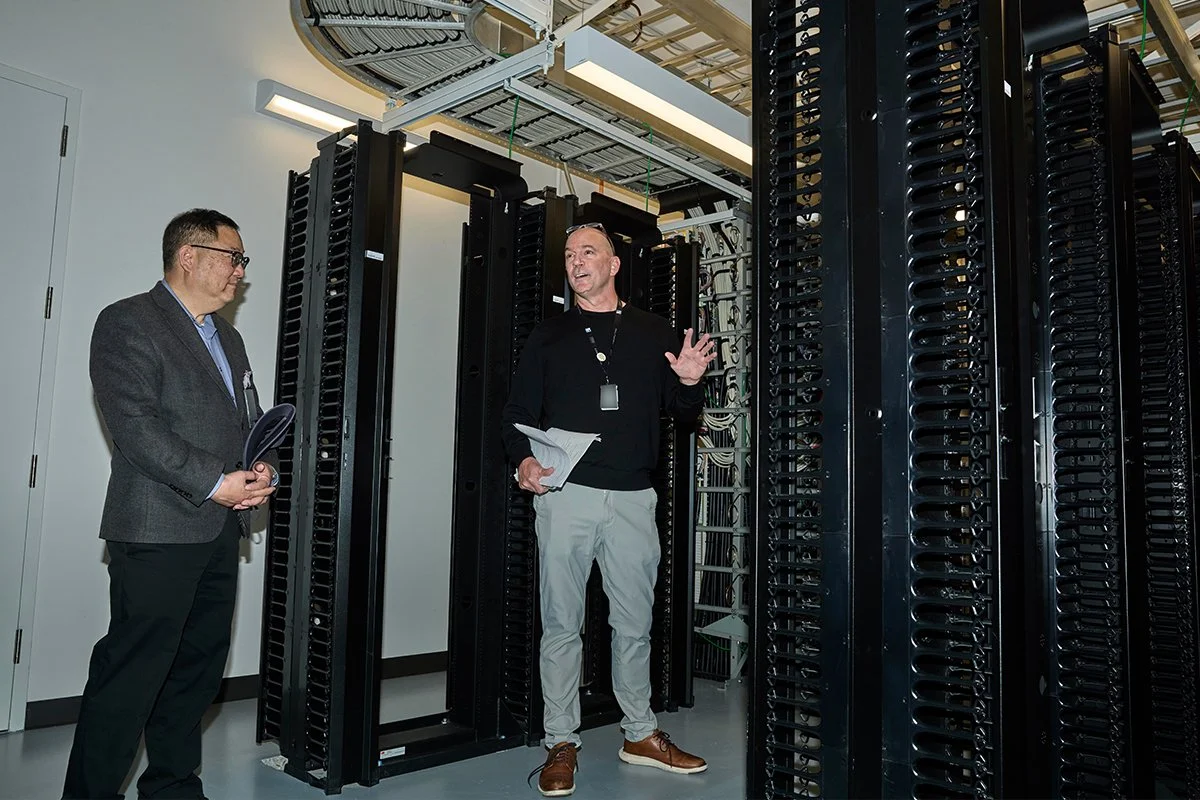
LLNL Enterprise Network Services Associate Program Leader William Beckett shows LLNL Associate Principal Deputy Director Cliff Shang where copper communications lines enter DICE from an underground cable vault before being routed to equipment that supports phone and emergency communications services across LLNL. Image: Glenn Silva/LLNL
Mission-critical facilities have traditionally prioritized reliability above all else, sometimes at the expense of energy efficiency. DICE demonstrates that the two objectives need not be mutually exclusive. Designed to Tier 3 standards while achieving LEED Gold certification, the facility integrates resilient building systems with efficient mechanical and electrical infrastructure.
“Mission assurance remained the highest priority, but sustainability was integrated into the design from the very beginning rather than treated as a separate objective,” Pettit says. “The facility combines high-availability infrastructure with energy-efficient building systems, resulting in a resilient infrastructure facility that also achieved LEED Gold certification.”
That integrated approach reflects a broader trend across research facilities, where owners increasingly seek to balance operational resilience with long-term stewardship of energy and environmental resources.
Coordinating a decade-long project
Delivering a secure infrastructure project under NNSA oversight required close coordination among numerous stakeholders, including LLNL’s Office of the CIO, Laboratory Infrastructure, the NNSA Livermore Field Office, project management teams, safety personnel, and multiple design and construction contractors.
Unlike many commercial projects, DICE operated within the rigorous governance structure required for national security facilities while also serving as one of the first line-item projects to benefit from NNSA’s Supplemental Directive 413.3-7, which streamlines delivery of non-nuclear capital projects. Project officials said the directive helped reduce costs and accelerate construction by incorporating more commercial project delivery approaches.
According to Pettit, successful collaboration depended on establishing shared goals from the outset.
“Right from the project’s inception, the team fostered a culture of partnership centered around a unified goal,” he says. “Long term success depended on sustained collaboration among LLNL, NNSA, the Livermore Field Office and multiple design and construction partners.”
Laboratory officials also noted that the project was completed on time and under budget despite challenges that included the COVID-19 pandemic, supply chain disruptions, and complex site constraints.
Beyond LLNL, DICE represents part of a broader NNSA strategy to modernize digital and physical infrastructure throughout the nation’s nuclear security enterprise. As mission requirements become increasingly data-driven, secure, high-speed communications and the ability to rapidly process and move large volumes of data have become foundational capabilities. Pettit similarly views DICE as a cornerstone of those modernization efforts.
“DICE is integral to NNSA’s commitment to modernize both physical and digital infrastructure across the nuclear security enterprise,” he says. “Its implementation aligns with the NNSA’s broader strategic goals by providing a foundation for secure, high-speed communications and digital modernization.”
Next phase: migration without disruption
Although construction is complete, one of the project’s most technically demanding phases is only beginning. LLNL’s IT organization must now migrate thousands of fiber optic and telecommunications circuits, along with complex communications and networking equipment, into the new facility while maintaining uninterrupted operations across the laboratory.
“A successful transition means migrating many thousands of fiber optic and telecommunications circuits, and complex communications and networking equipment into the new facility while minimizing disruption to laboratory operations,” Pettit says. “Meticulous planning, phased cutovers, and thorough testing are essential to minimize operational risk.”
For laboratory planners, DICE underscores an increasingly important reality: as research becomes more computationally intensive and digitally connected, communications infrastructure can no longer be viewed as simply an IT utility. It has become a mission-critical building system—every bit as essential as power distribution, HVAC, or laboratory process utilities.
As research institutions continue investing in AI, digital twins, automation, and data-driven science, projects like DICE offer a glimpse into the next generation of laboratory infrastructure, where resilient digital backbones become foundational assets supporting scientific discovery and national security alike.