
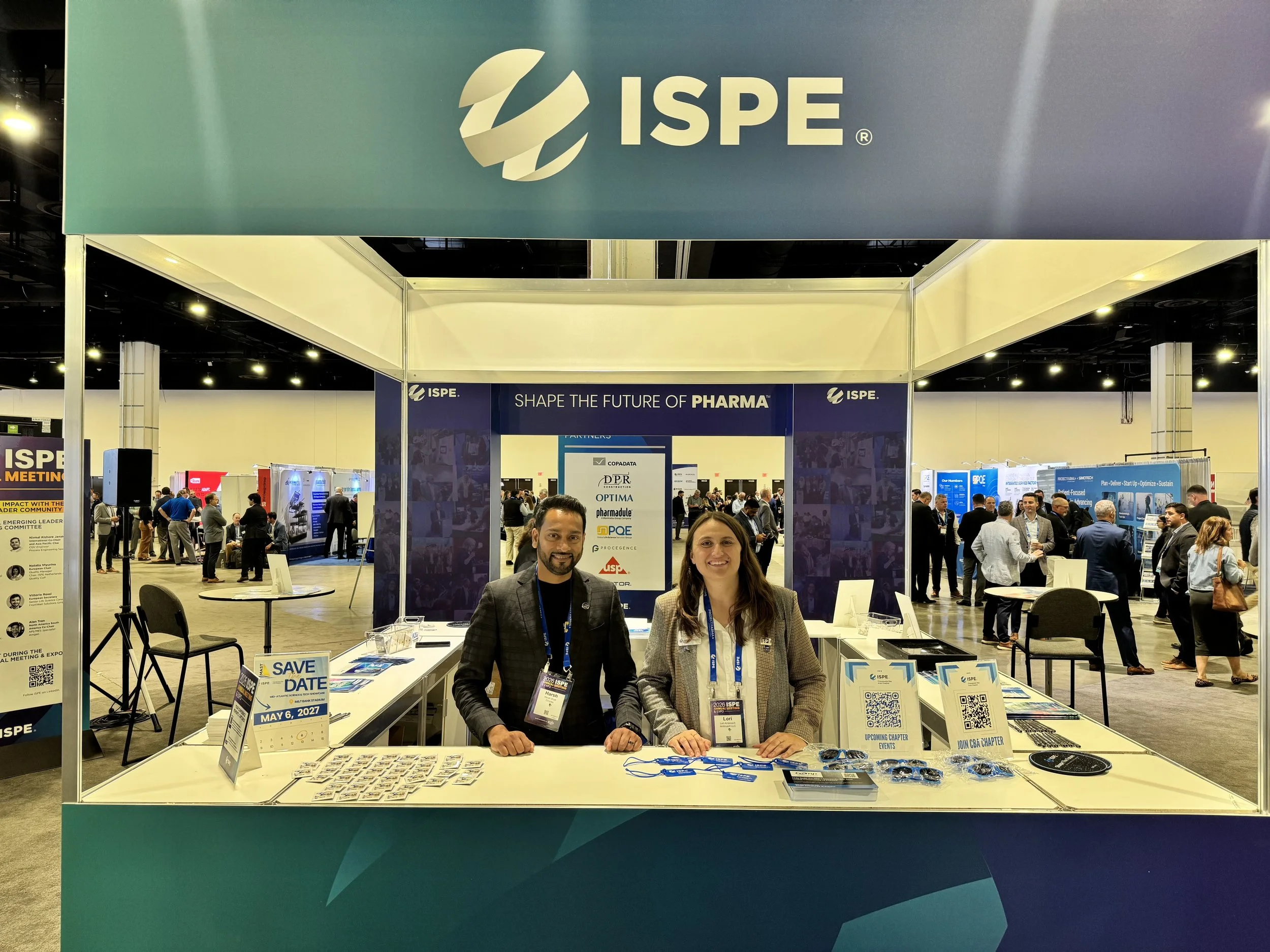
With the ISPE Annual Meeting happening in our backyard this year, I would be remiss not to touch on it in this month’s column. Chapters from around the globe converged on the Gaylord National Harbor in Maryland (although Washington, DC was given the spotlight) from October 18-23 for a week of reflecting on the industry and discussing where it may go next. As I very briefly touched on in my last column, I believe quantum is going to be more of a disruptor in innovation than AI will be. However, AI is very much still at the forefront of discourse and advancements in research and technology, and therefore was unsurprisingly a major topic of discussion.
One of the exhibits present on the expo floor was a demonstration by Siemens. They showed how AI can be used to prevent hours of downtime if something goes wrong during pharma manufacturing, allowing operators to address issues within minutes before batches are lost, even if they have relatively limited experience. This type of technology can have truly transformational impacts on how we approach research and production, and cost savings from fewer lost batches.
However, it does raise the question of whether this inherently impacts the types of roles that will be needed on teams to incorporate the new technology. In speaking with colleagues within the AEC community after experiencing the exhibit, we wondered whether data scientists with the primary focus on interpreting the data fed from AI to implement solutions when errors arise would be necessary as this new technology becomes more omnipresent. Or would these new setups necessitate that the scientists become trained in these areas? I will be interested to see how AI impacts traditional roles and responsibilities in the S&T world. Primarily, will it free up people’s time to yield higher productivity, or will the maintenance and operation of the AI end up filling in the time saved, with the benefit being improved results and cost savings? Perhaps neither, so I am excited to witness the continued innovation and evolution.
AI is of course hitting other parts of the S&T world as well, including the AEC industries. If I had to place myself along the spectrum from skeptic to full embracer, I probably fall somewhere in the middle. Not because I don’t believe AI can have profound impacts on the industry, but rather I believe that the roles it can replace or improve are limited. If design were truly something that can be generated from program data, code restrictions, and past precedent, algorithms would have already been made to generate statistically successful spaces that accommodate both the human and life safety needs of a scope.
However, architecture has always been a blend of physics and art, with the art piece being deeply personal and human. Creating an experience requires lived human experience, as it is not something that can be quantified or even fully articulated. Moreover, a successfully curated experience is heavily site-specific, and isn’t something that can be duplicated from past precedents in other contexts. If we want to continue creating spaces that inspire innovation, we must remember that design is more than code compliance and efficiency.
This is clearly an oversimplification, and there is much more to dive into here, so I will continue to share some of my thoughts on AI’s intersection with architecture and design in future columns—and I welcome AI experts and enthusiasts to share insights on how it will improve architecture, as I continue to learn about and navigate its implementation.
As part of this effort to learn more, I will be moderating a panel with four AI experts in different S&T fields on November 2, and it should be a great conversation around tips and tricks as well as lessons learned. It is a free lunch-and-learn, so be sure to sign up to listen in and ask questions! AI in Action: A Roundtable Lunch & Learn | How Industry Professionals Are Using AI.
All opinions expressed in Design Between the Lines with Lori Ambrusch are exclusive to the author and are not reflective of Lab Design News.