
How AI Can Support a More Human-Centered Approach to Lab Design
Artificial intelligence can generate a laboratory space program in seconds. But should designers trust the answer?
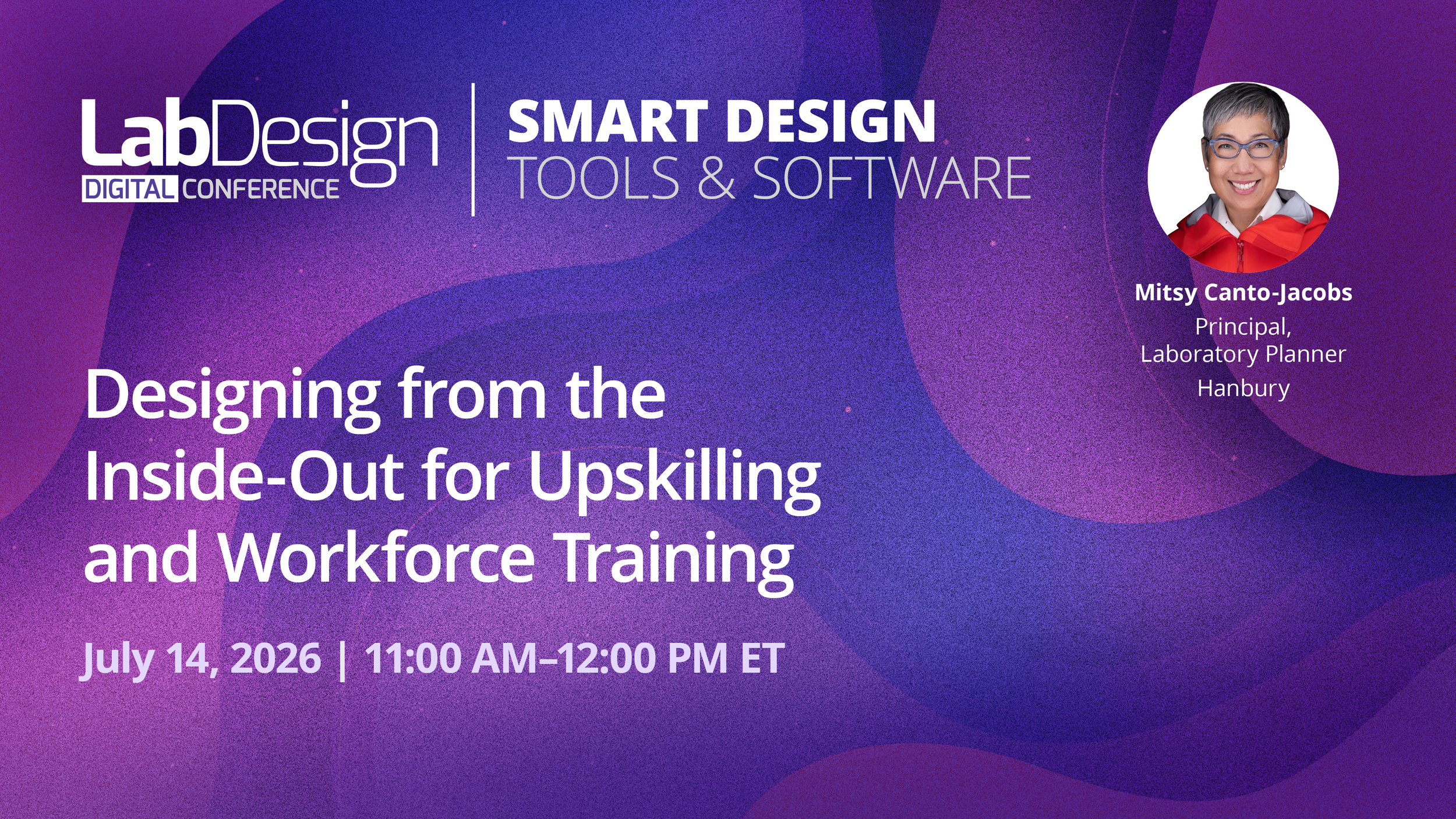
That question came up again and again during Designing from the Inside-Out for Upskilling and Workforce Training, an on-demand Lab Design webinar presented by Mitsy Canto-Jacobs, principal and laboratory planner at Hanbury, as part of the Smart Design Tools & Software Digital Conference.
As workforce training grows in advanced manufacturing, biotechnology, cybersecurity, and other specialized fields, colleges and innovation centers face a tricky design challenge. They need training environments that reflect what employers need today but can also adapt as equipment, certifications, and curricula change.
Canto-Jacobs argues that digital tools can help teams sort through that complexity—but they work best as part of an “inside-out” design approach that starts with people, workflows, and the user experience.
[INSERT QUOTE FROM MITSY ON THE RISK OF LETTING TECHNOLOGY DRIVE EARLY DESIGN DECISIONS]
Putting AI-generated programs to the test
During the webinar, Canto-Jacobs walks viewers through an experiment: She submitted the same workforce training and cybersecurity lab planning questions to several AI platforms and compared the results.
The answers varied considerably. The platforms organized information differently, pulled from different sources, and offered different levels of equipment detail. In one example, the AI tools generated substantially different room-by-room programs for the same cybersecurity training lab.
Some responses also used confident phrases such as “ideal program” or “common practice” without clearly explaining whether a recommendation came from a code, an industry standard, or a planning assumption.
The lesson isn't to avoid AI. Instead, Canto-Jacobs recommends treating the results as a starting point: compare outputs, trace references, check the numbers, and test the information against professional experience and actual client requirements.
[INSERT QUOTE FROM MITSY ON IDENTIFYING USEFUL AI OUTPUTS VERSUS RED FLAGS]
The full on-demand webinar takes a closer look at Canto-Jacobs' platform comparison and shows how different AI tools responded to the exact same programming questions.
Planning training labs for what's next
The session also looks at how workforce training facilities differ from traditional academic environments. These spaces are increasingly shaped by partnerships between educators and employers that want students and trainees to gain practical skills before entering the workplace.
For designers, that can mean planning what Canto-Jacobs calls “flexible specialized labs.” A training facility may need to accommodate changing equipment and curricula, but providing every possible utility from day one could quickly push a project beyond its budget.
Modular spaces, accessible utility pathways, and early conversations about ventilation and future infrastructure needs can give project teams more room to adapt.
[INSERT QUOTE FROM MITSY ON THE MOST IMPORTANT EARLY DESIGN DECISION FOR LONG-TERM ADAPTABILITY]
Keeping people in the process
One of the clearest takeaways from the webinar is that faster access to information doesn't replace conversations with the people who will actually use the lab.
Canto-Jacobs discusses workflow mapping and “day in the life” exercises that look at how different users move through and interact with a facility. Human behavior, safety risks, and day-to-day operational realities are still difficult for AI to fully understand.
AI-generated images come with similar limitations. A polished visualization may help a team explore an idea, but it might not account for engineering requirements, support spaces, or other real-world constraints. Instead of treating those images as finished solutions, Canto-Jacobs suggests using them to get users talking about what they see—and what may be missing.
Ultimately, AI's biggest value may be its ability to speed up research and iteration so project teams can ask better questions earlier. Architects, engineers, lab planners, and end users still have to decide which ideas are practical, safe, and right for the project.
Watch Designing from the Inside-Out for Upskilling and Workforce Training on demand to see Canto-Jacobs' AI platform comparison, programming examples, and practical discussion of where digital tools can—and can't—support the lab design process. The session is approved by AIA CES for 1 LU credit.