
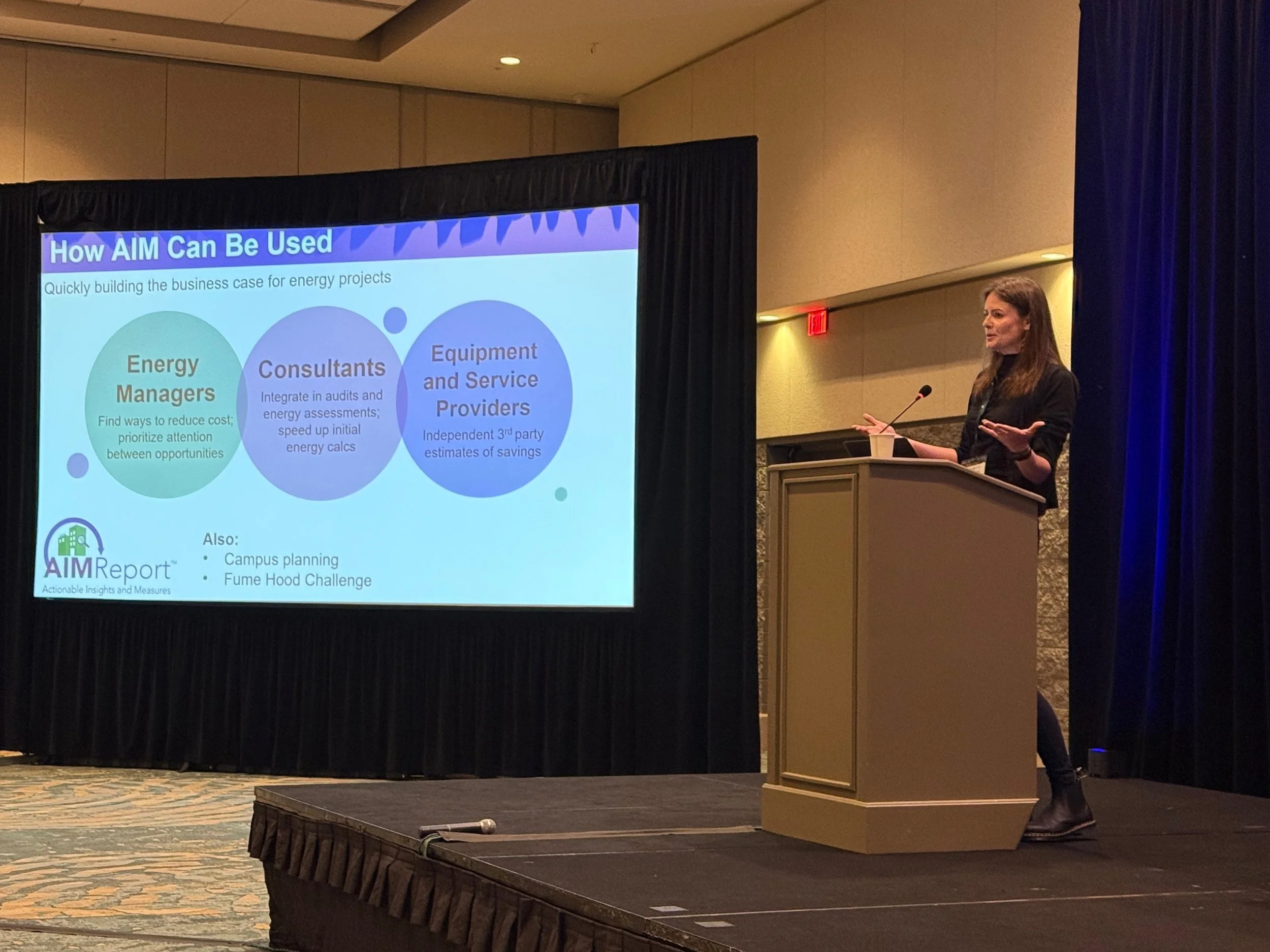
At the 2026 Lab Design Conference in Orlando, FL, I2SL’s Alison Farmer explored how laboratory organizations can use benchmarking, energy audits, and targeted improvements to reduce operating costs despite shrinking budgets.
As research organizations face shrinking budgets, rising energy costs, and increasingly stringent building performance requirements, improving laboratory energy performance can seem like another expense rather than a way to reduce costs. But according to Alison Farmer, president of the International Institute for Sustainable Laboratories (I2SL), energy efficiency can be a powerful tool for controlling operating expenses—particularly when organizations focus on the measures that matter most in laboratories.
Speaking at the 2026 Lab Design Conference in Orlando, FL, Farmer presented “Energy Improvement When Challenged With Shrinking Budgets,” outlining I2SL’s Labs to Zero program and a suite of tools designed to help laboratory organizations benchmark building performance, identify energy-saving opportunities, and prioritize improvements.
The need for those resources is particularly acute because laboratories do not perform like conventional commercial buildings. Federal research funding reductions are putting pressure on laboratory organizations, while building performance standards are introducing energy-use and emissions targets in jurisdictions around the country. At the same time, rising energy costs are increasing the financial incentive to reduce consumption.
“It's all putting an increased focus on our existing lab facilities at our organizations, and it means that we have to start to find cost-effective savings opportunities at those organizations, and also cost-effective ways of finding those opportunities,” Farmer said.
Benchmarking laboratories on their own terms
One of the challenges is determining which laboratory buildings are performing well and which warrant attention. Conventional commercial-building benchmarking tools do not adequately account for the wide range of laboratory types and energy-intensive systems.
For example, Farmer noted that laboratories do not have an Energy Star score, making it difficult to compare their performance with meaningful peers. Building performance standards can also place laboratories into broad categories that fail to recognize differences between teaching laboratories, research-and-development facilities, and vivarium-dominated buildings.
I2SL’s Laboratory Benchmarking Tool (LBT) addresses that gap by comparing laboratory buildings against a growing database of more than 1,500 facilities. The database incorporates not only energy consumption but also factors that influence that consumption, including laboratory type and the amount of laboratory space.
The result is a more meaningful basis for comparison. Energy-use intensity varies dramatically among laboratories, Farmer explained, with the database showing facilities ranging from approximately 50 to 950 kBtu per square foot per year. Teaching laboratories tend to fall toward the lower end, while research-and-development and vivarium-heavy facilities generally consume more energy.
The LBT now provides each participating building with an energy score and an operational emissions score on a scale of 1 to 100. The scores are percentile-based, so a score of 80 means the building performs better than 80% of the laboratories in the database.
Farmer said the tool's use increased significantly after I2SL introduced the scores, resulting in a larger dataset and allowing the organization to improve its scoring methodology. Updated scores released in February 2026 provide better treatment of facilities with significant fume hood use, vivarium space, and cold-climate locations.
For designers working on new facilities, the tool also includes a target-setting capability that can help establish the energy consumption needed to achieve a desired performance score.
Moving from benchmarking to action
Identifying an underperforming building is only the first step. The next challenge is determining what can actually be done about it.
Farmer cautioned that traditional commercial-building energy audits may not produce the most useful recommendations for laboratories. Measures such as shutting down air handlers when a building is unoccupied may not be practical when laboratories require continuous ventilation, while lighting upgrades, although worthwhile, may represent a relatively small portion of a laboratory’s overall energy-saving potential.
That is where I2SL’s new AIM report comes in. The automated online rapid energy audit tool is designed specifically for laboratory facilities and provides a faster, lower-cost way to identify and prioritize potential energy-efficiency projects.
AIM uses data from the Laboratory Benchmarking Tool to construct an energy model of the facility. Because the LBT requires only a relatively small amount of building information, AIM fills in missing information using what Farmer described as “intelligent assumptions” based on industry-standard practices and other building characteristics. Users can review and modify those assumptions when they have more accurate information.
The tool then evaluates potential energy-efficiency measures and provides estimated energy savings and implementation costs. Users can select individual measures and build customized packages based on their facility’s needs, available capital, or desired payback.
Importantly, AIM recalculates savings as measures are added, accounting for interactions between measures and avoiding double-counting savings.
The current version includes 26 measures, spanning building-level HVAC strategies, zone-level controls, fume hood measures, and occupant-focused strategies such as ultra-low-temperature freezer settings. I2SL was also working to add additional measures, including strategies addressing controls degradation and other operational dysfunction.
Prioritizing improvements with limited capital
For lab owners and end users facing shrinking capital budgets, the ability to prioritize improvements may be as valuable as identifying them.
AIM allows users to sort potential measures by implementation cost or simple payback, making it possible to build an energy-efficiency package around financial constraints. The tool also provides case studies of similar facilities and measures, which can help organizations develop the business case for investment.
“It's about being able to see what other people have done under similar circumstances,” Farmer said.
That information can also support conversations among owners, facilities teams, architects, engineers, and consultants. Farmer noted that consultants have been among the strongest early adopters of AIM, incorporating its results into their own assessment and audit processes.
The tool can also provide an independent point of comparison when equipment or service providers present their own energy-savings calculations.
For architects and lab planners, these capabilities offer another way to connect design and operational decisions to measurable energy performance. For existing facilities, they can help shift the conversation from broad sustainability goals toward specific projects with quantifiable costs and savings.
Building a culture of continuous improvement
Farmer emphasized that Labs to Zero was developed as a collective effort rather than around the recommendations of a single consultant or vendor. More than 100 I2SL volunteers participated through eight technical advisory councils, with SmithGroup, Buro Happold, and Lawrence Berkeley National Laboratory providing additional technical support.
The program also includes a professional accreditation initiative intended to create a network of individuals who understand the tools and can help organizations apply them effectively.
Ultimately, Farmer encouraged conference attendees to use the resources and provide feedback as I2SL continues expanding the program.
“We do really hope that you'll try using the tools,” she said. “Start using these tools as part of your projects with your clients, and absolutely let us know how it goes.”
For laboratories operating under financial pressure, energy efficiency does not necessarily have to begin with a major capital project. Better benchmarking, targeted operational changes, and careful prioritization can help organizations identify where limited resources are likely to have the greatest impact—while creating a clearer path toward lower operating costs and improved building performance.
Looking for practical ways to improve laboratory performance without relying on major capital investments? Join architects, engineers, laboratory owners, facility managers, and researchers at the 2027 Lab Design Conference, taking place May 10-13 in Dallas, TX. Learn from real-world projects and industry experts about strategies for improving energy efficiency, prioritizing investments, managing operational challenges, and making smarter decisions about the future of laboratory facilities.