
Ergonomics for Coding: Lighting & Acoustics in the Hybrid Lab
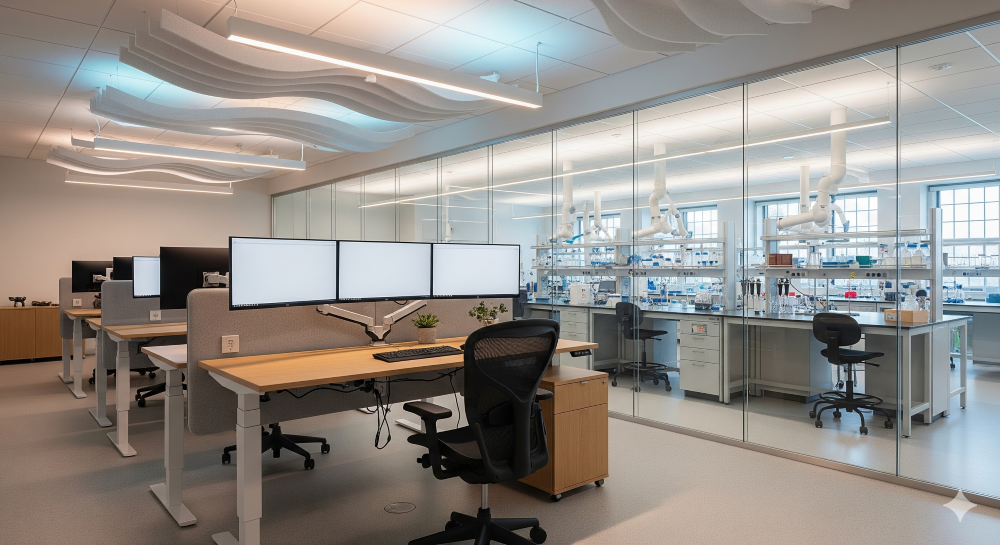
Bioinformaticians are coders, not chemists. Stop putting them on stools under fluorescent lights.
Credit: Gemini (2026)
Introduction: The coder in the chem lab
For decades, the "office" portion of a laboratory was treated as an afterthought—a row of desks squeezed against a corridor wall, subjected to the same harsh lighting and mechanical hum as the bench next door. However, the rise of computational biology has introduced a new type of resident: the data scientist.
These researchers do not pipette; they code. Their work is sedentary, screen-intensive, and demands deep focus. Yet, many facilities still force them to work in environments designed for wet chemistry. As highlighted in our analysis of dry lab design trends, neglecting the unique physical needs of these digital scientists can lead to burnout, eye strain, and lost productivity. This article explores how specific lab lighting design and acoustic strategies can create a high-performance environment for the computational workforce.
Lighting: Preventing digital eye strain
The lighting requirements for a wet lab and a dry lab are diametrically opposed, creating a schism in lab lighting design. A wet lab is a space of physical hazards; it requires high illuminance (typically 70 to 100 foot-candles) and uniform distribution to eliminate shadows. Scientists need this intensity to safely handle reagents, read small graduations on pipettes, and discern subtle color changes in assays.
Conversely, a dry lab is a digital environment where the primary focal point is a backlit monitor. Flooding this space with the same high-intensity light causes "veiling glare"—a phenomenon where ambient light reflects off the screen, washing out the data. To prevent digital eye strain, the dry lab requires significantly lower ambient light levels (often 30 to 50 foot-candles), prioritizing the illumination of vertical surfaces over horizontal benchtops.
Strategies for screen glare reduction:
Indirect Lighting: Instead of recessed troffers that cast harsh shadows, use suspended linear fixtures that bounce light off the ceiling. This creates a soft, diffuse glow that illuminates the room without creating "hot spots" on glossy screens.
Task Lighting: Democratize the lumen count. By lowering the overhead ambient light to 30 foot-candles and providing adjustable task lights at each desk, lab planners allow researchers to customize their environment. A coder debugging a script may prefer near-darkness, while a PI reviewing a paper needs bright light.
Zoning: If the wet and dry labs are visually connected (e.g., through glass partitions), ensure that the lighting zones are switched separately so the bright "safety light" of the bench doesn't bleed into the coding zone.
Circadian lighting: Syncing with the sun
Bioinformaticians often work long, irregular hours, frequently in windowless core facilities. Staring at blue-light-emitting screens under static cool-white LEDs can severely disrupt the body's natural sleep-wake cycles. This is where circadian lighting becomes a critical tool for human-centric design.
Definition: Circadian lighting is a strategy that controls the intensity and color temperature (Kelvin) of electric light to support human biological rhythms. It is designed to mimic the natural progression of sunlight, stimulating the production of cortisol (alertness) in the morning and melatonin (sleep) in the evening.
Implementation strategy: In a dry lab setting, this is achieved through tunable-white LED fixtures linked to a sophisticated control system.
Morning (Alertness): The system delivers high-intensity, cool blue light (4600K-6500K). This suppresses melatonin production, helping researchers wake up and focus during the start of their shift.
Midday (Sustain): The light transitions to a neutral white (3500K-4000K), balancing visual comfort with task performance.
Late Afternoon/Evening (Wind Down): As the day ends, the system shifts to a warmer, amber light (2700K-3000K) with lower intensity. This signals the body to prepare for rest, preventing the "wired and tired" feeling common among tech workers.
Implementing these tunable systems in dry lab zones has been shown to improve cognitive function, mood, and sleep quality, serving as a critical retention factor in the competitive tech-bio market.
Acoustics: The sound of science
Wet labs are noisy machines. Fume hoods, ultralow temperature freezers, and centrifuges create a constant mechanical drone that often exceeds Noise Criteria (NC) 50. For a chemist active at the bench, this is white noise; for a bioinformatician trying to hold a mental model of a complex algorithm, it is a cognitive disruptor.
To create a viable hybrid environment, the lab architect must manage the transmission loss between zones with precision.
The Glass Barrier (STC Ratings): While visual transparency is desired to maintain team cohesion, a simple pane of 1/4" tempered glass is often insufficient to block low-frequency mechanical noise (rumble). High-STC (Sound Transmission Class) assemblies are required. Specifying laminated glass or double-glazed systems with an air gap can raise the STC rating from a standard 30 to a robust 45+, effectively dampening the roar of the wet lab equipment.
Absorption vs. Reflection (NRC Ratings): Wet labs are constructed of hard, impervious surfaces (epoxy, sheet vinyl, steel) that reflect sound, creating a reverberant chamber. The dry lab zone must compensate for this. To lower the Reverberation Time (RT60), the computational zone should maximize absorptive materials. This includes high-NRC (Noise Reduction Coefficient) ceiling tiles (0.75 or higher), carpet tiles with cushion backing, and fabric-wrapped acoustic wall panels to soak up speech frequencies.
Sound Masking: Paradoxically, a room that is too quiet can be distracting, as every whisper becomes audible. Introducing a sound masking system—emitters that generate a calibrated, unobtrusive "pink noise"—raises the ambient background sound level just enough to mask distinct conversations. This creates the "library quiet" atmosphere essential for deep focus work, allowing researchers to code without being interrupted by a phone call three desks away.
Furniture: sit, stand, code
The traditional lab stool is an ergonomic disaster for a full-time computer user. Designed for short-term "perching" at high benches, these stools typically lack lumbar support, armrests, and proper seat pan depth. For a bioinformatician sitting for eight hours a day, this leads to slouching, restricted circulation in the legs, and chronic back pain.
Dry lab workstations require a fundamental shift in specification. The standard must be BIFMA-rated task chairs that offer synchronous tilt, adjustable armrests, and dynamic lumbar support. Furthermore, because coding is a sedentary activity, electric sit-stand desks are highly recommended to promote circulation and reduce the health risks associated with prolonged sitting.
In terms of hardware, monitor arms are non-negotiable. A bioinformatician typically uses two or three monitors to view code, data, and visualizations simultaneously. Fixed monitor stands clutter the desk and often force the user into a static, hunched position. Heavy-duty articulating arms allow the user to position screens at the perfect focal depth and height, reducing neck strain and reclaiming valuable desk real estate for papers or tablets.
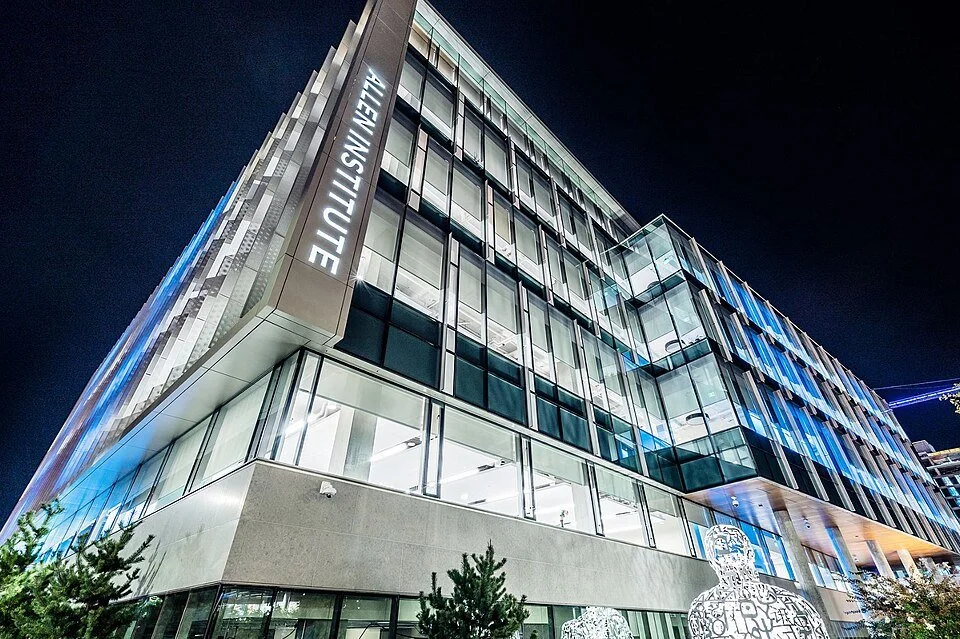
Case study: The Allen Institute
A premier example of successfully integrating these ergonomic principles is the Allen Institute in Seattle, designed by the architecture firm Perkins&Will. As a pioneer in brain and cell science, the Institute generates and analyzes massive amounts of biological data, relying heavily on both physical experimentation and computational modeling.
Instead of isolating the data scientists on a different floor or in a generic office building, the design team created a series of "computational pods" located directly adjacent to the wet bench areas.
Image via Wikimedia Commons
Acoustic and Visual Balance: To achieve this close proximity without the noise penalty, the dry computational pods are enclosed in high-STC double-glazed glass. This provides the "library quiet" necessary for deep coding while maintaining a continuous visual connection to the active lab floor, fostering spontaneous, interdisciplinary collaboration.
Ergonomic Workspaces: Recognizing the intensive screen time required for their bioinformatics teams, the computational pods feature height-adjustable sit-stand desks, dual-monitor articulating arms, and BIFMA-certified ergonomic seating.
Lighting: The building maximizes daylight harvesting, but automated roller shades and indirect ambient lighting ensure that the digital workspaces remain free from veiling glare, protecting the researchers from digital eye strain.
This human-centric approach proves that with the right architectural infrastructure, data scientists and bench chemists can thrive in the exact same hybrid ecosystem.
Conclusion: human-centric infrastructure
The successful hybrid lab recognizes that the human is the most expensive piece of equipment in the room. By tailoring lab lighting design, acoustics, and ergonomics to the specific tasks of the computational team, the lab architect creates a space that supports the science by supporting the scientist.
Frequently asked questions (FAQ)
What is the ideal color temperature for a dry lab?
For general working hours, a neutral white (3500K to 4000K) is standard. However, a tunable system that shifts from cool to warm throughout the day is the gold standard for occupant health.
Can you use carpet in a dry lab?
Yes, provided it is physically separated from the wet lab zone. Carpet is an excellent acoustic absorber and improves comfort for standing desks. However, it should never be used where chemicals or biological agents are handled.
How do you reduce noise from server closets?
Local server racks are loud. They should be located in a dedicated, enclosed room with sound-sealed doors and independent cooling, rather than sitting open in the dry lab workspace.
