

Avantor’s reception space welcomes staff and visitors with curvilinear corners in the ceiling and on the floor, creating clear transitions between the custom reception desk and circulatory space. Image: Kat Kendon
When Avantor, Inc. set out to create its new Innovation Center in Bridgewater, NJ, the company envisioned more than a traditional laboratory facility. The project, designed by HLW, sought to merge advanced research environments with collaborative office space, creating a holistic ecosystem capable of supporting next-generation biopharmaceutical and materials development.
Completed in August 2024, the Innovation Center brings together a wide range of laboratory environments, including BSL-2 viral labs, analytical and chemistry labs, cleanrooms, pilot production areas, and specialized manufacturing suites. Integrated offices, training rooms, and collaboration spaces further support a unified workplace that advances research while enhancing the employee experience and operational efficiency. The project cost, totaling $18,274,571 ($354/usf), reflects the extensive infrastructure overhaul required for a 65,000 sf facility.
But delivering this vision required transforming an existing office building into a highly technical laboratory facility. This was a complex process that demanded careful planning, creative engineering, and deep collaboration among designers, engineers, and contractors. The project team included HLW (architecture and design), Vanderweil Engineers (MEP), O’Donnell & Naccarato (structural engineer), Spark (lighting designer), Langan (civil engineer), Cerami (acoustical engineer), and Cenero (AV consultant).
Strategic site selection and early planning
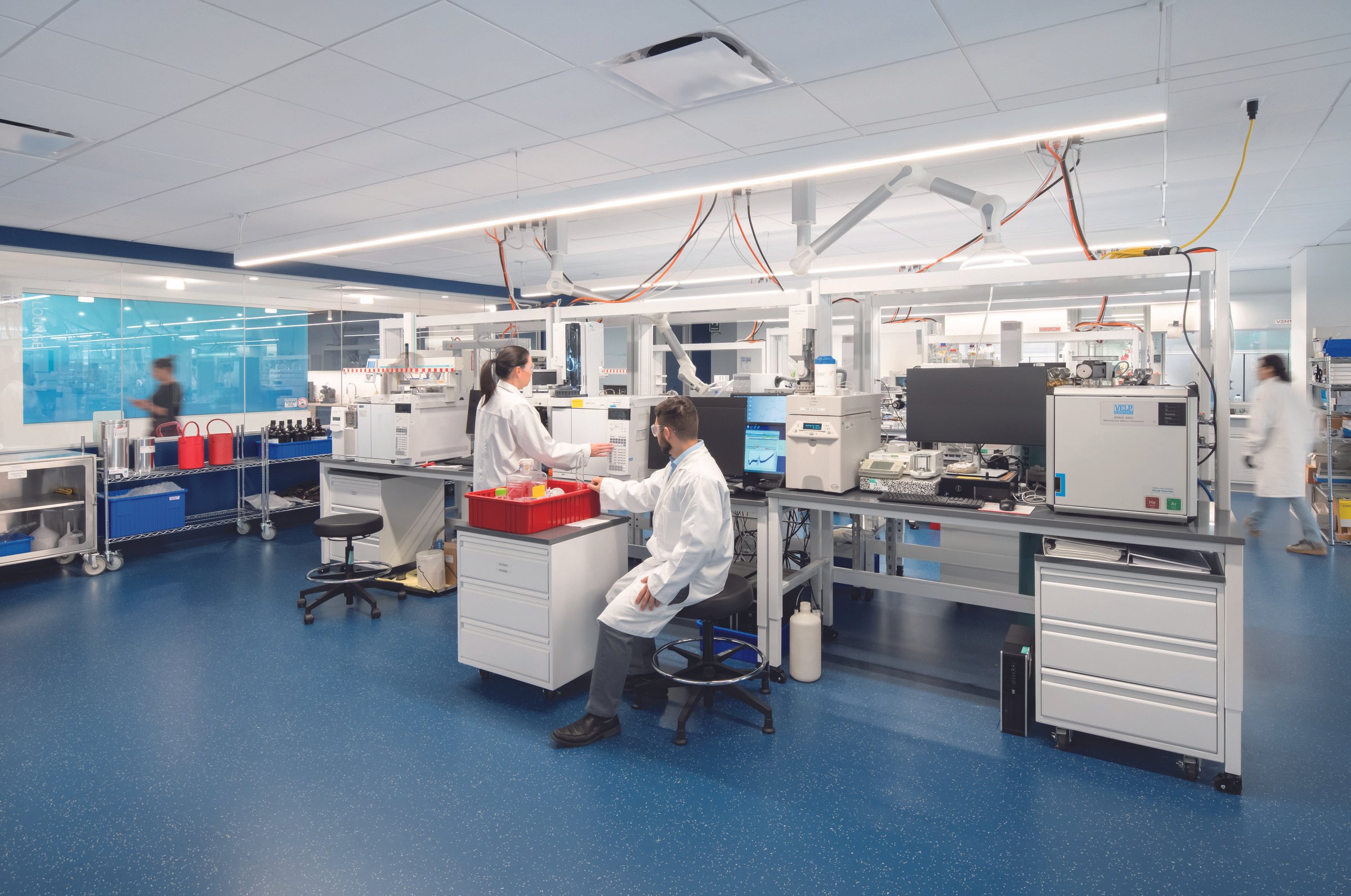
Early and frequent coordination with engineering partners and specialty consultants overcome infrastructure challenges to ensure the robust mechanical, electrical, and plumbing systems required for laboratory environments could be achieved. Image: Kat Kendon
Converting an office building into a laboratory environment introduces inherent constraints, particularly around ceiling heights, infrastructure capacity, and utility distribution. From the outset, the project team recognized that selecting the right building would be critical. The laboratories are on the ground floor, while the office spaces are on the second floor.
The building’s ground-floor layout provided several strategic benefits. Its generous floor-to-deck height made it easier to install and maintain complex laboratory mechanical systems than in a standard office building. Additionally, an existing loading dock facilitated the smooth movement of materials into and out of the labs.
“Having the ground floor a little bit higher than the other office spaces [gave us] an extra foot or so to play with,” says Robert Thomas, principal at HLW. “The initial site selection was well done.”
Early engagement from the full project team, including engineers, contractors, and sustainability specialists, also played a crucial role in identifying potential risks and opportunities. This integrated approach ensured that infrastructure upgrades, space programming, and utility planning aligned with Avantor’s operational needs from the beginning.
Collaborative BIM solutions and infrastructure hurdles
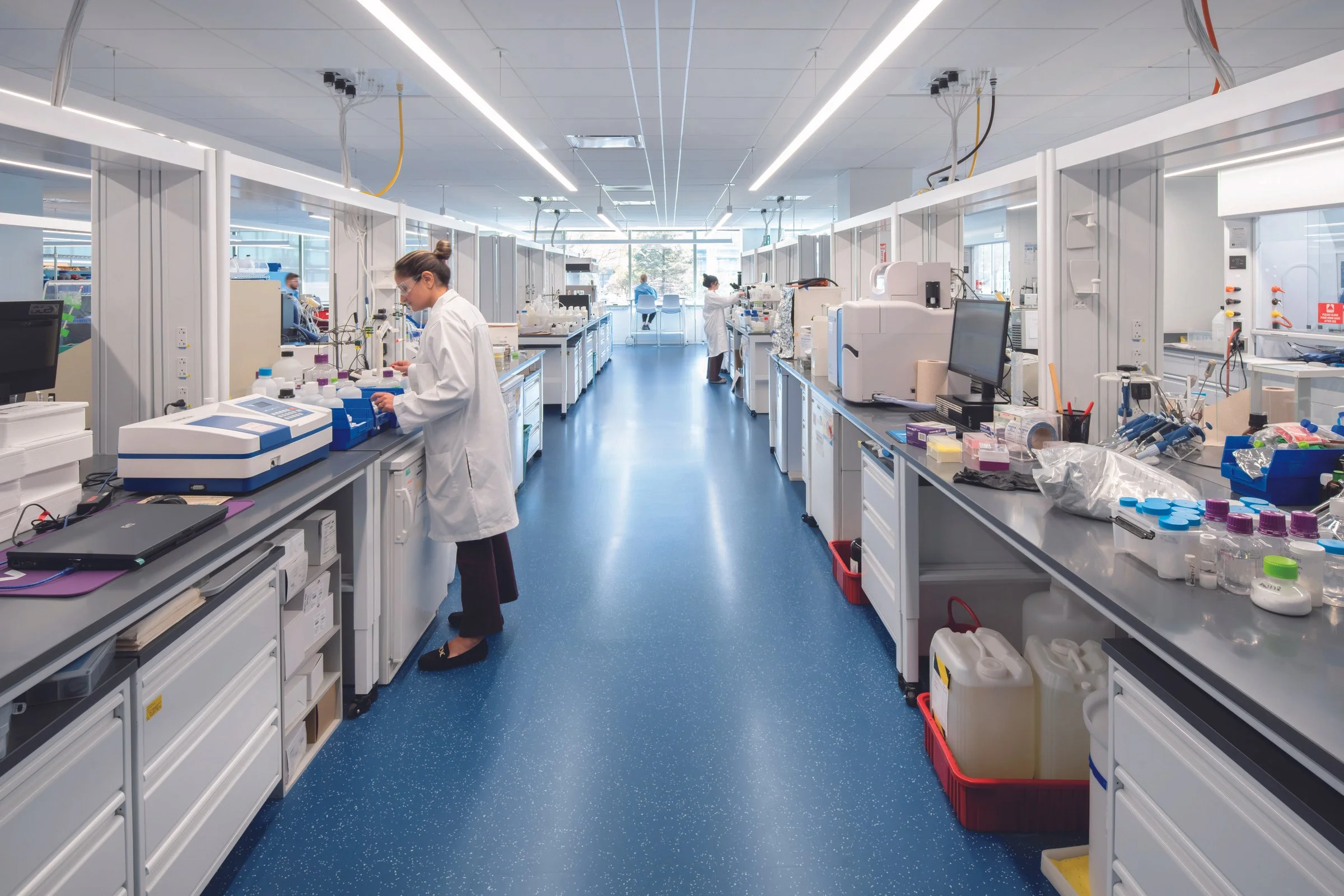
Existing structure heights challenged the design team to identify efficient routing strategies and select low-profile equipment to maintain proper clearances and meet code requirements while preserving ceiling heights within the lab areas. Image: Kat Kendon
One of the most significant challenges was adapting an office building’s infrastructure to meet laboratory requirements. Office buildings are typically not designed to support the high ventilation rates, specialized exhaust systems, and increased electrical loads required in lab environments.
“A big part about the existing facility there was the floor-to-floor height of an office building compared to what your traditional laboratory would have,” Thomas says. “We were able to work within the existing building envelope to create an efficient laboratory.”
The team upgraded mechanical and electrical systems and created new vertical utility pathways to support exhaust and supply requirements. To optimize space, the design team used Building Information Modeling (BIM) extensively, specifically Revit.
“We coordinated in 3D where the infrastructure was landing, and how that was going to affect the architecture,” says Erin Vasold, senior project manager at HLW. “We could really make sure that we didn’t have any conflicts. We could see that early on, prior to construction.”
This detailed modeling enabled infrastructure to be routed strategically—often through corridor zones—to preserve the maximum ceiling height in laboratory spaces. Furthermore, the team addressed slab-on-grade conditions by executing targeted slab trenching and core drilling to install new wet lab infrastructure without compromising structural integrity.
Zoning diverse lab programs for safety and efficiency

By positioning the labs along perimeter glazing and incorporating interior glass partitions, employees benefit from access to natural daylight. Image: Kat Kendon
The Innovation Center houses a broad spectrum of laboratory functions, from analytical chemistry to cGMP pilot production. Each requires different environmental controls, safety protocols, and utility systems. To address this complexity, the design team organized laboratories into clearly defined zones based on function, chemical usage, and airflow requirements.
“We separated the cGMP facility with the other labs,” Thomas says. “We grouped chemistry and biology together to utilize one control zone, and then the cGMP was on the other side.”
This zoning strategy improved safety and operational efficiency while allowing each lab type—including protein resin manufacturing, material testing, and bacterial labs—to maintain its required environmental conditions. Material flow was equally prioritized, with the layout supporting a logical progression from raw material intake to packaging, minimizing contamination risks.
At the same time, Avantor wanted its scientific work to remain visible. Branded portals and full-height glass doors were used at lab entrances to support wayfinding and transparency.
“A lot of what we did was to kind of put it in a logical order, to showcase it,” Thomas says, “and also to allow glimpses into the facility. Visiting groups could come by and they could look into the production without going into it to see how things were manufactured and how the process worked.”
Natural light and collaborative spaces for well-being
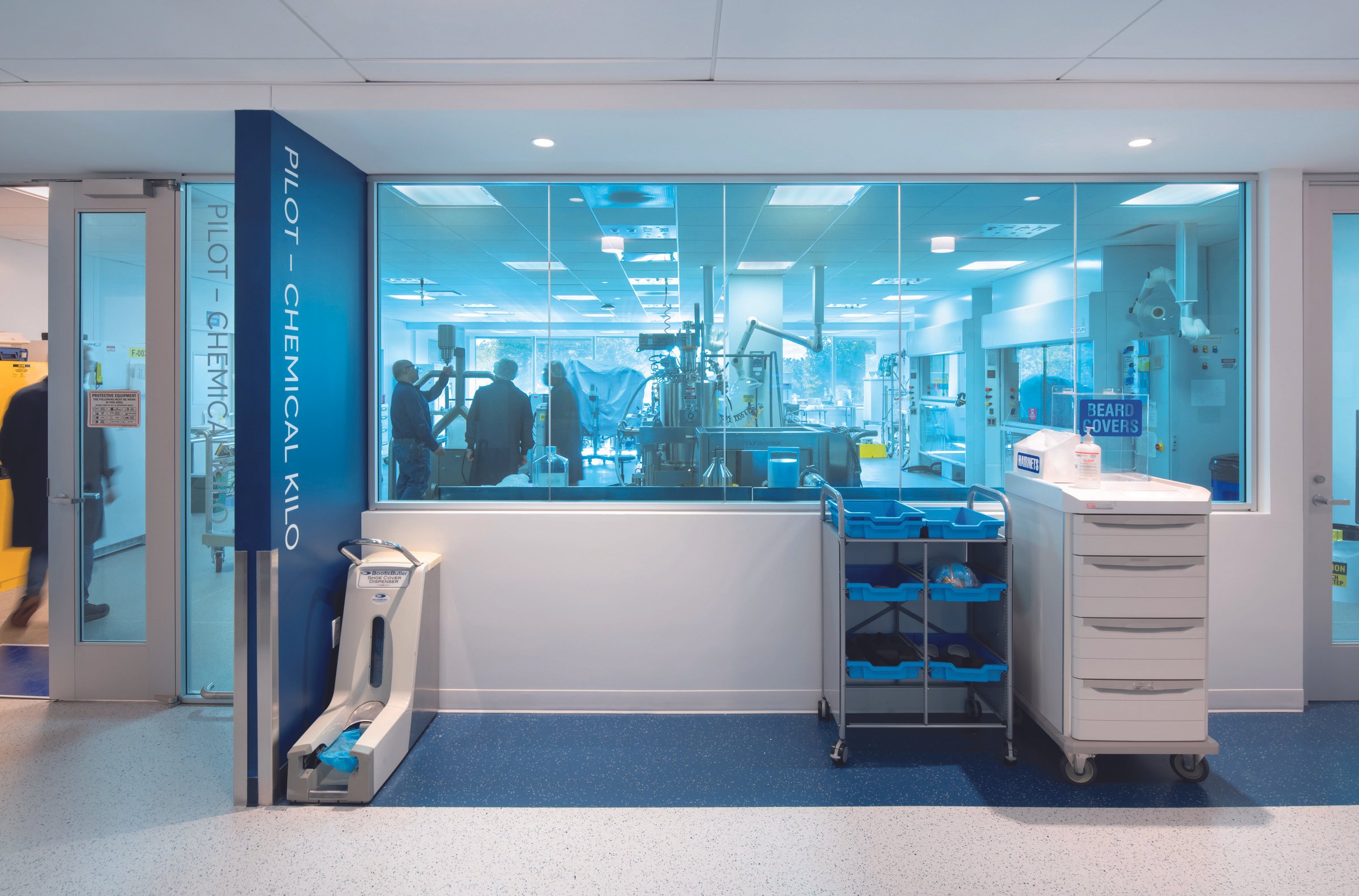
A variety of specialized labs support Avantor’s scientific advances, including a production pilot lab to test new processes and technologies. Image: Kat Kendon
Unlike many laboratory facilities, Avantor’s Innovation Center prioritizes access to natural light—an uncommon feature in high-performance lab environments.
“The drivers are definitely the end users within the lab,” Vasold says. “Avantor really wanted to make sure that their people had a healthy workspace. And we all know that natural light creates a healthy workspace.”
To achieve this, laboratories were positioned along the building perimeter, taking advantage of the office building’s expansive windows. Interior glass partitions and carefully designed sightlines allow daylight to penetrate deep into laboratory corridors.
Glass fronts allow lab users to see all the way out to the outside, Vasold explains. “People within the corridors could also feel the natural light. It really was employee-driven—they wanted to make sure that they had this access to natural light.”
Balancing transparency with functionality required careful design adjustments. Full-height glass walls were initially considered but ultimately modified.
“After a lot of discussion, we decided to bring the glass up to only half-height so they had the ability to put equipment along that wall and hide it, but still have the layering effect to see through,” says Thomas. This approach preserved access to natural light while maintaining necessary workspace functionality and flexibility in equipment placement.
A key goal of the project was to integrate laboratory and corporate environments to foster greater collaboration. The facility’s layout places laboratories on the ground floor and office functions above, connected by shared circulation and visual continuity. Amenities such as collaboration lounges, a tech hub, and a hydration lounge were distributed throughout, encouraging spontaneous interaction.
Despite the energy-intensive nature of laboratory operations, the Innovation Center targeted LEED Silver certification. The project achieved significant performance metrics, including a 40 percent reduction in water use, a 17 percent reduction in energy consumption, and the implementation of low-profile equipment and efficient routing to preserve ceiling heights while meeting technical codes.
Collaborative design is key

Corridors support adjacent laboratory spaces by providing necessary storage, access to PPE, distinct wayfinding, and clear circulation paths. Image: Kat Kendon
Looking back, both Thomas and Vasold emphasize that early collaboration and team engagement were the most important contributors to project success.
“The repeat [lesson] is just engaging everybody,” says Vasold. “We were able to have early programming meetings, early reviews of their existing lab space, [to ask] what worked for them in their existing space? Why do they want to move? What did not work? What were the challenges that they had in their existing space?”
The Innovation Center stands as a compelling example of how adaptive reuse, combined with forward-thinking design, can meet the evolving demands of life sciences research—creating flexible, sustainable environments ready to support future scientific breakthroughs.