
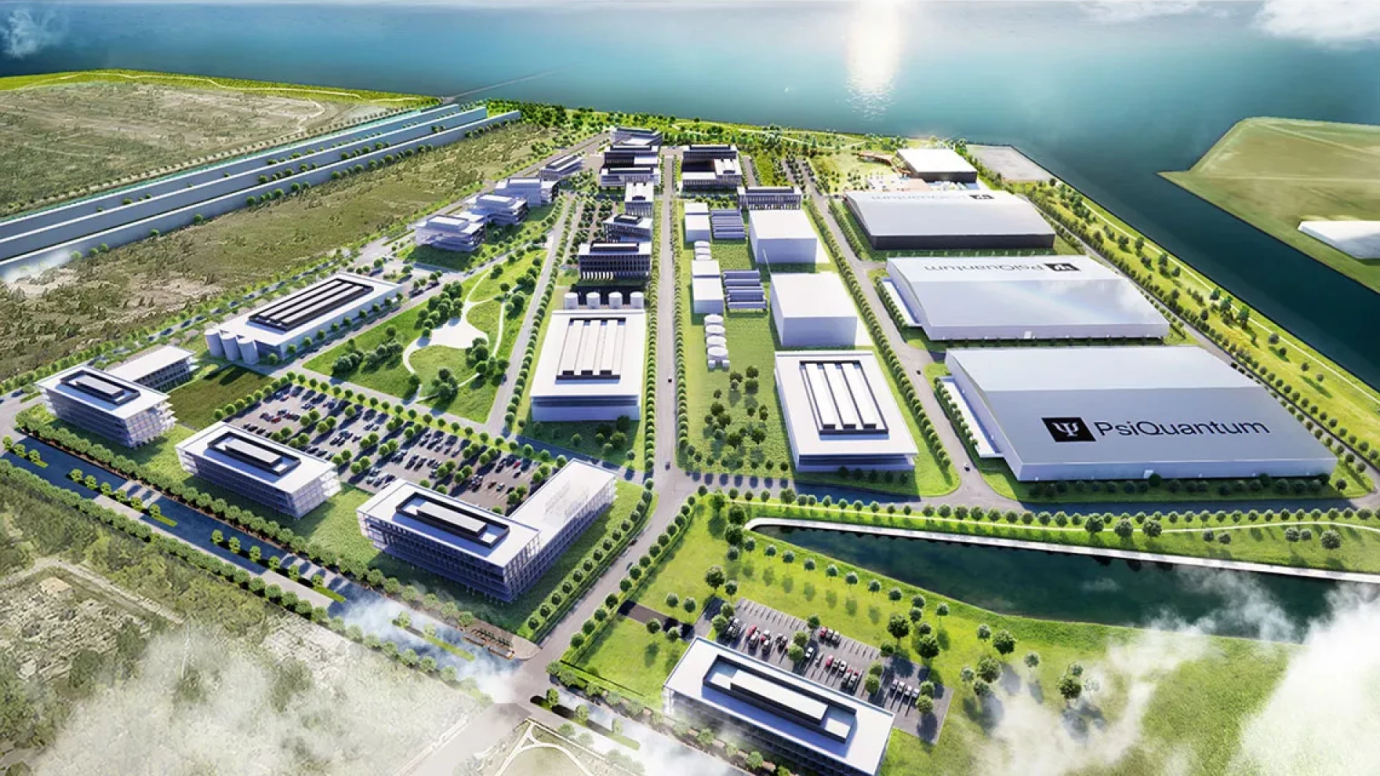
A rendering of the Illinois Quantum and Microelectronics Park when completed. Image: Courtesy of IQMP
The future of technology is taking shape on the south side of Chicago, where a historic industrial site is being reimagined as a global hub for quantum and microelectronics research. The Illinois Quantum and Microelectronics Park (IQMP)—the largest concentration of quantum activity in North America—celebrated its ceremonial groundbreaking on September 30, 2025, marking a shift from the former US Steel South Works plant to a center designed to attract billions in investment and create thousands of jobs.
Anchor tenant PsiQuantum aims to build the first utility-scale, error-corrected quantum computer at the Park, joining other global innovators including IBM, Diraq, and Infleqtion. The overarching goal is to accelerate the development and commercialization of quantum technologies with the potential to address critical challenges, including climate change, health care, and energy solutions.
Navigating the legacy of an industrial site
Transforming a former steel mill into a state-of-the-art research facility brings unique challenges. “We’re excited to start building on a site with so many advantages in land availability, power, logistics, and proximity to partners and talent,” says Harley Johnson, PhD, CEO and executive director of IQMP. “Because we’ve been diligent and proactive throughout the preparation process, there haven’t been many hurdles to jump.”
The site’s industrial past required careful environmental planning. While two ‘No Further Remediation’ (NFR) determinations had been issued by the Illinois Environmental Protection Agency (IEPA) in 1997 and 2010, the development team enrolled the 440-acre property in the IEPA’s Site Remediation Program to ensure any lingering concerns were addressed. Site conditions have remained stable and will not affect design or construction plans.
“We knew further environmental testing would be conducted; because technology has advanced since the last evaluation in 2010, we’re able to go beyond the protections of the prior NFR letters and conduct a more thorough, targeted assessment,” says Johnson.
The remediation approach includes vertical barriers around the perimeter to physically contain and treat contaminants physically, and horizontal barriers covering the site to protect underlying soils from future exposure. This strategy aligns with the US EPA’s Greener Cleanups framework, reducing energy use, emissions, and water consumption while responsibly repurposing brownfield land.
The lakeside location necessitated planning for weather and water-related risks. Extensive geotechnical analysis confirmed that the site is stable. Flooding concerns are limited because the property is outside a FEMA-designated flood zone, and building grades are set high. Existing lakefront structures, including shoreline revetments and concrete ore walls in Steelworkers Park, provide additional protection.
Specialized lab design features
Quantum and microelectronics research requires precise environmental controls, and IQMP is addressing these needs with tailored design solutions. “Specialization will vary between buildings, and likely within buildings, too. This kind of variation is typical within research labs you’ll find at any major university. We have experts focused on vibration tolerances, electromagnetic shielding, humidity, and other specialty designs,” says Johnson.
At the same time, flexibility remains a core principle. “We see the IQMP as a malleable space that can be reconfigured over time. Similarly to how we plan university labs, the technical lab spaces on campus will start as flexible, basic shells. When businesses come and go, these rooms will be customized. People who work in this industry (like the tenants seeking to operate at the IQMP) understand that you start with basics and renovate over time to meet evolving demands. The campus is not meant to be a monolith—it’s meant to be accessible and adjustable for companies tackling issues that don’t even exist yet.”
Recognizing the high cost and complexity of cryogenic systems, IQMP is building a shared facility to give tenants scalable access to essential cooling technologies. “One way we’re ensuring that the IQMP is a flexible ecosystem is by developing onsite cryogenic cooling (‘cryo’) systems. Due to the varying nature of new technologies, companies across the quantum computing industry have different cryo needs; we anticipate 70 to 75 percent of the industry needing some form of access to cryo. The point of having a shared facility at the IQMP is to help companies scale up quicker and more efficiently by accessing equipment that would be difficult to acquire independently. It also means tenants who are NOT quantum computing companies but would still use or support quantum—especially those in the microelectronics space—can have access to the same technology, like cooling power and helium.”
Sustainability and decarbonization

President of Cook County Board of Commissioners Toni Preckwinkle, Chicago Mayor Brandon Johnson, and Illinois Governor JB Pritzker join in a ceremonial groundbreaking at the future site of the PsiQuantum facilities at the Illinois Quantum and Microelectronics Park (IQMP) on the South Side of Chicago on September 30, 2-25. Image: Alexandra Buxbaum/Sipa USA)(Sipa via AP Images)
IQMP is designed with sustainability at the forefront. “Unlike the steel mills of the past, facilities housed at the IQMP will not utilize substances that pollute the air, water, or soil. The cryogenic cooling facilities at the Park will use helium and nitrogen (both inert, non-toxic and safe gases) and no chemical pollutants, similar to facilities that already operate at national labs, universities, and other institutions. The IQMP will also use closed-loop water cooling that not only requires less energy, but draws water from the city of Chicago’s municipal water system, not Lake Michigan. Anchor tenant PsiQuantum will essentially have zero emissions and use 100 percent carbon-free electricity to power their facility,” says Johnson.
The responsible reuse and remediation of the brownfield land is another key element. “To meet the highest ecological and regulatory standards, the remediation strategy for QSC encompasses multiple measures designed to ensure the site is safe for development now and into the future. It also follows the US EPA’s Greener Cleanups framework, which minimizes energy use, air emissions, and water consumption while reducing waste and protecting land and ecosystems.”
Beyond technical and environmental considerations, IQMP is thoughtfully connecting with Chicago’s South Side community and the lakefront. “As we work through the buildings’ feasibility and explore design ideas, our intention is to incorporate details that pay homage to the US Steel South Works’ history. We’re planning to use materials and aesthetic elements that highlight historic references and invoke the natural landscape around our space. The architects we’re working with are helping us consider how to thoughtfully elevate pieces of the site’s past to communicate our vision for its future. We also envision the façade having recognizable features of the lakefront, and we plan to use native greenery in our landscape to strengthen ecological and community connections,” Johnson explains.
Lessons in design and flexibility
The former steel mill provides some pre-existing advantages. “In terms of utilities, one positive is that the steel mill had a lot of power coming in, so we’re fortunate to have some electrical transmission infrastructure already in place—though it will naturally need to be upgraded over time,” Johnson says. Additionally, the site’s proximity to the lake and river facilitates efficient transport of construction materials.
The IQMP illustrates how proactive planning, thoughtful remediation, specialized lab design, sustainability measures, and flexible building shells can transform an industrial legacy into a hub for global scientific innovation. As Chicago’s South Side begins this next chapter, the project sets a blueprint for high-tech campus development, marrying rigorous environmental standards with the adaptability needed for rapidly evolving research.