
Building Quantum Research Spaces: Planning for Power, Precision, and Flexibility
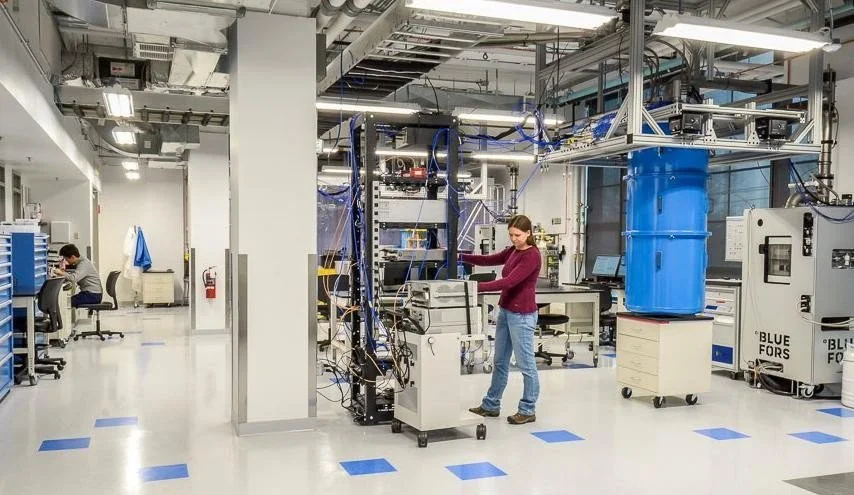
Quantum Circuits in New Haven, CT, designed by Svigals + Partners, an FCA Company. Image: Courtesy of FCA
As quantum technologies move from theoretical exploration toward practical application, research institutions are building specialized facilities to support the next generation of computing and materials science. For architects and lab planners accustomed to wet labs or traditional physics facilities, quantum research spaces introduce a different set of design priorities—ones centered on power infrastructure, environmental stability, fabrication capabilities, and adaptability.
Despite their reputation as highly complex environments, the spatial requirements of quantum research facilities can be surprisingly straightforward. According to Robert B. Skolozdra, partner with FCA and Lab Design News editorial board member, the biggest misconception is that these facilities resemble traditional research labs.
“Quantum research spaces are simpler than you would think,” says Skolozdra. “Generally, they feature very tall, open ceilings, and can benefit from elevated working platforms for enhanced overhead access. They require large amounts of floor space to accommodate necessary quantities of process equipment, in addition to easy access to compressed air and chilled water.”
For project teams, this means prioritizing spatial openness and infrastructure access over densely arranged benches or extensive wet-lab casework. The equipment used in quantum research—such as dilution refrigerators, cryogenic systems, and specialized computing hardware—often demands generous clearance, stable environmental conditions, and substantial mechanical and electrical support.
Infrastructure and power demands
In many ways, quantum facilities resemble high-performance computing environments. Equipment must run continuously while maintaining extremely low temperatures, and interruptions can disrupt sensitive experiments or damage costly hardware.
“Very similar to data centers, quantum research facilities need large amounts of noise-free grounded power and, ideally, these spaces come equipped with 100 percent backup power,” Skolozdra says.
Electrical reliability is therefore one of the most critical design considerations. Systems must support uninterrupted operation, often requiring redundant feeds, backup generators, and uninterruptible power supplies (UPS). These redundancies extend beyond the research equipment itself to include mechanical systems responsible for cooling and environmental stability.
The need for stable conditions also influences mechanical design. Quantum systems often depend on cryogenic cooling using liquid nitrogen or other specialized systems, and even minor fluctuations in temperature, vibration, or air quality can compromise experimental outcomes.
Retrofitting existing buildings
As universities and research institutions race to establish quantum programs, many look to retrofit existing laboratory or academic buildings. While adaptive reuse can be cost-effective, the infrastructure demands of quantum research present significant challenges.
“Retrofitting for quantum research requires understanding the infrastructure demands of these facilities,” says Skolozdra. “It is important to make sure the building has the capacity and availability of processed chilled water. Additionally, full electrical backup for all mechanical systems and research equipment is crucial.”
Skolozdra cautions that overlooking these requirements can have serious consequences. “Without these redundancies in place, you run the risk of compromising both the sustainability and reliability of your research operation.”
Structural considerations can also come into play. Older buildings may lack the ceiling heights or floor load capacity needed to accommodate large cryogenic systems, vacuum chambers, or fabrication equipment. Early feasibility assessments are therefore essential to determine whether an existing facility can realistically support the program.
The manufacturing connection
Another factor that often surprises design teams is how closely quantum facilities resemble advanced manufacturing environments.
“One of the most non-intuitive challenges involves how closely quantum computing environments can resemble facilities for advanced manufacturing rather than conventional research labs,” Skolozdra says.
While some institutions purchase specialized components from external vendors, many fabricate their own devices on-site. Quantum research often involves developing microchips, circuit boards, and other delicate components that require controlled fabrication environments.
“The reality is that many institutions are fabricating their own chips and circuit boards in-house. This requires clean rooms, specialized fabrication spaces, and infrastructure reminiscent of a chip manufacturing facility more than an academic lab,” says Skolozdra.
As a result, facility programs frequently include cleanrooms, precision machining spaces, soldering areas, and electronics assembly labs. These environments must maintain strict particulate control to prevent contamination of micro-scale components.
Rethinking traditional lab design
The functional emphasis of quantum research also differentiates these facilities from traditional wet labs. Instead of extensive chemical experimentation, quantum labs focus primarily on hardware development and computational experimentation.
“The design strategies utilized in quantum labs differ from traditional facilities primarily because their main function is computer processing,” Skolozdra explains. “Computer processing requires significant amounts of electricity, and each piece of equipment typically requires a backup power source for emergency interruptions.”
The activities taking place in these environments are also distinct, he adds. “Additionally, quantum labs involve very little bench chemistry, instead focusing on machining, soldering, and circuit board production, where airborne particles can contaminate microchips and components,”
This shift in function affects everything from HVAC design to material selection. Clean environments, vibration control, and electromagnetic stability can be just as important as chemical safety systems in these facilities.
Sustainability challenges
Quantum computing’s infrastructure requirements create significant energy demands, particularly because systems must maintain extremely low temperatures for continuous operation.
“Quantum facilities require a large amount of power to maintain ultra-low temperatures and continuous operation. This makes energy use a significant sustainability challenge in the field,” Skolozdra notes.
To address these concerns, research institutions and designers are exploring ways to offset the energy intensity of these systems, he says. “The industry is increasingly exploring renewable energy sources to offset electrical loads. At the same time, facilities are repurposing and retrofitting older hardware, which both reduces waste and extends the lifecycle of existing equipment.”
These strategies—along with ongoing research into more efficient cooling technologies—represent early efforts to balance the performance demands of quantum research with long-term environmental goals.
Designing for collaboration
Despite their technical complexity, quantum research facilities must also support collaboration among interdisciplinary teams. The field brings together physicists, engineers, computer scientists, and materials researchers, making communication between groups essential.
“The most effective design features to connect the researchers are those that enhance communication and transparency,” Skolozdra says.
Architectural strategies can help foster this interaction. “We make sure to have whiteboards in meeting rooms to aid in brainstorming, windows in offices that look into labs to provide a visual connection with the work, and thoughtfully placed break rooms and collaboration spaces that encourage interaction,” Skolozdra says. “Combined, these elements create an environment that helps teams connect.”
Visual transparency and proximity between theoretical and experimental teams can accelerate problem-solving and innovation.
Planning for rapid change
Finally, quantum research facilities must remain adaptable. Equipment, methodologies, and technologies in the field are evolving rapidly, making flexibility a critical design goal.
Rather than designing one monolithic facility, Skolozdra’s team often takes a modular approach. “We typically start by designing each research facility individually, then interconnect these centers as a scalable network—literally ‘daisy-chaining’ systems together as demand and technology progress,” he says.
This strategy allows institutions to expand capacity incrementally as their programs grow.
“This modular approach allows us to expand capacity and processing power in segments rather than at the outset of a given project as needs increase,” says Skolozdra. “Forward-looking flexibility is also a key consideration from the start of any initiative.”
Designing for quantum research requires balancing specialized infrastructure with long-term adaptability. As the field evolves, facilities that can scale, reconfigure, and integrate new technologies will be best positioned to support the next breakthroughs in computing and physics.