
Breathing New Life into an Old Asset: University of Waterloo Wins Excellence in Whole Building/Holistic Design—Renovation
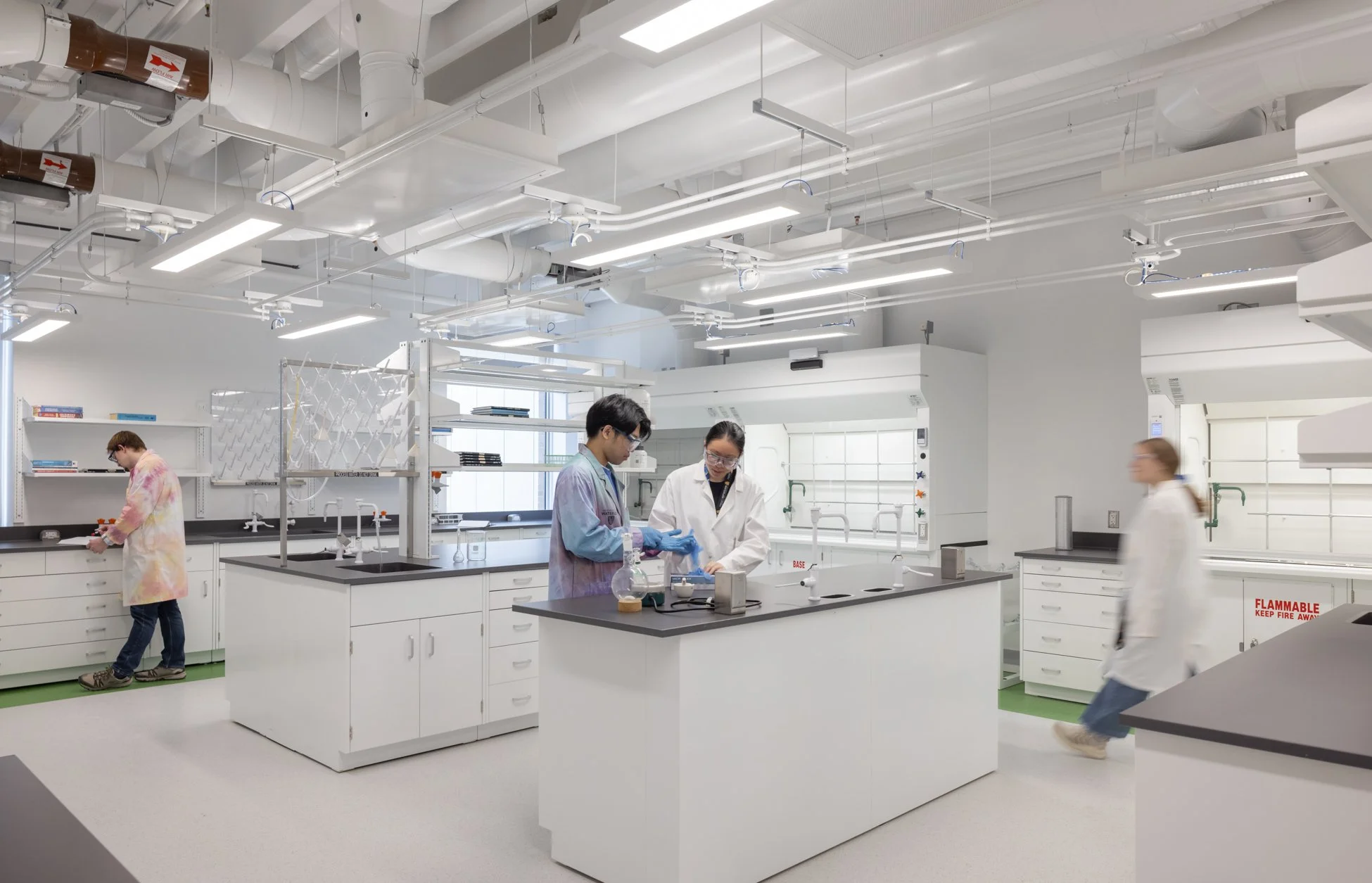
Researchers working within a bright, modular laboratory environment, showing improved daylight, clear sightlines, and flexible bench layouts that support daily scientific activity. Image: Adrian Ozimek
The renovation of the Earth Sciences & Chemistry (ESC) Building at the University of Waterloo in Ontario demonstrates how 1960s-era academic infrastructure—long considered physically and functionally obsolete—can be reimagined without demolition. Focused on a 28,309 sf transformation of Level 3, the $24.3 million project also serves as a prototype for a broader 250,000 sf campus renewal strategy, balancing architectural reconfiguration, systems modernization, and the operational constraints of an active research environment.
Recognized with the Excellence in Whole Building/Holistic Design—Renovation prize in the 2026 Design Excellence Awards, the project was submitted by mcCallumSather, which provided architectural and interior design services and accepted the award at the 2026 Lab Design Conference in Orlando, FL. The renovation was completed with support from Blackwell Structural Engineers (structural), Stantec (electrical), Hanscomb (cost), and Vortex Fire Consultants (fire and safety).
From fragmentation to spatial clarity
Before renovation, Level 3 consisted of outdated laboratories and narrow double-loaded corridors that limited daylight and reinforced a sense of separation across the floorplate. The design team, led by mcCallumSather, addressed these challenges by fundamentally reorganizing circulation.
A single-loaded corridor was introduced along the west façade, shifting circulation to the perimeter and bringing daylight deep into the floorplate. The result repositions the corridor as a social and visual spine rather than a service route, improving transparency, wayfinding, and informal interaction.
Glazed partitions reinforce a “science-on-display” approach, increasing visual connectivity between research zones while maintaining appropriate separation for safety and function.
The floor is organized into eight modular research laboratories, supported by adjacent graduate write-up areas and faculty offices. Planning follows Council of Ontario Universities (COU) standards, providing a consistent framework intended to support long-term adaptability as research programs evolve.
Infrastructure as the driver of renewal

A legacy laboratory condition prior to renovation, illustrating outdated cabinetry, inconsistent storage, and aging mechanical systems that limited safety, efficiency, and workflow. Image: Adrian Ozimek
Rather than treating the project as a cosmetic upgrade, the renovation was driven by a full mechanical and infrastructure overhaul, targeting long-term performance and a net-zero-ready operational profile.
The mechanical strategy centers on a hydronic system with three simultaneous water-source heat pumps, enabling independent heating and cooling across spaces while recovering and redistributing thermal energy throughout the building.
Key system upgrades include:
Dedicated Outdoor Air System (DOAS): rooftop unit providing controlled ventilation and improved air quality management
Glycol runaround loop: heat recovery system transferring energy between exhaust and incoming air streams
Variable-air-volume fume hoods: equipped with sash sensors to reduce ventilation demand, a major driver of energy use in laboratory buildings
District energy integration: heat exchangers linked to campus chilled water and steam systems, supporting future low-carbon transitions
Delivering renovation in a live research environment
A defining challenge of the project was maintaining ongoing research activity on Levels 1 and 2, while Level 3 underwent full redevelopment.
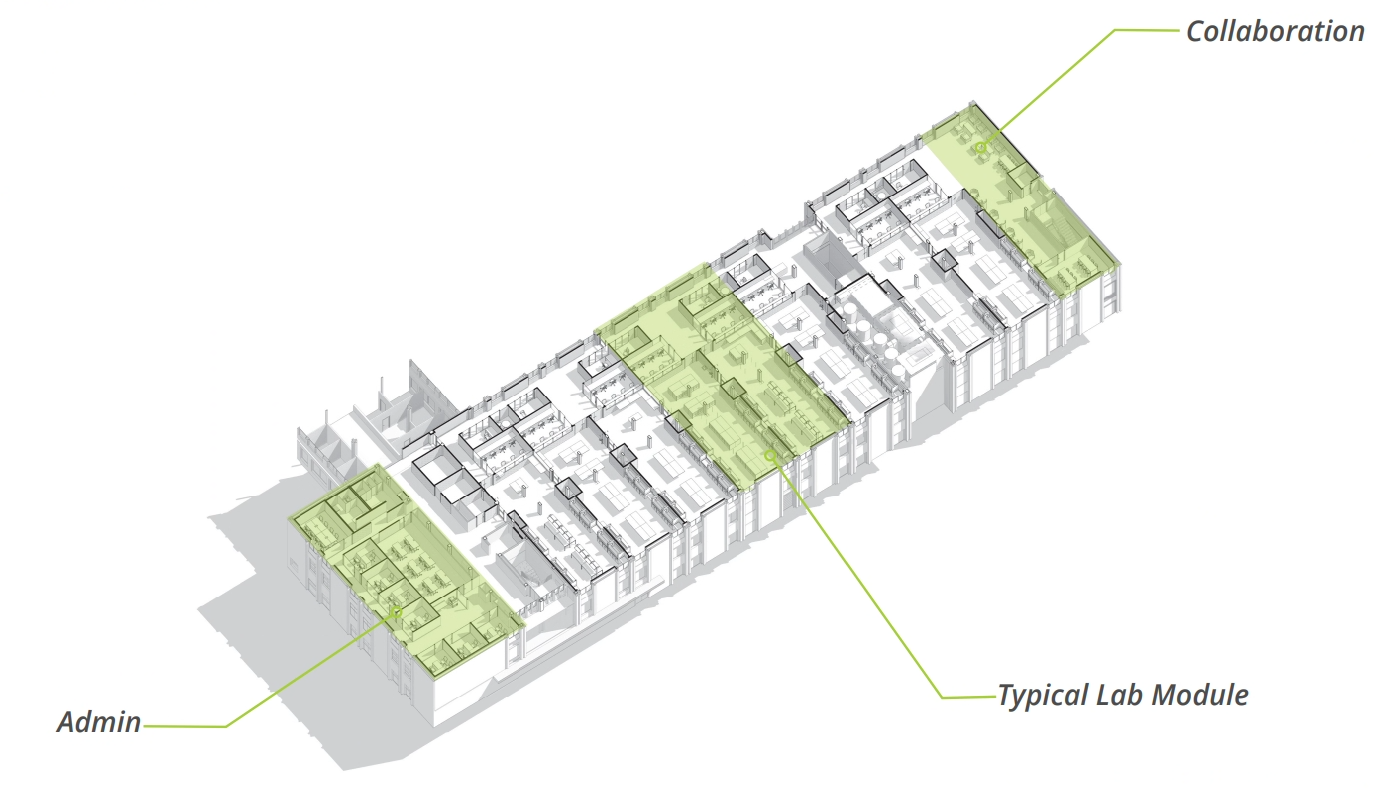
A floor plan diagram highlighting typical lab modules, collaboration zones, and administrative areas, illustrating how organization and clarity drove the restructuring of Level 3. Image: mcCallumSather
To address structural limitations in the original 1960s frame—insufficient for modern mechanical loads without triggering extensive building-wide upgrades—the team introduced a discrete three-story mechanical addition. This externalized infrastructure houses key equipment and buffering systems, allowing phased construction with minimal disruption to occupied floors.
Complexities extended into legacy infrastructure. Existing exhaust systems serving a ground-floor chemistry store were found to run through the renovation zone on Level 3. Because these systems remained operational, new mechanical layouts had to be carefully routed around them, supported by iterative BIM coordination and clash detection.
Human experience and environmental performance
Beyond technical performance, the renovation emphasizes user experience, comfort, and long-term durability. Interior finishes are intentionally restrained, prioritizing resilience and maintainability, including recycled-content rubber flooring selected for acoustic and ergonomic benefits.
Preserving the existing structure also reduced embodied carbon, allowing capital investment to focus on system upgrades and spatial reconfiguration rather than full reconstruction.
Informal breakout rooms and touchdown spaces were added along the corridor to support collaboration and short-duration work. These smaller, enclosed areas help counter the constraints of older lab typologies, offering flexibility for both focused work and informal exchange.
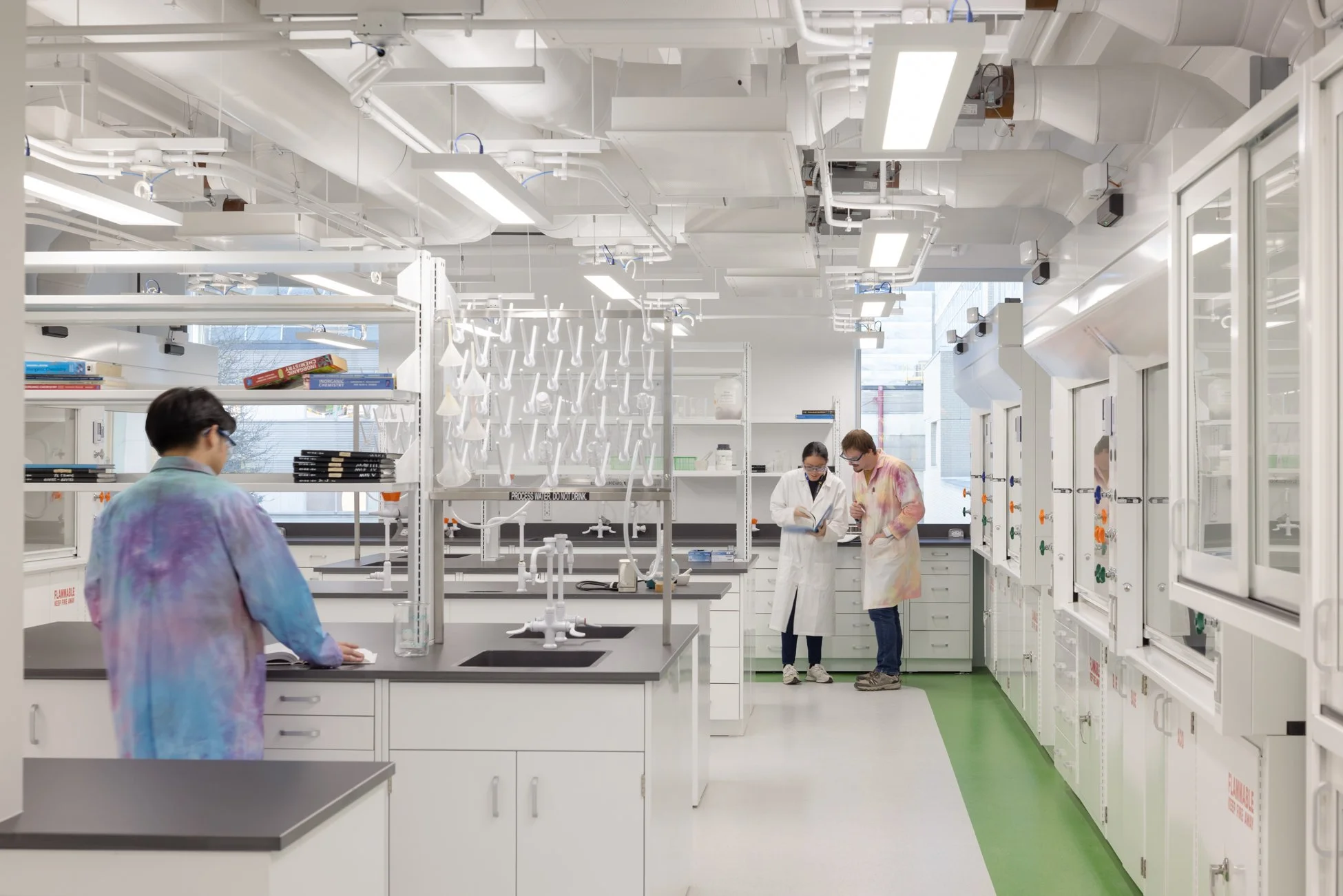
Researchers working along the new single-loaded corridor with glazed partitions, demonstrating the “science-on-display” approach and enhanced transparency across the floor. Image: Adrian Ozimek
A model for incremental campus renewal
The ESC Building renovation illustrates how aging academic facilities can be repositioned to meet contemporary research needs through strategic, systems-driven interventions rather than demolition.
By treating Level 3 as a pilot phase, the University of Waterloo and mcCallumSather have established a replicable framework for the broader 250,000 sf building renewal. The project transformed an aging facility into a more resilient and functional research environment aligned with current scientific demands. It also underscores the value of holistic renovation strategies that integrate architecture, infrastructure, and operational continuity into a coordinated approach to long-term campus renewal.