
GMP vs. Non-GMP Zones: Managing Personnel Flow
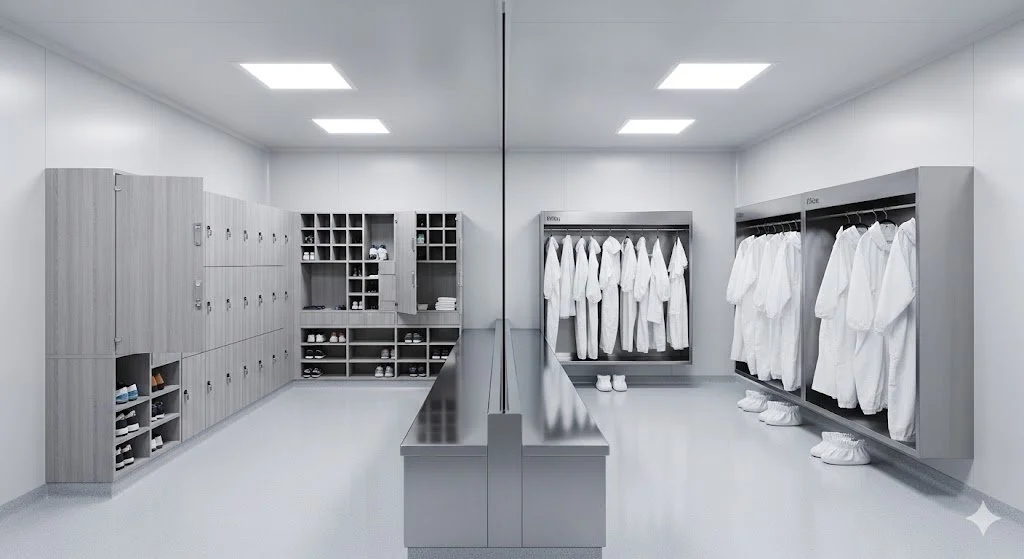
A GMP gowning room utilizes architectural features like the step-over bench (SOB) to physically and mentally enforce the boundary between the uncontrolled "dirty" side and the classified "clean" side. | Credit: Gemini (2026)
You Can't Wear Jeans in the Pilot Plant
Designing the transition zones for GMP compliance requires a massive behavioral and architectural shift. While an R&D scientist might stroll into the laboratory wearing street clothes and a casually draped lab coat, producing clinical-grade therapeutics demands absolute, unrelenting sterility. When an organization upgrades its infrastructure to support a GMP pilot plant or full-scale manufacturing, the most challenging aspect is often managing the human element.
In these highly regulated environments, the facility's architecture must proactively dictate human behavior. Facility planners achieve this by engineering rigorous transition zones. These specialized airlocks act as the physical gateways between the standard commercial building and the pristine manufacturing core, ensuring that street-level contaminants never breach the critical sterile boundary.
Translating this regulatory requirement into a floorplan involves a mastery of GMP facility design. It requires mapping out strict, unidirectional personnel flows, integrating heavily interlocked door systems, and designing gowning rooms that act as pneumatic and physical filters to protect the integrity of the life-saving therapies being produced inside.
Key Takeaways
Personnel Flow: Engineering strict, unidirectional pathways that prevent cross-contamination by dictating exactly how and where humans move through the facility.
Gowning Room Design: Utilizing physical barriers, such as the step-over bench (SOB), to mentally and physically separate the "dirty" and "clean" zones of an airlock.
Cleanroom Classification: Stepping down airborne particulate counts through cascaded airlocks to achieve necessary ISO or Grade ratings for aseptic processing.
Pressure Cascades: Designing HVAC systems to maintain precise positive pressure gradients that constantly push contaminants away from the critical manufacturing core.
How Personnel Flow Dictates GMP Facility Design
In any cleanroom environment, the human body is the single largest source of contamination. Research confirms that a fully gowned, motionless person generates approximately 100,000 particles per minute, escalating to 1,000,000 or more particles per minute when walking. To protect the product, architects must design the facility to act as a physical filter for the people working inside it.
Unlike standard laboratories with open corridors and two-way swinging doors, GMP facility design relies on strict unidirectional personnel flow. This means creating a deliberate, one-way path: employees enter the clean core through a dedicated ingress gowning suite, perform their shifts, and exit through a completely separate de-gowning suite.
This unidirectional layout prevents cross-contamination. It ensures that personnel exiting the suite — who may carry trace amounts of active pharmaceutical ingredients (APIs) or biological vectors — never cross paths with clean personnel entering in fresh sterile garments.
The Structural Anatomy of Gowning Room Design
A gowning room is not merely a locker room; it is a highly engineered architectural airlock. Effective gowning room design breaks the transition down into distinct, sequential zones. First, personnel enter a pre-gowning area to remove street coats, jewelry, and personal items, swapping their outdoor footwear for dedicated, captive plant shoes.
The core of the room is bisected by a physical architectural feature known as a step-over bench (SOB). The SOB creates a hard, undeniable boundary between the unclassified "dirty" side of the room and the classified "clean" side. Personnel sit on the bench, don sterile booties over their plant shoes, and swing their legs over to the clean side without their feet ever touching the dirty floor again.
Furthermore, the architectural envelope relies heavily on interlocked doors. The building's access control system mechanically prevents the door leading to the cleanroom from opening if the door leading to the uncontrolled corridor is open. This guarantees that the airlock is never "open to the street," preventing a rush of unconditioned, contaminated air into the sterile core.
The flooring in these transition zones must be monolithic and highly durable to withstand heavy foot traffic and aggressive cleaning agents. Welded sheet vinyl or poured epoxy floors with integral cove bases — where the floor curves seamlessly up the wall — are mandatory to eliminate 90-degree corners where dirt and bacteria can accumulate.
Managing Cleanroom Classification Through Architectural Airlocks
Every step a technician takes deeper into a GMP facility should correspond with a stricter cleanroom classification. Moving from an uncontrolled office corridor to a classified manufacturing core cannot happen through a single door. Airlocks serve as pneumatic transition chambers, allowing the facility's HVAC system to step down particulate counts gradually.
Architects accomplish this using pressure cascades. The most critical, cleanest room is supplied with the highest volume of HEPA-filtered air, creating a positive pressure "bubble." When an interlocked gowning room door opens, this positive pressure forces clean air outward into the airlock, actively sweeping away contaminants introduced by entering personnel — ensuring airflow always moves from the cleanest zone outward toward dirtier zones.
It is important to note that cleanroom classifications operate in layers. A Grade A (ISO 5) zone — the most stringent classification — is typically a localized, point-of-use environment such as a laminar flow hood or isolator operating within a higher-grade background room, rather than a room-level classification accessed directly through a single airlock sequence. The cascaded airlock approach more typically transitions personnel from uncontrolled corridors into ISO 8 (Grade D) anterooms, then into ISO 7 (Grade C) processing rooms, with Grade A protection applied locally at the critical product exposure point.
For a broader discussion of how HVAC systems and pressure differentials underpin contamination control across all laboratory environments, see our guide to designing a resilient lab environment.
Comparing Environments: General R&D Lab vs. GMP Manufacturing
Entry Protocol: R&D labs allow direct, two-way entry from main facility corridors. GMP facilities require sequential, unidirectional entry through highly controlled, interlocked airlocks.
Personnel Attire: R&D requires basic PPE such as lab coats and safety glasses over street clothes. GMP requires full sterile gowning (coveralls, hoods, booties, masks, double gloves) donned in a strict, validated sequence.
HVAC Pressurization: R&D labs handling hazardous chemicals or biological agents are typically held at negative pressure relative to the corridor to contain fumes or bio-hazards; standard R&D spaces without hazardous materials may be positive or neutral. GMP cleanrooms are held at positive pressure relative to the corridor to keep external contaminants out of the sterile product.
Surface Finishes: R&D uses standard casework, painted drywall, and epoxy tops. GMP transition zones demand monolithic, seamless floors and walls with coved corners that can withstand harsh daily sporicidal washdowns without harboring bioburden.
Expert FAQ: GMP Gowning Protocols
Q: Can a personnel gowning room also serve as a material airlock?
A: No. Regulatory agencies strongly discourage mixing personnel flow with material flow. Humans shed particulates, while pallets, carts, and raw materials shed cardboard dust and industrial debris. GMP facilities must design separate Material Airlocks (MALs) and Personnel Airlocks (PALs) to prevent cross-contamination. For a real-world look at how institutions navigate this challenge, see our article on overcoming the obstacles to locating a cGMP facility in institutional settings.
Q: How do you handle emergency exits in a unidirectional GMP facility?
A: Life safety always supersedes GMP compliance. Emergency exit doors are equipped with crash bars and local break-glass alarms that override the cleanroom interlocks. This allows for immediate evacuation during a fire or chemical spill, even though opening the door temporarily compromises the cleanroom's pressure cascade and classification.
Q: What flooring is best for a gowning transition zone?
A: The flooring must be monolithic and highly durable to withstand heavy foot traffic and aggressive cleaning agents. Welded sheet vinyl or poured epoxy floors with integral cove bases are mandatory to eliminate 90-degree corners where dirt and bacteria can accumulate. For a detailed overview of flooring selection for controlled environments, see our guide to choosing the right flooring for your lab.
Q: How does GMP transition zone design connect to the broader pilot plant architecture?
A: Gowning suites and airlocks are the human-facing layer of a much larger compliance architecture. To understand how these zones integrate with the structural, utility, and regulatory demands of the scale-up environment as a whole, see our companion guide to pilot plant design: bridging the gap between R&D and manufacturing.
References
International Society for Pharmaceutical Engineering (ISPE). Baseline Guide Vol. 3: Sterile Product Manufacturing Facilities. 3rd ed., ISPE, 2018.
U.S. Food and Drug Administration (FDA). Guidance for Industry: Sterile Drug Products Produced by Aseptic Processing — Current Good Manufacturing Practice. FDA, 2004.
International Organization for Standardization (ISO). ISO 14644-4:2022 Cleanrooms and associated controlled environments — Part 4: Design, construction and start-up. ISO, 2022.
World Health Organization (WHO). WHO Good Manufacturing Practices for Pharmaceutical Products: Main Principles. WHO Technical Report Series No. 986, Annex 2, 2014.
