2026 Lab Design Conference Workshop: Collaborative Lab Planning
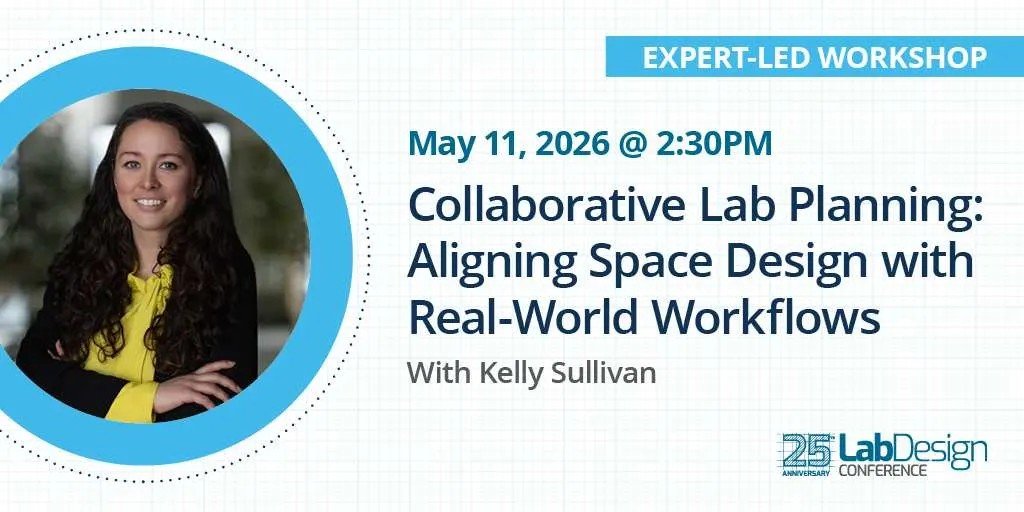
Laboratory design is most successful when it reflects how science actually happens—not just how it looks on paper. At the 2026 Lab Design Conference, attendees can explore how to better align lab spaces with real-world workflows in the two-hour interactive workshop, Collaborative Lab Planning: Aligning Space Design with Real-World Workflows, led by Kelly Sullivan, PhD, global director of operations & labs at CIC.
Scheduled for May 11, from 2:30 to 4:30 pm, this hands-on session is designed for lab directors and managers, lab end users, architects, planners, safety officers, life sciences real estate professionals, contractors, and equipment and furniture suppliers.
AIA continuing education credits will be available for those who complete this workshop.
Space is limited—participants must purchase a workshop ticket in addition to a regular conference pass. Click here to register!
Grounding design in lived lab experience
A central theme of the workshop is shifting lab planning conversations away from assumptions and toward how people actually work in laboratory environments. “We will ground everything in the lived experience of the people who use the lab, approaching design the same way a great kitchen is designed for a chef, built around how they move, reach, and work,” Sullivan says.
Led by a PhD scientist with15 years of extensive hands-on lab experience, the workshop focuses on mapping real workflows and translating them into design decisions. “This workshop shows participants how to map real workflows by capturing how individuals move, interact, solve problems, and stay safe throughout their day,” Sullivan explains. “By translating those behaviors into clear spatial and infrastructure requirements, attendees leave with a practical method to advocate for end-users and ensure their work is accurately represented from the start.”
Avoiding common planning pitfalls early
Many challenges in lab projects—such as inefficient adjacencies, storage shortfalls, or safety concerns—can be traced back to early planning decisions. This workshop provides practical tools to help teams identify and address those issues before designs are locked in.
“We use hands-on exercises to introduce tools like pre-design surveys to help avoid typical early-stage mistakes such as unclear adjacencies, poor material flow, underestimating storage, and unsafe congestion points,” Sullivan says. Participants will also focus on the human dynamics of planning. “Participants also practice the human side of planning by learning how to communicate with stakeholders early so concerns surface before designs become difficult to change.”
Through guided exercises, attendees will analyze sample layouts and learn how to spot risks early. “Participants will work through sample layouts to identify risks and correct them using simple planning tools like zone mapping, flow diagrams, and red-flag checklists so they can spot problems before they become costly,” Sullivan adds.
Translating operations into design decisions
One of the most persistent gaps in lab projects is the disconnect between scientific work and facility planning. The workshop addresses this challenge by helping participants turn operational needs into actionable design input.
“We look at a direct translation method: workflow to requirement to design implication,” Sullivan explains. “The challenge is often translating scientific benchwork into the broader operational and facility needs that inform design.”
By establishing a shared language between lab users and design teams, participants can improve alignment and outcomes. “We address this gap by learning how to speak a shared language between users and designers so requests are clear, aligned, and actionable,” Sullivan says. “Through communication strategies and practical examples, participants learn how to convey lab needs in a way that design teams can immediately apply.”
Read more about the Lab Design Conference workshops!
Strengthening collaboration across stakeholders
As research priorities evolve, labs must be able to adapt without disrupting ongoing work. The workshop highlights strategies that support long-term flexibility and continuity. “We highlight design strategies that preserve adaptability such as modular layouts, scalable utilities, interchangeable casework, and predictable service zones,” Sullivan notes.
Workshop participants will learn how to distinguish between fixed and flexible elements in lab design, giving them a framework to future-proof spaces as teams, technologies, and workflows change.
Effective lab planning requires alignment among scientists, designers, safety professionals, and leadership. The workshop provides tools to support collaboration before critical decisions are finalized. “The workshop includes communication tools grounded in facilitative leadership such as stakeholder mapping, shared vocabulary, visual planning aids, and decision making processes that teams can use before decisions are locked in,” Sullivan says.
These approaches help teams surface assumptions early and maintain shared understanding throughout the project lifecycle.
Register early—space is limited
This interactive workshop delivers practical tools, real-world scenarios, and immediately applicable strategies for creating safer, more functional, and more adaptable laboratory environments. For professionals seeking to improve communication, planning alignment, and long-term lab performance, this session offers clear, actionable value.
Secure your spot now and add Collaborative Lab Planning: Aligning Space Design with Real-World Workflows to your Lab Design Conference experience—hurry, space is limited! AIA continuing education credits will be available for those who complete this workshop. Register now.