What Goes Into Designing a BSL Lab?
Designing a biocontainment laboratory requires more than selecting the right equipment or meeting a set of containment requirements. Every major design decision needs to support the safety of personnel, the protection of research, and the facility’s ability to function effectively over the long term.
For architects, engineers, lab planners, facility managers, biosafety professionals, and other project team members, understanding how those decisions connect can be critical to delivering a successful BSL facility.
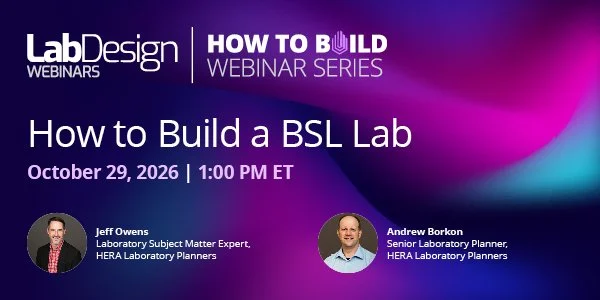
Join Lab Design on Thursday, October 29, at 1:00pm ET for “How to Build a BSL Lab,” a free webinar exploring the strategies behind designing and delivering safe, adaptable biocontainment environments.
The session will look at the process from the earliest stages of a project, beginning with the biosafety risk assessment and how it informs facility requirements. Attendees will explore how different biosafety levels affect architectural and engineering decisions, with particular attention to BSL-3 environments and the complex requirements associated with high-containment research.
Speakers Jeff Owens, laboratory subject matter expert at HERA Laboratory Planners, and Andrew Borkon, senior laboratory planner at HERA Laboratory Planners, will discuss critical considerations including directional airflow, pressure relationships, specialized HVAC systems, personnel and material flow, waste handling, and space decontamination. They will also address how these systems and strategies need to work together rather than being considered in isolation.
The webinar will also explore areas that can become particularly challenging during a project: coordinating architects, engineers, biosafety professionals, and end users; commissioning and verifying facility performance; navigating regulatory requirements; and incorporating flexibility into high-containment environments.
That last consideration is increasingly important as research programs evolve. A facility designed around today’s needs may need to accommodate different research, technologies, equipment, or safety requirements in the future. Understanding where flexibility can be built into the design can help project teams plan for those changes from the beginning.
Whether you are currently planning a biocontainment facility, supporting an existing BSL laboratory, or simply want a better understanding of the design considerations behind these specialized environments, this webinar offers a practical look at the decisions that shape their performance.
The course is approved by AIA CES for 1 LU/HSW credit.
Register for free and join us on October 29!