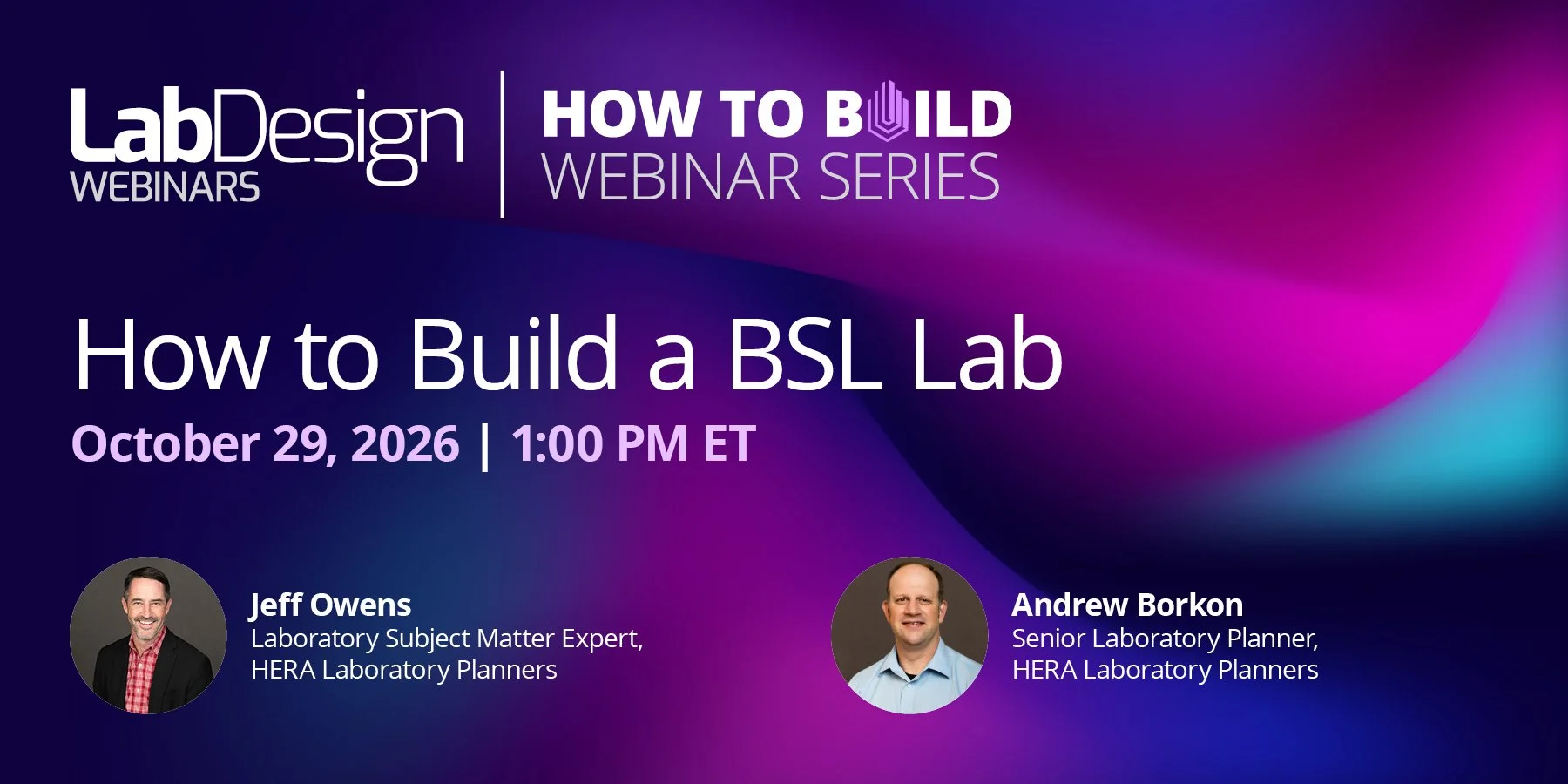
Biocontainment laboratories require careful coordination of architectural design, mechanical systems, safety protocols, and research needs. A free webinar from Lab Design News on Thursday, October 29, will explore how project teams can bring these elements together to create safe, functional, and adaptable facilities.
How to Build a BSL Lab will examine the process of designing and delivering biocontainment laboratories, from early programming and biosafety risk assessments through construction, commissioning, and ongoing performance verification. The session will feature Jeff Owens, laboratory subject matter expert, and Andrew Borkon, senior laboratory planner, both of HERA Laboratory Planners.
For architects, engineers, facility managers, biosafety professionals, researchers, and others involved in laboratory projects, the webinar will offer insight into how biosafety requirements influence facility planning and design decisions. Participants will explore the differences between Biosafety Level 1 through 4 (BSL-1 through BSL-4) laboratories, with particular emphasis on the design considerations associated with BSL-3 environments.
A central focus will be how risk assessments inform the physical requirements of a facility. These assessments help determine appropriate containment strategies, airflow direction, pressure differentials, specialized HVAC and filtration systems, and decontamination methods. Understanding these relationships can help project teams make informed decisions early in the design process, when choices about layouts, infrastructure, and building systems can have significant implications for safety and long-term functionality.
The session will also address personnel, material, and waste flows, including how potential conflicts can be identified and mitigated through thoughtful space planning. Attendees will learn about commissioning and performance verification, as well as the importance of coordinating architects, engineers, biosafety officers, and end users throughout a project.
Flexibility will be another key consideration. As research priorities, technologies, and safety standards evolve, biocontainment facilities must be prepared to accommodate changing needs without compromising containment. The webinar will explore strategies for incorporating adaptability into high-containment environments while balancing safety, functionality, efficiency, and regulatory compliance.
For the Lab Design News audience, these insights are relevant not only to teams planning new biocontainment facilities but also to those renovating or upgrading existing laboratories. Understanding how risk assessments translate into design requirements can help stakeholders ask better questions, anticipate infrastructure needs, and identify potential challenges before they become costly problems. The discussion also offers an opportunity to better understand the decisions and trade-offs that shape complex laboratory projects.
How to Build a BSL Lab takes place Thursday, October 29, starting at 1:00pm ET. The webinar is free to attend and approved by AIA CES for one Learning Unit/Health, Safety, and Welfare (LU/HSW) credit. Registration allows for free on demand viewing after October 29 as well.