
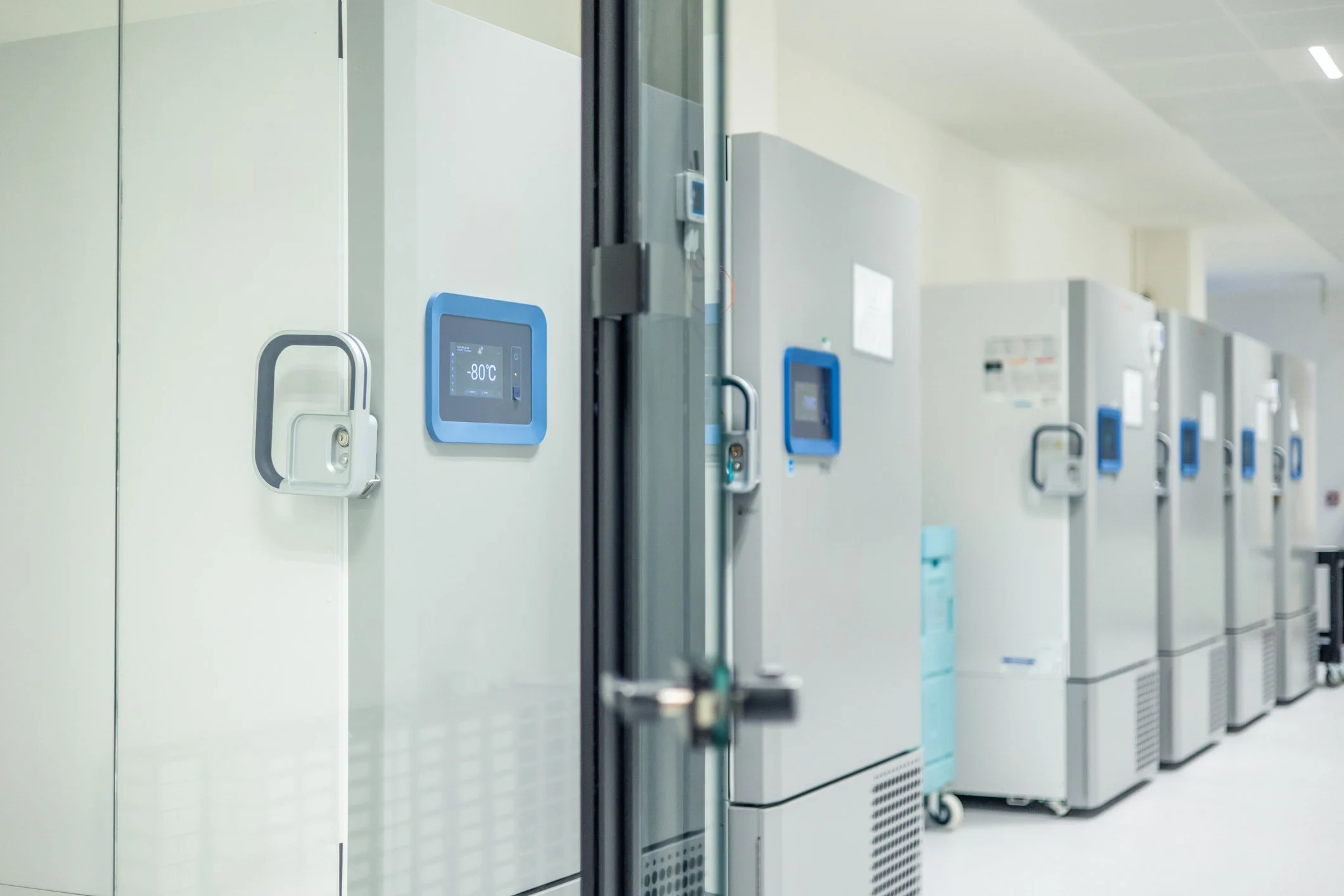
Most lab planning conversations start with benches, fume hoods and utilities. Storage tends to get whatever space is left. In reagent-heavy labs, that is a costly habit. Peptides, enzymes, antibodies, nucleotides and many small-molecule standards are only as reliable as the conditions they are kept in, and those conditions are set largely by room layout, freezer placement and daily traffic patterns. Planning storage on purpose, early, protects both the materials and the data that depend on them.
1. Why storage design affects sample integrity
Three environmental factors do most of the damage: temperature cycling, humidity and light.
Temperature cycling. Every time a freezer door opens, warm room air rushes in and the cabinet works to recover. Items near the door and on upper shelves see the biggest swings. A single excursion is rarely the problem; repeated small ones, day after day, are. Partial thawing at the surface of a vial, followed by refreezing, can drive aggregation, concentrate solutes in unfrozen pockets and speed up degradation of sensitive materials.
Humidity. Lyophilized and hygroscopic materials pull water from the air as soon as a cold container is opened in a warm, humid room. Condensation on a vial taken straight from −20 degrees C to the bench is a familiar sight. Absorbed moisture can promote hydrolysis and oxidation and makes weighed amounts less accurate.
Light. Many reagents, including some fluorophores, vitamins, cofactors and peptides with light-sensitive residues, degrade under ambient or UV light. Glass-door refrigerators and open shelving under bright fixtures are common, avoidable exposures.
The International Society for Biological and Environmental Repositories (ISBER) treats storage equipment, environmental monitoring and backup capacity as core parts of specimen quality, not afterthoughts.1 The same logic applies to a working reagent inventory.
2. Sizing −20 degrees C and −80 degrees C capacity and keeping access traffic low
Start with an inventory, not a floor plan. List what the lab stores at 2-8 degrees C, -20 degrees C and -80 degrees C today, then project growth over the life of the space. Labs routinely underestimate this, and the overflow ends up in hallway freezers or crowded shared units.
A few planning principles help:
Plan backup capacity. Reserve empty space (often one spare unit, or a fixed share of total volume) so contents can be moved quickly during a failure or defrost. ISBER recommends planning backup storage capacity explicitly.(1)
Separate working stock from archive. Frequently used aliquots belong in a "working" unit close to the benches. Long-term stock belongs in a separate unit that is opened rarely. This one decision cuts door openings on the archive freezer dramatically.
Place freezers deliberately. NIH policy for ultra-low and lab-grade freezers calls for placement in program spaces such as labs or dedicated freezer rooms, with adequate ventilation and away from heavy foot traffic.(2) Freezers reject a lot of heat; a freezer bank in a small, poorly ventilated room will run hotter, work harder and fail sooner. The NIH Design Requirements Manual addresses freezer farms and their environmental controls as a distinct space type.(3)
Choose efficient, right-sized units. ENERGY STAR now certifies laboratory-grade refrigerators, freezers and ultra-low temperature freezers.(4) Efficient units lower heat load on the room as well as energy bills. Programs such as the International Laboratory Freezer Challenge also show how inventory cleanouts and defrost routines recover usable capacity.(5)
Monitor and alarm. Every cold unit should have continuous temperature monitoring with alarms routed to people who can respond after hours, and a written response plan.
3. Desiccated storage and a receiving/quarantine bench
Dry storage deserves its own footprint. Desiccator cabinets or sealed containers with indicating desiccant keep lyophilized and hygroscopic materials stable at room temperature or inside cold units. Place them away from sinks, autoclaves and exterior doors, where humidity spikes are common. Assign responsibility for checking and regenerating desiccant on a schedule.
Just as important is a dedicated receiving and quarantine bench. Shipments often arrive on dry ice or cold packs and sit on a counter while someone finds space. A defined receiving area should have:
Room to open coolers and inspect packaging and temperature indicators.
A marked "quarantine" zone for materials awaiting paperwork review, such as a certificate of analysis or a packing-list check.
A short path to the right freezer or desiccator, so materials are not carried through busy corridors.
Space to let sealed cold containers reach room temperature before opening, to avoid condensation on hygroscopic contents.
Locating this bench near the loading or delivery entrance, rather than in the middle of the lab, keeps packaging debris and dry-ice handling out of working areas.
4. Labeling, lot tracking, and documentation
Good storage design fails without good records. Every container should carry a durable, cold-resistant label with the material name, lot number, date received, date opened and storage condition. Printed cryo-labels hold up far better than handwritten tape at -80 degrees C.
Link each physical location (freezer, shelf, rack, box) to an inventory system, whether a spreadsheet or a laboratory information management system. ISBER's guidance treats inventory and location tracking as part of specimen integrity, because a sample that cannot be found or traced is effectively lost.(1) Record lot numbers in experimental notebooks so results can be traced back to specific materials if a problem appears later. Keep certificates of analysis and receiving records together, filed by lot.
Finally, write down the routines: who checks alarms, how often desiccant is changed, when freezers are defrosted and inventoried, and what happens to expired or orphaned materials.
5. Short planning checklist
Inventory current 2-8 degrees C, -20 degrees C, -80 degrees C and dry-storage needs, plus projected growth.
Reserve backup cold capacity for failures and defrosts.
Separate frequently accessed working stock from rarely opened archive units.
Place freezers in ventilated program space, away from heavy foot traffic.
Specify continuous temperature monitoring with after-hours alarms.
Allocate desiccated storage away from humidity sources.
Build a receiving and quarantine bench near the delivery entrance.
Use cold-resistant labels and link every location to an inventory record.
Track lot numbers and file receiving documents by lot.
Write and assign storage maintenance routines.
Storage is rarely the most visible part of a lab design, but it quietly determines whether the materials on the shelf are still what the label says they are. Planning it early costs little; retrofitting it later costs far more.
References
Snapes E, Astrin JJ, Bertheussen Krüger N, et al. Updating International Society for Biological and Environmental Repositories Best Practices, fifth edition: a new process for relevance in an evolving landscape. Biopreserv Biobank. 2023;21(6):537-546. doi:10.1089/bio.2023.0140. Best Practices available at: https://www.isber.org/page/BPR
National Institutes of Health. NIH Policy Manual 26101-16: Management of ultra-low temperature and lab grade freezers and refrigerators to promote energy efficiency in cold storage for biomedical research. Accessed October 14, 2026. https://policymanual.nih.gov/26101-16
National Institutes of Health, Office of Research Facilities. Design Requirements Manual (DRM). Accessed October 14, 2026. https://orf.od.nih.gov/TechnicalResources/Pages/DesignRequirementsManual.aspx
US Environmental Protection Agency. ENERGY STAR: Laboratory grade refrigerators and freezers. Accessed October 14, 2026. https://www.energystar.gov/products/lab_grade_refrigerators_freezers
My Green Lab. Freezer Challenge. Accessed October 14, 2026. https://www.freezerchallenge.org/