
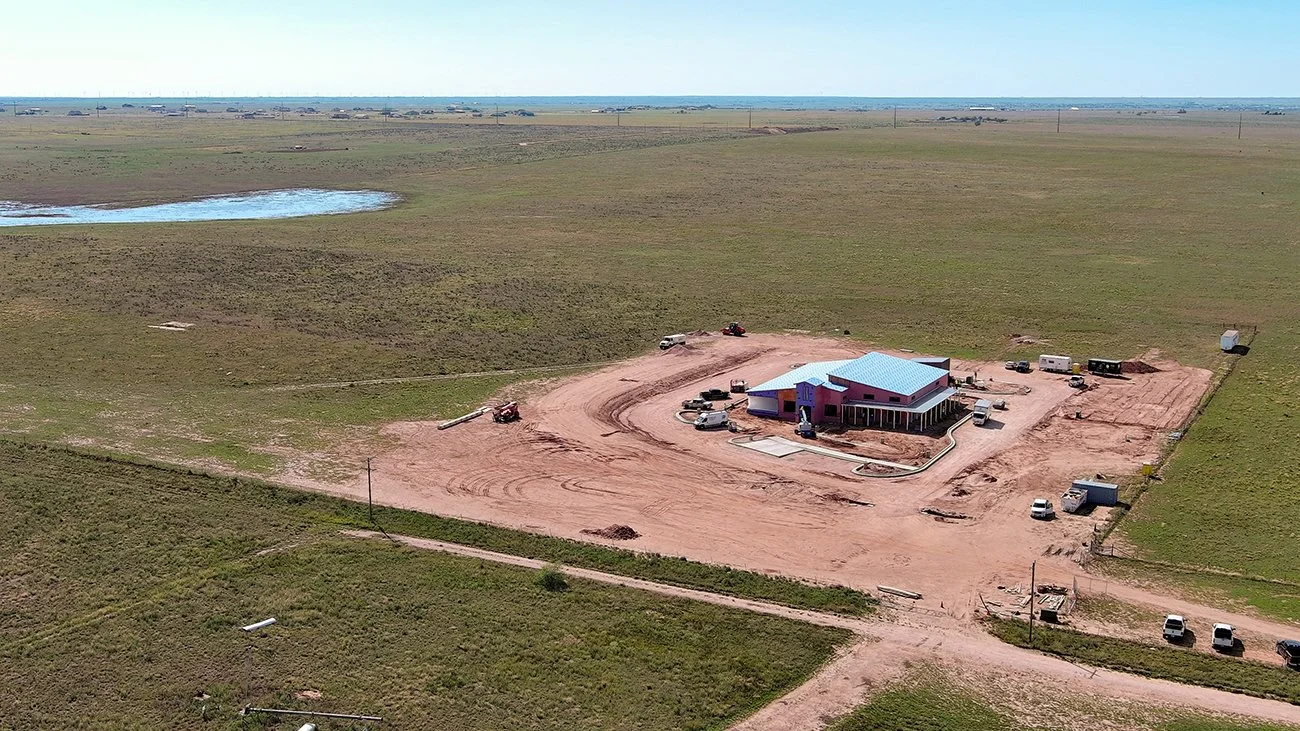
West Texas A&M University is developing a $19.5 million beef cattle research feedlot near Canyon, TX, designed to expand research into cattle feeding, health, and welfare. Image: WTAMU
After decades of piecemeal additions to its existing cattle research feedlot, West Texas A&M University (WT) is taking a different approach to supporting beef cattle research: starting from scratch with a facility designed to accommodate a wider range of studies and the evolving needs of the cattle feeding industry.
The university received a $9.75 million grant from the US Department of Agriculture’s National Institute of Food and Agriculture to support the new research feedlot, bringing the total project budget to $19.5 million with matching funds from The Texas A&M University System and other sources. Located adjacent to WT’s Nance Ranch near Canyon, TX, the facility is expected to expand the university’s research capacity while providing opportunities to evaluate new approaches to cattle feeding, health, and welfare.
For Dr. John Richeson, the Paul Engler Endowed Professorship of Beef Cattle Feedlot Management at WT, a central challenge has been designing a “living lab” facility that meets today’s research needs without limiting what researchers may want to investigate years from now.
Designing around researchers’ needs
Planning for the project began more than a decade ago, when the university first considered renovating its existing research feedlot. As faculty research activity and demand for cattle feeding studies grew, the team recognized that a larger facility was needed. The existing site also presented challenges: its natural slope and property layout were not well suited to expansion.
The approximately 40-year-old facility had accumulated additions over time, and its feed manufacturing equipment was more than 30 years old. Rather than continue adapting the existing infrastructure, the university decided a new facility would offer greater capacity and flexibility.
Richeson brought experience from multiple university and privately owned research feedlots where he had worked over the previous 30 years. Seeing different facility designs in practice helped him identify approaches worth carrying forward, as well as limitations to avoid.
“We have two other faculty that are at West Texas A&M that have also have feedlot experience as well,” he tells Lab Design News. “They obviously had instrumental input on different aspects from pen size to the dimensions of the pens, to the milling equipment, to the design of the feed manufacturing center, to the handling facilities.”
Industry stakeholders also played a substantial role in defining the project’s requirements. Early conversations with commercial feedlots helped shape the initial vision, while the Texas Cattle Feeders Association (TCFA) facilitated several stakeholder meetings as the project moved into more formal design.
Representatives from TCFA member organizations reviewed preliminary plans and discussed individual components, including pen sizes, the overall layout, the feed manufacturing center, cattle handling equipment, and loading facilities. This input helped connect the university’s research goals with the practical requirements of commercial cattle feeding.
Settje Agri-Services and Engineering was hired to develop the initial design, progressing through 30 percent and 60 percent completion drawings. At the time of this interview, the project had reached approximately the 60 percent design stage, with major planning decisions established and more detailed work still ahead.
Supporting research at multiple scales
The new facility will increase the feedlot’s capacity from approximately 800 head to about 4,500 head. Its design will support research at several scales, from intensive studies of individual animals to experiments that more closely replicate commercial feeding conditions.
Plans call for 90 small research pens accommodating approximately 10 animals each and 45 larger pens holding 60 to 70 animals. A metabolism facility will allow researchers to house individual cattle in stanchions and collect samples for more intensive studies.
This range of spaces is intended to support a progression from early-stage investigations to larger trials. Researchers could begin by studying how a feed additive or other intervention affects an animal biologically, then evaluate promising findings in small replicated pens before moving to larger groups that better represent commercial conditions.
“The great thing about the new facility, I think, isthe longitudinal capability of it,” Richeson says. “We can do research all the way from very hypothetical individual animal-intensive sampling research all the way to 70-head pen-replicated research.”
By bringing these capabilities together, the facility will allow researchers to evaluate new ideas across different stages of development without relying on a single type of research environment.
Planning for technology that does not yet exist
One of the most significant design challenges is preparing for technologies that may emerge over the facility’s lifespan. Advances in feeding, animal health, and handling could create new research opportunities, but incorporating equipment that has not yet been developed makes planning difficult.
“One of our concerns, which is a great problem to have, is we want to make sure that this facility accommodates future technology. We really want to showcase technology,” Richeson notes.
Accommodating both current tools and future innovations that could improve animal welfare, treatment, and feeding practices requires the project team to consider how the physical facility can support changing research methods rather than designing exclusively around known equipment and procedures.
The feed manufacturing center illustrates the complexity of translating research needs into a workable physical layout. The system will use multiple bins to store feed ingredients, which will be combined in a common mixer to produce rations for the cattle. Coordinating the components and their interactions required extensive discussion among the project team.
Richeson describes the mill as arguably the most complicated part of the facility. The team believes its resulting design will provide an efficient way to prepare feed for research while supporting the facility’s broader objectives.
As detailed design continues, the challenge will be to turn the established planning concepts into infrastructure that can accommodate both day-to-day research and future changes in equipment and technology.
Connecting research with education
The feedlot is also part of a broader effort to expand agricultural education at WT. An adjacent feedlot education facility is under construction, with plans for an auditorium, classroom, offices, and space to host meetings and training events. The arrangement will allow visitors to attend educational programs and then walk to the feedlot to observe cattle and research activities.
Together, the facilities are intended to strengthen connections among university researchers, students, and the commercial cattle feeding industry.
For project teams planning specialized research environments, WT’s approach highlights the importance of involving experienced end users and industry representatives before major design decisions are finalized. Their input can help establish the requirements of a facility while drawing on lessons learned from existing spaces.
Just as importantly, designing for research means accounting for uncertainty. The equipment and methods that will shape cattle feeding in the future may not yet be available, but the facility must be prepared to evaluate them. At WT, that balance between established needs and future possibilities is central to creating a research environment built to serve the industry for decades to come.