
Achieving Operational Readiness in Lab Relocation
In the startup world, the power dynamics have dramatically shifted. Recent reports show that in 2025, 41 percent of all venture capital dollars deployed in the US went to just 10 companies. For life sciences firms, medical device companies, and other research organizations requiring laboratory space, achieving operational readiness across the enterprise is essential to maintaining competitiveness for investment capital and preserving existing cash flow.
Spending capital wisely—whether from an outside investor or existing revenue streams—is paramount in today’s competitive environment. When it comes time to find a new lab space, lack of preparation and due diligence can lead to delays and other issues that may take months to unwind. That’s why there is increasingly little room for error when it comes to not only finding a suitable space but working with the landlord or property manager to ensure it is spec’d out as accurately as possible come move-in day.
What happens when a lab facility doesn’t support turnkey operations on Day 1 of occupancy? In this environment, delays and misalignment between landlord and tenant can cause a damaging ripple effect that impacts the bottom line immediately and may result in reputational harm. That’s why it’s essential to understand how to effectively manage the entirety of the leasing and relocation process, from scouting out the right space to ensuring it is production-ready when your team moves in.
Lab relocation demands comprehensive preparation
While every tenant has unique needs and specifications for a new office space, laboratory environments present a highly specific list of priorities that rarely exist in other facilities. Because of this, lab occupiers need to be aware of how essential it is to have a dedicated resource oversee site selection and coordination of renovations with the landlord on their behalf.
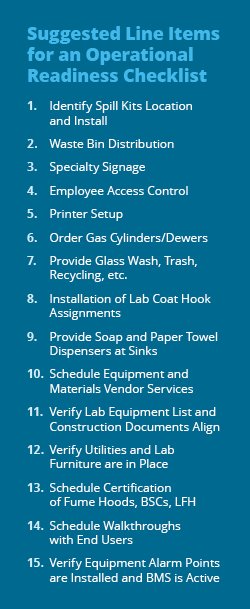
This due diligence, of course, begins in the design phase. The path from deciding on a building to science happening is incredibly short, and all of the work that occurs in between is what determines how quickly a life sciences company begins producing revenue-generating research and products. Once the design is fully baked, construction begins—and to some extent, that’s the point of no return. When the general contractor wraps up, all will be revealed, from the intricate to the massive. Are the lab coat hooks in the right place? Does the loading dock location reduce the time it takes to process shipments? And do we have a team of vendors that can calibrate and qualify our equipment so we can begin production the day we move in?
The list of priorities is different for every lab space, but there are a few key details that are essential to address to achieve operational readiness. Let’s take a look at some of the top concerns that materialize when building a new lab or renovating an existing one. Consider this a checklist for laboratory moves going forward:
Minimizing downtime, maximizing revenue: laboratory relocation checklist
Strategic impact of relocation: Before scouting out a new property or beginning renovations, all parties must understand the strategic benefit of the relocation—and how the new space should support those objectives. This involves all stakeholder groups, including the C-suite, head of research, bench scientists, facilities team, and more. Understanding the ways in which the new lab will enable more productive workflows and support customer relationships is key.
Design phase integration: The more details that are integrated into the design, the easier it is to transition from the construction phase to production ready. Some details that pay dividends when addressed in pre-construction include hazardous materials staging, manifold distribution setup, electrical panel locations, biological materials pathways, and more.
Equipment vendor coordination: In every lab, there is a short list of vendors that can properly calibrate and certify equipment. Knowing who these vendors are and having them tee’d up to support the relocation efforts, including pre-move, move, and post-move tasks once construction wraps up is essential to meeting occupancy and product milestone goals. Ensuring equipment is calibrated correctly is paramount.
Planning downtime around relocation: Most life sciences and medical device companies have clients they can’t shut down for, and in general, minimizing downtime is the best way to protect revenue. Having a plan for a move that doesn’t impact operations, such as conducting it over a weekend or keeping some processes in the existing lab operational while outfitting the future space allows for operations to continue while a relocation advances.
Pre-planning drives meaningful action—and results
It’s tempting to think of a relocation and associated work with outfitting a new space purely in terms of the labor involved. This is a mistake, however, because moving to a new lab is as much a part of your business strategy as developing a new drug or bringing a life-changing device to market. In larger firms, there is likely a dedicated facilities leader or team handling capital projects, but in smaller organizations, most of the team only has the bandwidth to focus on core business as it relates to product pipeline and achieving key milestone goals.
That’s why a dedicated project management team transforms what can potentially be a disruptive and revenue-impacting move into a streamlined transition that supports future revenue growth. Achieving operational readiness starts at the beginning of the project, not the end, and in environments where a dedicated facilities staff doesn’t exist, the gap between business leaders and the landlord of a new lab space is significant. Accounting for downtime and its impact on stakeholders is one of the most significant components of a move, and it often gets missed in the planning phase when a project manager isn’t part of those early conversations.
Oftentimes, a proper assessment of existing space gets overlooked in the excitement of going to a new building. When reviewing what works and what doesn’t work in a research entity’s current lab environment, you’ll often find ways to create efficiencies in the new space that immediately yields time savings which can result in more revenue. For instance, a laboratory client realized that having consumable storage in the basement was highly inconvenient, and chose to move it up to the lab in their new facility; this change yielded time savings of 250 manhours simply by not having to go up and down stairs in their new location. This is the type of intricate but meaningful result that is possible when companies prioritize operational readiness in the planning stages of a move.
Planning is a key factor in success—a saying often used when considering a relocation or expansion is, “Planning without action is futile, but action with planning is fatal.” For laboratory tenants shopping for a new space, this wisdom absolutely holds true.