
A Sustainable Approach to Bioanalytical Lab Design
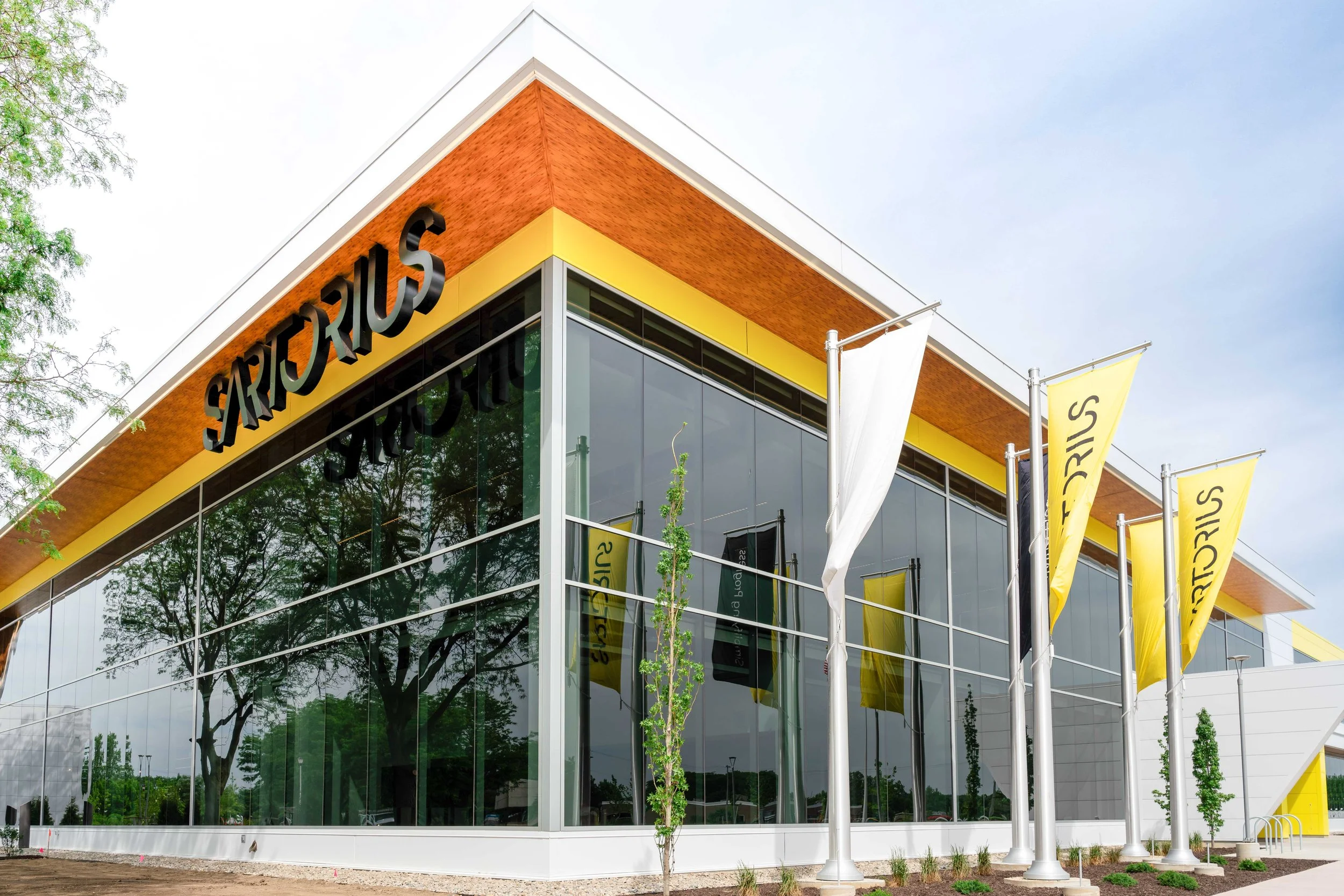
Sartorius’ Center of Excellence for Bioanalytics in Ann Arbor, MI, achieved LEED v4 Gold certification for its approach to sustainable laboratory design and building operations. Image: Courtesy of Sartorius
When Sartorius set out to develop its Center of Excellence for Bioanalytics in Ann Arbor, MI, the project team faced a familiar challenge for laboratory owners: how to pursue ambitious sustainability goals while meeting the demanding environmental requirements of bioanalytical research and manufacturing.
The facility, which opened in 2024 following an investment of more than $100 million, recently received LEED v4 Gold certification from the US Green Building Council. The certification recognizes the site’s approach to energy efficiency, water management, material selection, indoor environmental quality, and resource conservation. The brownfield facility also incorporates on-site solar power, energy-efficient building systems, advanced air filtration, CO₂ monitoring, LED lighting, low-emission materials, electric vehicle infrastructure, and a storm runoff pond.
For Peter Mertens, head of operations for Sartorius’ BioA Business Unit and site head for three BioA sites, including Ann Arbor, achieving LEED Gold required careful coordination between sustainability objectives and laboratory performance requirements.
“Complex” is a good word and achieving what we did took expertise in several different areas so we assembled a small but mighty team of subject matter experts,” Mertens tells Lab Design News.
Designing around laboratory requirements
Sartorius established LEED certification as a project objective from the outset, with Gold as the target. But the sustainability goals could not be considered independently from the requirements of the laboratory environment.
The facility contains biosafety level two laboratories, creating stringent requirements for ventilation and environmental control. According to Mertens, HVAC became one of the project’s most significant design challenges.
“With the specific environmental controls required for our biosafety level two labs, the control for the HVAC was a major design feat,” he says.
The project team brought in a laboratory architecture firm specifically for the laboratory design. Because the facility’s safety requirements had to be reconciled with the performance criteria associated with LEED certification, Sartorius also hired a commissioning subcontractor to help establish system balancing and achieve the required environmental conditions.
This multidisciplinary approach was central to the project. Rather than treating sustainability as a separate layer added to the design, the team had to consider how individual building systems would interact with the operational needs of the laboratories.
Finding the right energy balance
Laboratories can be particularly challenging environments for reducing energy consumption because ventilation requirements can drive substantial HVAC loads. At Ann Arbor, Sartorius evaluated multiple approaches to heating the facility, including all-electric and geothermal systems.
Ultimately, the project team determined that natural gas heating was the most effective option given the intensity of the required laboratory air exchanges.
“It was determined from the beginning that the use of natural gas for heating was the most effective method because the intensity of the air exchanges we needed in the labs,” Mertens says.
The decision illustrates one of the practical challenges laboratory projects can encounter when sustainability goals intersect with operational requirements. While the team evaluated lower-carbon alternatives, the cost of implementing those systems ultimately did not justify replacing natural gas for the facility’s heating needs.
Instead, the project team looked beyond the laboratory spaces for additional opportunities to improve efficiency.
“We also focused on other parts of building (non-laboratory) to help provide some balance on efficiency and sustainability,” Mertens says. “If the labs required more, what areas could we adjust to need less? Balance gave us a little more room to be sustainable.”
That approach can be particularly relevant to laboratory projects, where reducing energy consumption in one system may be constrained by safety or research requirements. Opportunities elsewhere in the building can help project teams pursue overall performance goals without compromising critical laboratory functions.
Building on a brownfield site
The Ann Arbor facility was also developed on a brownfield site, adding another layer of complexity to the project. Construction began with remediation of contaminated soils around the site, a highly regulated process that required careful planning and adherence to established protocols.
For Mertens, one of the most important lessons was the value of understanding site conditions before construction begins.
“Having a deep understanding of what you are up against helps to plan and prepare,” he says.
He also emphasizes the importance of assembling the right team early and bringing in specialists with relevant expertise.
“Take your time, build your team and in that, find the subject matter experts who understand the challenge and what’s required to overcome those challenges,” Mertens says.
Planning for LEED from the start
The project’s experience also demonstrates the value of establishing sustainability priorities early enough that they can influence design, materials, construction methods, and budgeting.
Sartorius used the LEED scorecard to evaluate opportunities for earning certification points and determine which strategies made the most sense for the project. The framework provided flexibility to select higher-value strategies while balancing budget and project requirements.
“The LEED ‘scorecard’ is pretty self-explanatory,” Mertens says. “A company has the choice to tackle the higher scoring items with design, material selection and construction method.”
For laboratory owners considering a similar project, Mertens recommends starting with the desired operational environment rather than beginning with a list of sustainability features.
“First know what the end environment, lab and working conditions you want to accomplish,” he says. From there, project teams can establish sustainability goals, develop multiple scenarios, identify must-haves and tradeoffs, and determine which goals cannot be achieved.
Only after those decisions are made, he says, should the project team finalize the budget and move toward execution.
“Finally, hiring vetted experts to help is a must,” Mertens says. “The ins and outs of each step is only handled by the people who know the latest steps.”
The Ann Arbor project demonstrates that sustainable laboratory design is not necessarily about applying the same solutions to every part of a building. Instead, it can require a more nuanced approach: understanding where laboratory performance requirements impose limits, identifying opportunities elsewhere, and bringing the right experts together early enough to make informed tradeoffs. For organizations pursuing high-performance laboratories, that balance may be just as important as any individual technology or certification strategy.