
Designing the "Ghost" Corridor: Service Strategies for Flexibility
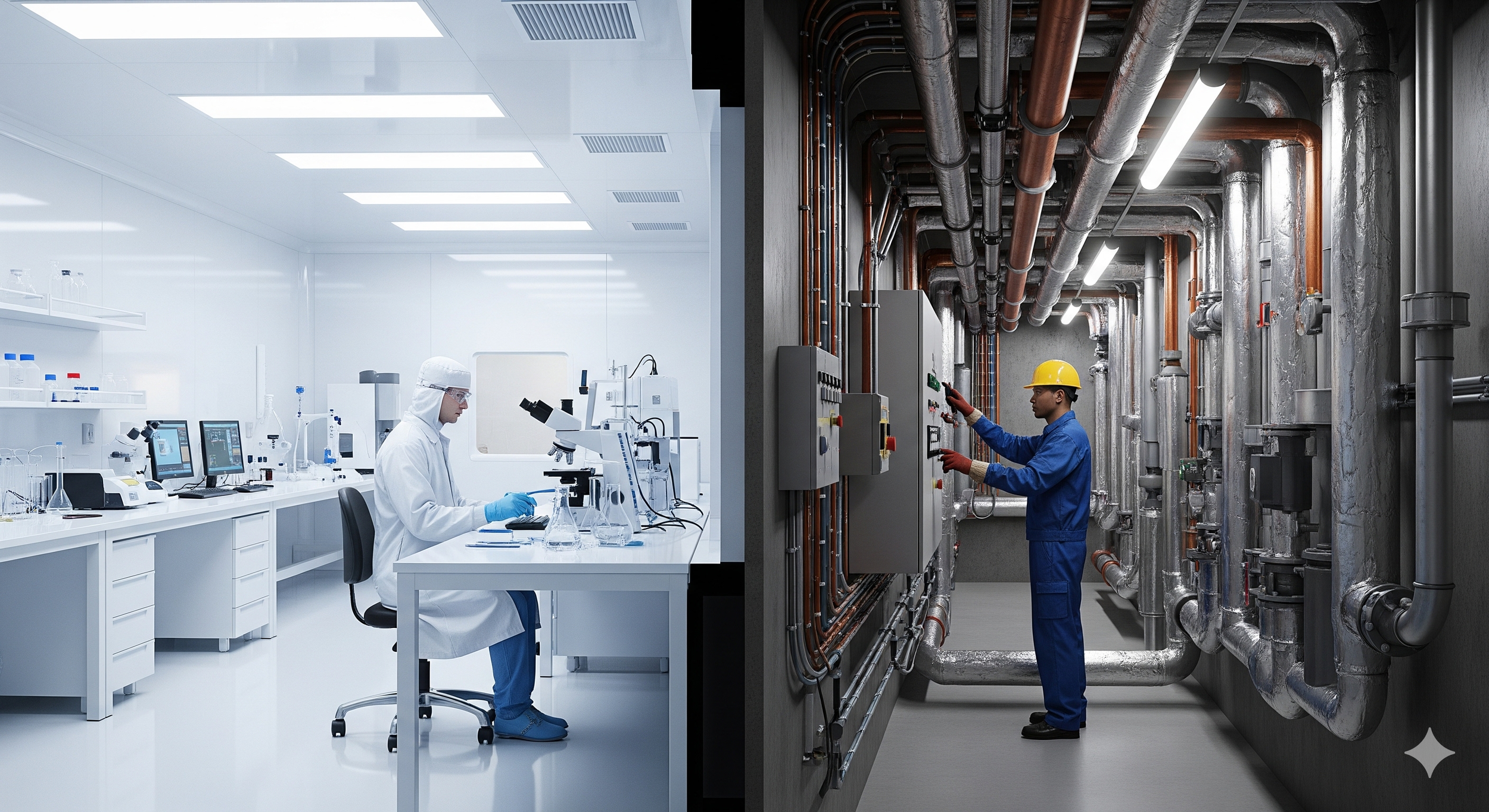
Keep the maintenance crew out of the clean zone. The strategic value of the service corridor.
Credit: Gemini (2026)
Introduction: the disruption of maintenance
In a standard laboratory, the mechanical systems are located above the ceiling grid. When a VAV box fails or a vacuum line leaks, the solution involves a facility manager bringing a ladder into the lab, removing ceiling tiles, and potentially contaminating a sterile environment with dust and debris. For the duration of the repair, science stops.
For the lab architect designing high-performance or containment facilities, this disruption is unacceptable. The solution is interstitial space design—the creation of a "ghost" corridor behind the lab bench that houses the mechanical infrastructure. By separating the "served" space (the lab) from the "servant" space (the corridor), facilities can ensure near-zero downtime during routine maintenance.
What is interstitial space design?
Interstitial space design involves creating a dedicated service zone, often sandwiched between two active lab suites. Instead of utilities dropping from the ceiling, they run horizontally through this service corridor and penetrate the wall to feed the lab benches.
This architectural strategy allows for MEP maintenance access to occur entirely outside the research envelope. A technician can replace a filter, fix a valve, or upgrade a data line without ever donning PPE or entering the controlled environment of the laboratory.
Geometry and dimensions: service corridor width
The critical constraint for the lab planner is the loss of Net Leasable Area (NLA). Developers often view service corridors as "dead space" that generates no revenue. However, the operational value outweighs the square footage loss in high-stakes environments.
To be effective, service corridor width must be carefully calculated.
Minimum Functional Width: Four feet (1.2 meters) allows for a single technician and a tool cart.
Optimal Width: Six feet (1.8 meters) allows for two-way traffic and the movement of larger equipment or replacement parts.
Vertical clearance: These corridors often house vertical risers, so maintaining clear head-height access to valves is essential.
Lab utility routing: cleaning up the ceiling
By moving the "guts" of the building into the ghost corridor, lab utility routing becomes cleaner and more efficient. Gases, vacuum, and power are piped directly through the back of the casework.
This approach offers two major architectural benefits:
Ceiling Height: With less ductwork and piping above the lab proper, architects can push ceiling heights higher, creating a brighter, more open "ballroom" feel in the research zone.
Gravity Drainage: Service corridors provide an ideal chase for gravity waste lines, avoiding the need for pumped drainage systems often required in island bench configurations.
The cleanroom advantage
While valuable in general chemistry, the ghost corridor is mandatory in cleanroom design (ISO 7 and above) and Biosafety Level 3 (BSL-3) facilities.
In these environments, breaking the seal of the ceiling to access a VAV box can require a complete facility shutdown and a 24-hour decontamination cycle. By placing all control valves, dampers, and monitoring equipment in the interstitial space, the cleanroom remains sealed and operational 24/7, regardless of mechanical issues.
Conclusion: the value of invisibility
The best laboratory infrastructure is the kind the scientist never sees. By adopting interstitial space design, the lab architect creates a facility where maintenance is invisible. While it requires a shift in thinking regarding floor plate efficiency, the result is a robust, resilient research environment where the building systems support the science without ever getting in its way.
Frequently asked questions (FAQ)
Does a service corridor need to be fire-rated?
Yes, typically. Because these corridors act as vertical shafts or utility chases connecting multiple zones, they often require a one-hour or two-hour fire rating depending on local building codes and the quantity of hazardous chemicals being piped through them.
Can existing buildings be retrofitted with ghost corridors?
It is difficult. Adding a service corridor usually requires widening the structural grid or consuming significant floor space from existing labs. This strategy is most easily implemented during new construction or major gut renovations.
How does this impact the cost of construction?
Interstitial design increases the initial construction cost due to the added partition walls and the "loss" of usable square footage. However, for critical research facilities, the ROI is realized through increased uptime and reduced contamination risk.
