
Building Lab Space that Adapts as Science Advances
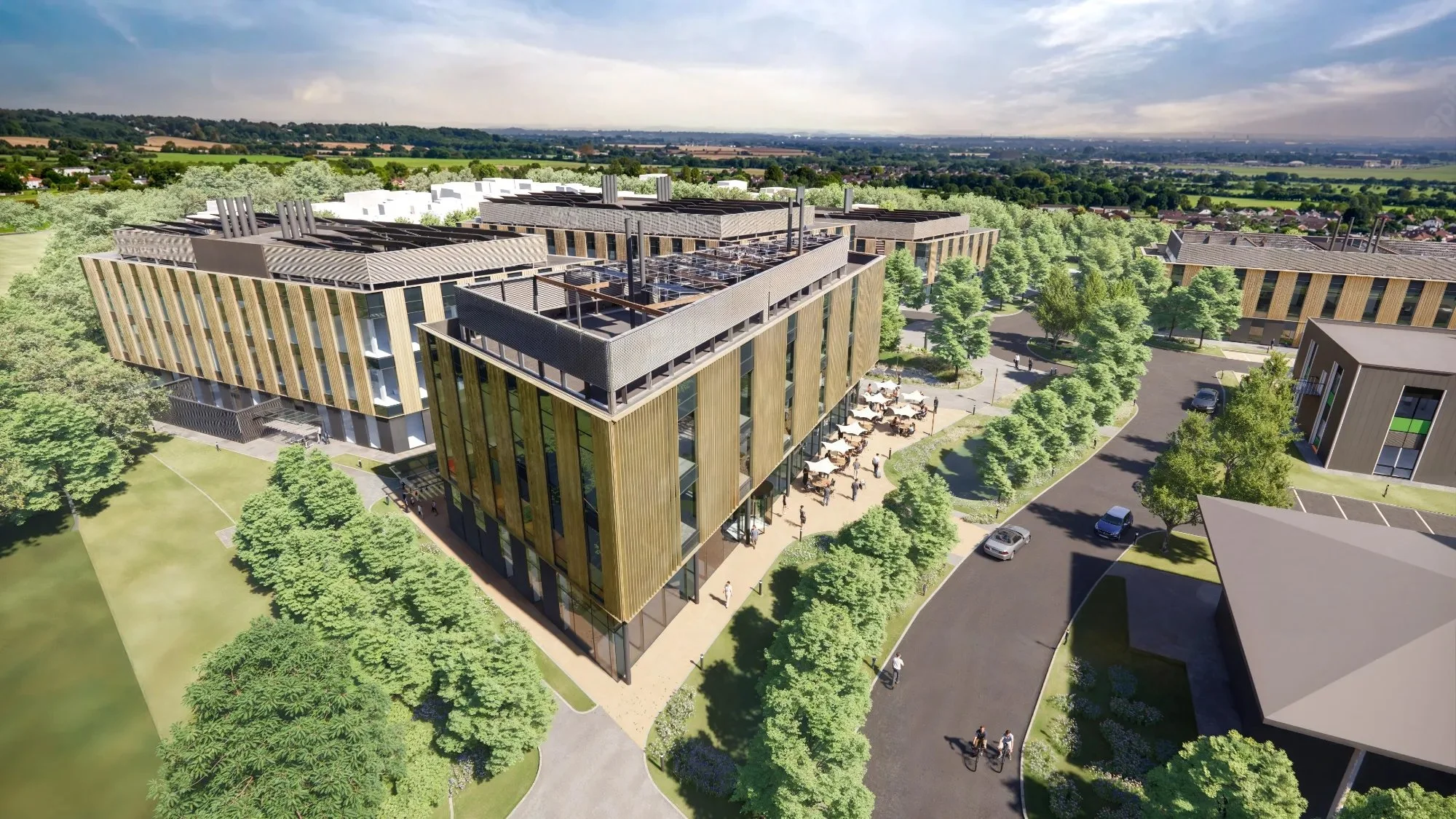
Wootton Science Park, delivering new carbon-efficient lab and workspace buildings for science and technology SMEs, has received a green light to proceed with a £44 million masterplan that will add five new buildings, landscaped amenities, and flexible spaces designed to support growth and innovation in the Oxford region. Image: Courtesy of Hartwell Plc
Hartwell Plc has received planning approval for a £44 million masterplan to deliver a new generation of science and technology laboratory and workspace buildings at Wootton Science Park, located southwest of Oxford, UK. The development is designed to cater to small and medium-sized enterprises (SMEs) in emerging sectors such as life sciences, quantum, AI, and sustainability, while integrating amenities to support workforce wellbeing and community engagement.
The approved scheme will provide approximately 106,233 sf (9,869 sm) across five new buildings, complemented by landscaped areas, secure bike storage, a bistro, a gym, and public walking and running trails. Wootton Science Park, already home to Bupa’s Stratum Dermatology Clinic and DeepTech Recycling in its Origin Building—a purpose-built, two-storey CL2 laboratory completed in 2024—benefits from excellent connectivity via the A420 and A34, and proximity to Oxford’s science and business clusters.
The project team includes Scott Brownrigg (architecture and test fits), Hoare Lea (M&E engineers), and Campbell Reith (civil and structural engineers.
Responding to market gaps
According to Mark Scrivens, property project manager at Hartwell Plc, the masterplan was informed by extensive engagement with commercial agents and feedback from existing tenants: “Through extensive engagement with our commercial agents, we identified a significant gap in the Oxford science and technology market: the availability of flexible, lab-enabled space outside the established science parks and Oxford city center. Feedback from prospective tenants for the Origin Building [the two-story, purpose-built CL2 laboratory building which was completed on the Park in 2024 let to Bupa’s Stratum Dermatology Clinic and DeepTech Recycling] reinforced this insight, highlighting that competitive rental levels—without the premium associated with city-center locations—were highly attractive.”
Scrivens explains, “These findings shaped our development strategy by driving the creation of a masterplan focused on delivering adaptable, lab-enabled spaces that meet current demand while providing scalability for future growth. This approach ensures the scheme is both commercially viable and aligned with the evolving needs of the local innovation ecosystem.”
Central to the design strategy is the concept of “grow-on lab and workspace,” aimed at companies that have moved beyond incubator spaces but are not yet ready for full-scale headquarters. Scrivens says, “Flexibility was a key priority: we created spaces that can be reconfigured and fitted out for a range of laboratory types—wet, dry, and computational—ensuring adaptability to diverse research needs.”
The development incorporates a new private power network delivering a 1.8 MVA supply, ample plant areas, and risers to accommodate large equipment and specialized services, such as fume cupboard flues. The masterplan also allows tenants to start with smaller units—up to 3,300 sf—and expand into adjacent units or additional floors without relocating, supporting seamless growth within the park.
Lessons from the Origin Building informed this strategy. Scrivens says, “The Origin Building provided a valuable foundation for lessons learned. One of the key insights was the importance of delivering highly flexible buildings that cater to both early-stage start-ups and established life science companies seeking expansion space.” Consequently, the new buildings offer a range of unit sizes—from approximately 2,200 to 3,300 sf to entire floors or whole buildings—to accommodate evolving tenant needs.
High-performance, cost-efficient buildings
From a design and engineering perspective, Hartwell’s goal is to deliver buildings that are both high-performance and cost-effective for SMEs. Joanne Churchill, group property manager, Hartwell Plc, describes the approach as “smart simplicity,” optimizing layouts, building form, and systems to reduce upfront and operational costs while maintaining high environmental and functional standards.
Key strategies include:
Flexible layouts enabling space adaptation as tenant needs evolve
Efficient mechanical and electrical systems for lower energy consumption without compromising comfort
Standardized, modular construction elements to control capital costs and accelerate delivery
Lifecycle-focused engineering that considers long-term operational efficiency and maintenance
Churchill emphasizes the integration of technical lab requirements with a human-centered campus design: “From the outset, we established a fully integrated design approach where the technical specialists—covering ventilation, vibration control, and complex utilities—worked hand-in-hand with the architectural and user-experience teams.”
“Ultimately, the guiding idea was that a high-performing technical environment and an inviting human environment are not mutually exclusive,” she says. “By integrating engineering and architectural decisions from day one, we created a park that meets demanding scientific standards while still fostering collaboration, wellbeing, and a strong sense of place.”
Collaboration and market alignment
The Wootton Science Park development targets BREEAM Excellent and an EPC A rating. Scrivens highlights several features designed to help tenants achieve their own ESG objectives: “Key features include electric vehicle charging points, extensive cycle storage with showers, and on-site amenities such as a gym and café, complemented by local walking and running trails…our buildings will incorporate roof-mounted photovoltaic panels for renewable energy generation, sustainable drainage systems, and rain gardens alongside planted retention basins. In addition, the landscape strategy introduces areas of grassland, scrub, recolonizing habitats, and enhanced hedgerows, enabling the scheme to deliver a minimum +10 percent biodiversity net gain against the current baseline.”
The project underscores the importance of interdisciplinary collaboration. Scrivens notes that the appointment of consultants with specialist life science expertise and local presence was critical in aligning scientific and commercial goals. “This collaborative approach enabled us to balance scientific requirements with commercial objectives, resulting in an efficient, future-proof masterplan that meets tenant needs while maintaining viability for Hartwell.”
Looking ahead, Hartwell envisions Wootton Science Park as a key contributor to the Oxford innovation ecosystem. “We expect Wootton Science Park will help strengthen the Oxford Innovation Ecosystem to help attract not only science start-ups but established companies which will create jobs and attract more companies to either base themselves or expand in Oxfordshire,” says Scrivens. Over the next decade, the masterplan will deliver up to 84,500 sf of flexible lab-enabled space, providing the capacity and infrastructure needed for a broad range of scientific disciplines, from quantum and AI to life sciences.
For lab planners, architects, and end users, Wootton Science Park provides a useful example of speculative lab development that addresses technical performance, tenant flexibility, sustainability, and human-centered design. By incorporating lessons from previous projects, considering market trends, and coordinating across disciplines, the development aims to support innovation and growth in the Oxford region.